
Polyester can feel airy in one garment and hot or clammy in another. That is not a contradiction. “Polyester” identifies a fibre category, while breathability and comfort depend on how the yarns become fabric, how that fabric is finished, and how the garment fits and vents.
The useful question is not “Is polyester good or bad?” It is: What is this particular garment built to do, and does the available evidence match that claim?
Six quick answers
| Question | Short answer |
|---|---|
| Is polyester breathable? | It can be. An open, lightweight construction may pass air well; a dense, brushed, coated or lined one may not. |
| Is polyester more breathable than cotton? | Neither fibre always wins. Compare the finished fabric and garment. |
| Does polyester make you sweat? | The fibre does not switch sweating on, but a poorly ventilated garment can interfere with heat and moisture leaving the body. |
| Is polyester good for summer? | Sometimes—especially when the garment is light and ventilated and its moisture claims are supported. It is not an automatic summer choice. |
| Why can polyester smell? | Odor can be affected by skin microbes, sweat and soil, time left damp, textile surface, laundering and storage. It is not simply “how much you sweated.” |
| How should you choose? | Read the label, inspect the construction, check the whole garment, match the claim to evidence and consider your activity and climate. |
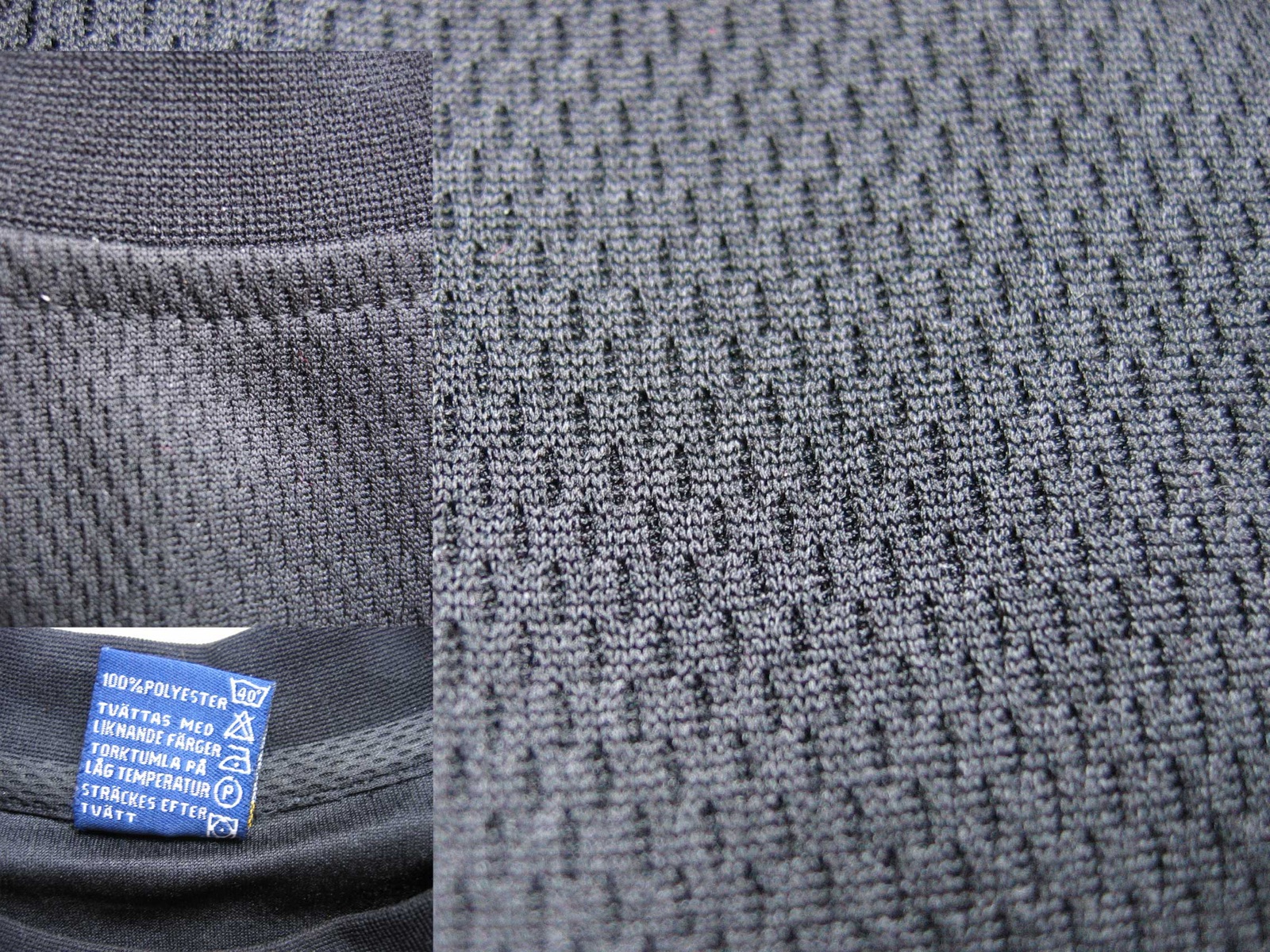
One documented 100% polyester shirt and its care label. This is an identification and label-reading example only—not a breathability, cooling, wicking or odor result, and not a WellDoneTex product. Photo: Antimoni, source, CC BY-SA 3.0; resized from the original. This derivative remains available under CC BY-SA 3.0.
Is polyester breathable?
Polyester can be breathable, but fibre content alone cannot answer the question. If “breathable” means air can pass through the material, the important variables include knit or weave geometry, yarn spacing, thickness, mass, brushing, coating, lamination and print coverage. Garment layers and openings matter too (ISO 9237; ASTM D737).
This is why a polyester sports mesh and a polyester wind-resistant shell can behave very differently even when both labels say 100% polyester. The first may use an open structure to encourage air movement. The second may intentionally restrict it. Neither behaviour is caused by the fibre name alone.
The word is also used for several different experiences. A seller may mean airflow, water-vapour movement, liquid-sweat transport or simply a cool hand feel. Those are not interchangeable. If the claim matters, look for the exact property rather than accepting “breathable” as a complete specification.
At garment level, check for:
- open or compact construction;
- light or heavy, thin or bulky fabric;
- coatings, dense prints, membranes or brushed surfaces;
- lining and the number of layers;
- fit around the torso and underarms; and
- vents, mesh panels, collar and cuff openings.
A fabric panel can pass air while the complete garment still feels closed because a lining, print or tight fit limits ventilation.
Is polyester more breathable than cotton?
Not as a universal rule. An open polyester mesh can pass more air than a dense cotton twill. An open cotton fabric can pass more air than a compact, coated or lined polyester fabric. A fair comparison requires the actual finished constructions, not just two fibre names.
Cotton and conventional polyester do differ in how their fibres interact with moisture. Cotton is more hygroscopic, while polyester generally holds little atmospheric moisture within the fibre. That can influence wet feel and moisture retention, but it does not measure air flowing through the spaces in a fabric (NIST fibre moisture-regain discussion).
The comparison often becomes confused because shoppers use “breathable” to mean “did not feel sweaty.” A cotton garment may absorb some moisture and feel comfortable for one use, then feel heavy or damp when saturated. A polyester garment may absorb little within the fibre yet still move liquid along the textile if its yarn, structure or finish was designed for that job. Neither outcome proves greater airflow.
For the liquid-moisture side of the question, see What Is Moisture-Wicking Fabric?. That guide explains liquid transport; it should not be read as an air-permeability or cooling guarantee.
What is the most breathable fabric?
There is no single most breathable fibre for every garment and setting. If the goal is airflow, compare the finished fabric’s openness and any actual air-permeability evidence. If the goal is feeling less wet, moisture retention, liquid movement and drying may also matter—but they are separate questions. The most useful choice is the light, appropriately open construction and garment design that fits the activity, layers and climate, not a universal fibre winner.

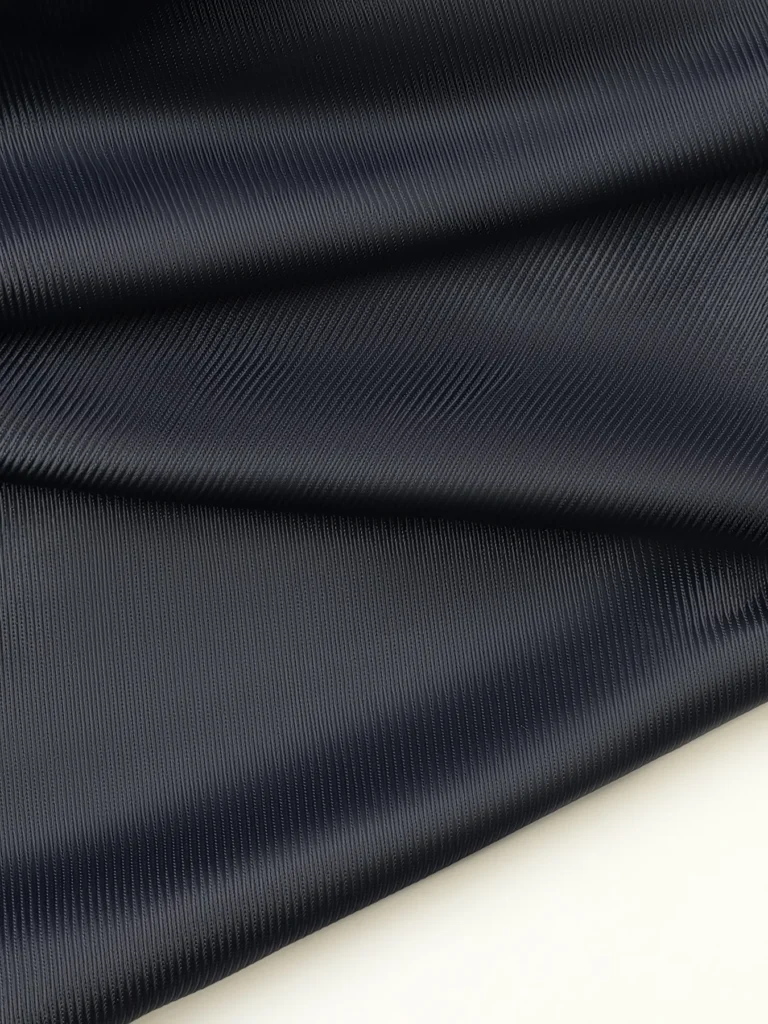
A source-identified cotton-jersey material scan. It is not a matched specimen for the polyester garment above and cannot establish a cotton-versus-polyester airflow ranking. It is not a WellDoneTex product. Photo/material scan: colormass; processing: Rico Cilliers via Poly Haven, source, CC0 1.0; resized from the original.
Does polyester make you sweat or feel hot?
Polyester itself does not activate your sweat glands. Sweating is part of the body’s response to heat and physical work. Clothing can change the experience by affecting convection, evaporation and the warm, humid space between skin and garment.
A thick, compact, close-fitting or poorly ventilated garment may reduce air exchange and make it harder for moisture and heat to leave. That can make the wearer feel hotter, stickier or wetter. A lightweight, open garment with useful ventilation may interfere less. Humidity, air movement, sunlight, activity, coverage and individual response can outweigh a simple fibre choice.
There is another important distinction: feeling wet does not reveal how much a person produced sweat. Liquid can remain on skin, enter a fabric, spread over a surface, move between layers or evaporate. Polyester’s low fibre moisture regain does not tell you which of those routes the finished garment provides.
NIOSH notes that thicker or less-permeable clothing can hamper heat exchange and that some clothing systems can reduce sweat evaporation. It also reports that most studies in one reviewed hot-exercise evidence set did not find a clear thermoregulation or comfort advantage for synthetic over natural fabrics. The practical conclusion is modest: judge the garment system and setting, not a fibre slogan.
For heat risk at work or during extreme conditions, apparel marketing is not safety guidance. Use appropriate occupational or medical advice.
Is polyester good for summer?
It can be, when the construction and garment suit the use. A light, open polyester shirt may be practical for warm-weather activity. A dense polyester lining, brushed knit or coated jacket may be a poor choice for the same conditions.
Start with what you will actually do:
- Low activity: A loose fit and open construction may matter more than a fibre label.
- Commuting: Check whether a lining, backpack contact area or dense print will reduce ventilation during the trip.
- Sustained activity: Air exchange may need to work alongside verified liquid transport and drying.
- Dry heat: Air movement and sun protection still matter; a fibre name does not account for radiant exposure.
- Humid heat: Spreading liquid does not guarantee that it will evaporate quickly; the surrounding air may limit evaporation.
- Layering: A breathable shirt cannot fully overcome a low-permeability outer layer.
Avoid treating “quick-dry,” “wicking” and “cooling” as synonyms. A garment might spread liquid but still have limited airflow. It might dry under one laboratory setup without keeping every wearer cool. It might feel light in a shop but use a large print or lining that changes ventilation in use.
No fabric can guarantee “cool and dry all summer.” A useful summer claim should describe the exact garment or fabric, the property evaluated and the conditions of that evaluation.
Why can polyester clothes smell?
Polyester does not arrive with an inevitable smell, but worn polyester garments can develop or release noticeable malodor under some conditions. The pathway can include skin microbes transferred to clothing, sweat and skin oils, time left warm or damp, textile surface properties, residues, laundering and storage.
One peer-reviewed study by Callewaert et al. collected shirts from 26 healthy participants after a one-hour spinning session and evaluated them after 28 hours of incubation. A trained panel rated the 100% polyester shirts as less pleasant and more intense in odor than the 100% cotton shirts in that experiment. The researchers also found different microbial profiles, including enrichment of micrococci on synthetic shirts.
That finding is meaningful but narrow. It does not show that every polyester garment smells more than every cotton garment. It does not cover every finish, blend, wash routine, wearer, activity or drying interval. It is not a WellDoneTex product result.
If odor is a concern:
- let a worn garment dry rather than leaving it bundled while damp;
- follow the actual care label;
- avoid assuming that fragrance proves odor removal;
- evaluate persistent odor after the permitted wash and dry route; and
- treat “odor-resistant” or “antibacterial” as claims that need a defined method and durability evidence.
Odor adsorption and bacteria-related odor are different questions. A test showing one should not be rewritten as proof of the other.
How should you choose a polyester garment?
Use a five-step check.
1. Read the fibre and care labels
Confirm whether the item is 100% polyester or a blend. Look separately for lining, filling or elastic components. In the United States, the FTC Textile Fiber Rule requires covered textile products to disclose generic fibre names and percentages, while the Care Labeling Rule requires regular-care instructions for covered apparel. The labels identify the product; they do not supply a breathability score.
2. Inspect the actual construction
Hold the fabric normally rather than stretching it to create temporary openings. Compare how open or compact it looks, how thick it feels, whether it is brushed, and how much of the surface is covered by print or coating. Appearance is only a screen—not a test—but it can reveal why two polyester garments should not be treated as equivalent.
3. Check the complete garment
Look inside. A mesh outer layer may cover a dense lining. A loose body may have tight cuffs. Back vents, underarm panels and collar openings can change ventilation. For close-fitting activewear, contact may help liquid reach the fabric, while the same fit may reduce free ventilation; the design goal matters.
4. Match the claim to the evidence
- “Breathable” should identify whether the claim means air permeability or water-vapour resistance.
- “Wicking” should use liquid-transport evidence.
- “Quick-dry” should use a drying method, not a droplet photo.
- “Cooling” needs a defined thermal or wear context.
- “Odor-resistant” should identify adsorption, bacterial odor or another mechanism, plus care durability.
5. Match the garment to your use
Choose for activity, climate, fit preference, layers and care routine. A traveller who needs fast turnaround, a runner generating substantial sweat and an office wearer in air conditioning do not have the same decision.
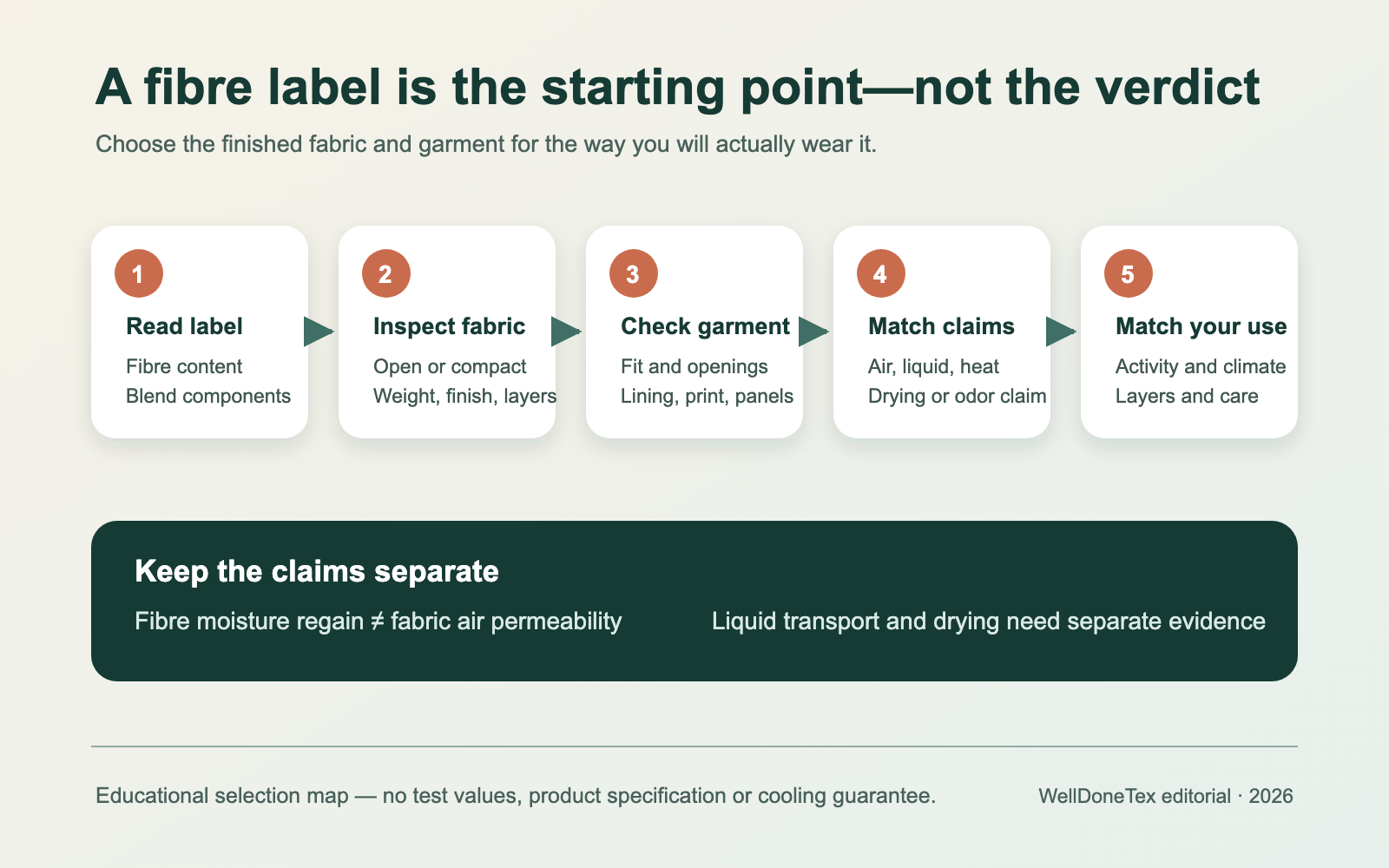
Original educational selection map. It contains no air-permeability, drying, cooling or odor result and does not rank cotton against polyester. Graphic: WellDoneTex editorial, 2026.
What evidence supports a performance claim?
This is the technical check, kept deliberately short.
| Claim | Relevant evidence | What it does not prove by itself |
|---|---|---|
| Air can pass through the fabric | ISO 9237 or ASTM D737 on the exact finished specimen, with method details and units | Human comfort, liquid transport or garment ventilation |
| The material manages heat and water vapour | ISO 11092 or a claim-matched method on the exact fabric or assembly | Comfort for every climate or wearer |
| Liquid moves or the textile dries | A claim-matched AATCC liquid-transport or drying method | Air permeability, sweat rate or cooling |
| The garment resists odor | A method that states adsorption, bacteria-generated odor or a controlled wear endpoint, plus an appropriate control and care state | Every odor mechanism or indefinite wash durability |
ISO 11092:2026 explicitly states that its steady-state conditions are not intended to represent specific comfort situations and it does not set physiological-comfort performance specifications. That is a useful warning for every headline claim: a test result describes its specimen and method, not every possible use.
Frequently asked questions
Is polyester breathable?
It can be. Construction, thickness, finish, lining, fit and openings determine far more than the fibre name alone.
Does polyester make you sweat?
Polyester does not switch sweating on. A garment can still feel hotter or wetter if it restricts ventilation or evaporation in the conditions where it is worn.
Is polyester more breathable than cotton?
Not universally. An open polyester fabric can pass more air than a dense cotton fabric, and the reverse can also be true.
What is the most breathable fabric?
There is no single winner for every use. Compare the finished construction, garment ventilation and claim-matched evidence.
Is polyester good for summer?
It can be when it is light, appropriately open and designed for the activity. Dense, brushed, coated or lined polyester may be uncomfortable in the same weather.
Why does polyester smell?
Odor can involve wearer microbes, sweat and skin soil, textile surface, time left damp, laundering and storage. Defined studies have found stronger odor in some polyester exercise garments, but that result is not universal.
Bottom line
Polyester can be breathable, suitable for summer and practical during activity—but none of those results follows automatically from the word “polyester.” Cotton is not the universal winner either. Choose the finished construction and garment for the job, separate airflow from liquid transport and drying, and ask for claim-matched evidence when performance matters.
References
- ISO, ISO 9237:1995 — Textiles: Determination of the permeability of fabrics to air, current edition confirmed in 2023.
- ASTM International, ASTM D737-18(2023) — Air Permeability of Textile Fabrics.
- ISO, ISO 11092:2026 — Measurement of thermal and water-vapour resistance.
- ISO, ISO 9920:2007 — Estimation of thermal insulation and water-vapour resistance of a clothing ensemble, current edition confirmed in 2026.
- NIST, Zangmeister et al., supporting information for Hydration of Hydrophilic Cloth Face Masks Enhances the Filtration of Nanoparticles, fibre moisture-regain discussion.
- NIOSH, Heat Stress in Construction: Role of Clothing.
- Callewaert et al., Microbial Odor Profile of Polyester and Cotton Clothes after a Fitness Session, Applied and Environmental Microbiology 80(21), 2014.
- AATCC, TM195 — Liquid Moisture Management Properties of Textile Fabrics.
- AATCC, TM216-2024 — Measuring the Odor Adsorbency of Textile Materials.
- AATCC, TM211-2021 — Reduction of Bacterial Odor on Antibacterial-Treated Textiles.
- Federal Trade Commission, Textile Fiber Rule.
- Federal Trade Commission, Care Labeling Rule.


.webp)