Moisture-wicking fabric is a textile designed or selected to move liquid moisture away from the place where it first contacts the material. The liquid may travel along the fabric, rise through it or transfer from one face toward the other. The route depends on how the liquid wets the fibres and yarns and on the small spaces formed by the textile structure.
That definition is narrower than many product descriptions. “Moisture-wicking” does not automatically mean that a fabric absorbs more water, dries faster, allows more air through, passes more water vapour, feels cooler or keeps skin dry in every use. Those outcomes can be related, but they are not the same measurement.
A better question than “Is this fabric wicking?” is: What liquid moved, in which direction, on which face, under what conditions, and what was the measured result? That wording turns a broad adjective into something a consumer can understand and a buyer can verify.
Quick answer
A moisture-wicking fabric gives liquid an available pathway through or along the textile. That pathway can be influenced by:
- the surface and shape of the fibres;
- yarn size, twist, texture and spacing;
- knit, weave or nonwoven geometry;
- pore size and connection between spaces;
- the relationship between the fabric face and back;
- finishes or patterned treatments that change wetting behaviour;
- dyeing, printing, coating, heat setting and other processing; and
- laundering, wear, contamination and the condition of the final garment.
No single fibre name or visible texture proves the result. A test on the exact production-representative fabric is more useful than a generic claim about “polyester,” “cotton” or “sports fabric.”
What does moisture-wicking fabric mean?
In plain language, wicking is liquid movement through connected spaces in a material. NC State’s Textile Protection and Comfort Center describes vertical wicking by placing one end of a fabric strip in water and measuring how far the water travels up the specimen over time. Its liquid-moisture guidance also describes water being drawn into a fabric through capillary action.
AATCC TM195 addresses liquid moisture management in woven, knitted and nonwoven fabrics. Its scope links the measured behaviour to the fabric’s geometric and internal structure and to the wicking characteristics of fibres and yarns. This is why “wicking” should be treated as a property of the finished textile system rather than a label attached automatically to one raw material.
The direction matters
Liquid can be evaluated in more than one direction:
- Vertical wicking: how far liquid rises along a hanging strip over a stated time.
- Horizontal or in-plane wicking: how liquid spreads across the plane of the fabric.
- Face-to-face transport: how liquid moves from the side where it was applied toward the opposite face.
These routes answer different questions. A fabric that spreads liquid widely on one surface may not move it strongly to the opposite side. A result measured on the technical face may differ when the fabric is reversed. Any useful claim should identify the tested direction and application side.
Wicking is not a promise of comfort
People often want wicking because they hope a garment will feel less wet during exercise, work or warm weather. That goal is reasonable, but comfort depends on more than one fabric result. Sweat rate, garment fit, fabric area, layering, ambient temperature, humidity, airflow and activity all affect the experience.
Therefore, a laboratory liquid-transport result should not be rewritten as “guaranteed cooling,” “always dry” or “no sweat.” The result describes the specimen under its method. It does not simulate every wearer or climate.
How does moisture move through a wicking fabric?
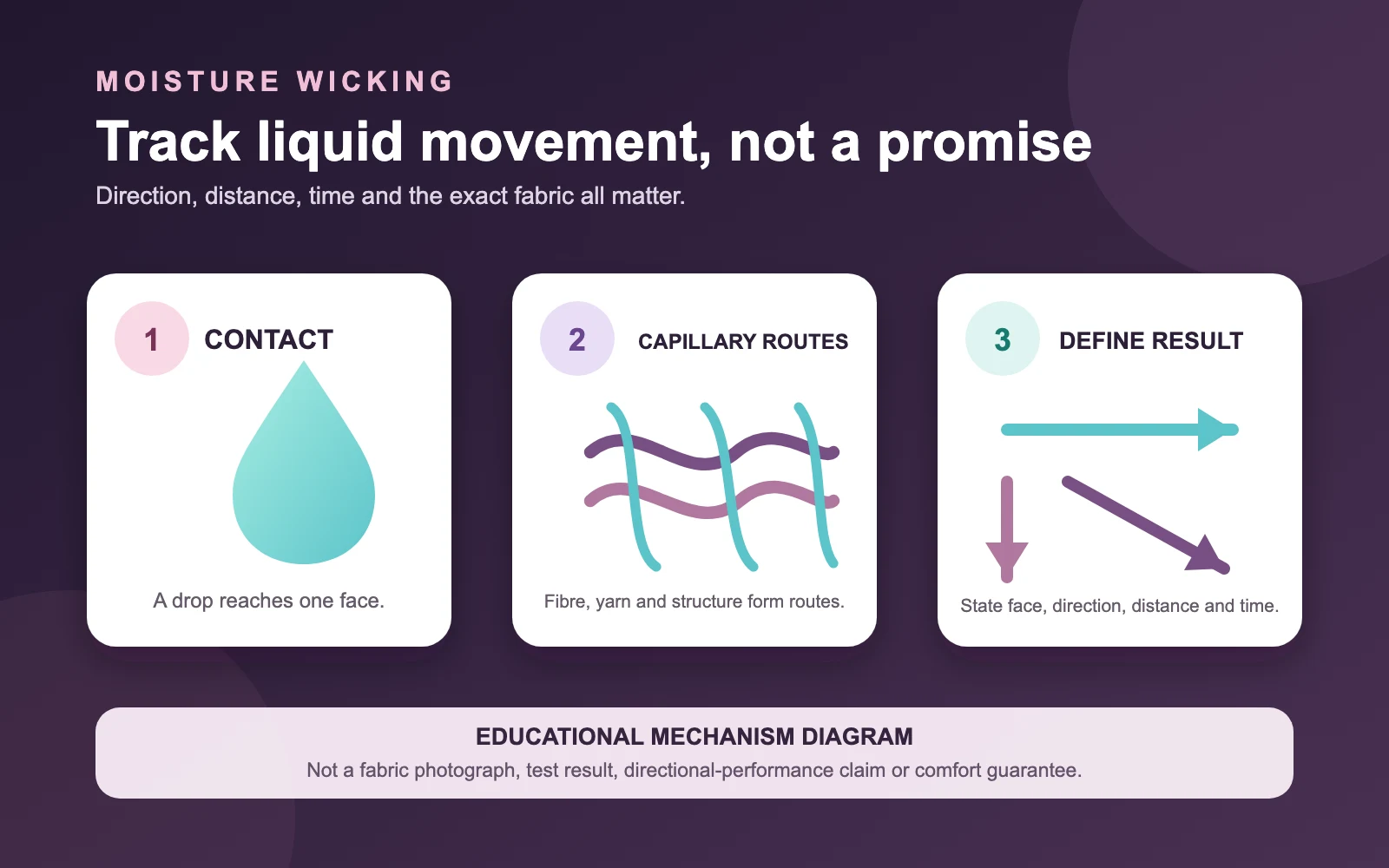
The process begins with wetting. When a droplet contacts a textile, the liquid meets fibre surfaces and the spaces between fibres, within yarns and between yarns or loops. If those surfaces and spaces create an accessible route, capillary forces can draw liquid along that route.
Think of the structure as a network rather than a hollow pump. There may be many small, irregular channels. Some lead along a yarn; some connect neighbouring yarns; some pass from one face toward the other. The liquid does not need a visible tube, and movement does not always occur in only one preferred direction.
Four stages to separate
- Contact and wetting. Liquid reaches the textile and interacts with its surface. If it beads strongly, entry into some pathways may be delayed. If it wets readily, it may enter or spread sooner.
- Capillary movement. Surface forces and connected small spaces can pull liquid through or along the fibre–yarn–fabric network.
- Distribution. The liquid may spread over a larger area or move toward another face. The pattern depends on structure, direction and surface treatment.
- Removal from the system. Evaporation, transfer to another layer or drainage may later reduce moisture in the textile. This final step is not proved merely because wicking occurred.
Spreading liquid over a larger area can create more exposed wet surface under some conditions. It may support a drying design, but spread distance is not a drying-time result. Drying still depends on retained liquid, airflow, temperature, humidity, fabric mass, construction and the test endpoint.
Gravity and capillary action are not interchangeable
In a vertical strip test, gravity acts against the upward movement being observed. In a horizontal setup, that relationship changes. In face-to-face testing, the placement of the liquid, face orientation and contact with sensors or other layers can matter. That is why results from different orientations should not be compared without method details.
Likewise, a simple droplet demonstration can be useful for screening, but it is not automatically equivalent to an established method. Drop size, liquid composition, specimen conditioning, camera angle, timing and the person judging the endpoint can all change the observation.
Is moisture wicking caused by fibre type or fabric finish?
The accurate answer is both can contribute, and neither works alone. Fibre surface, yarn arrangement, fabric geometry and finish interact. A production fabric should be evaluated as a system.
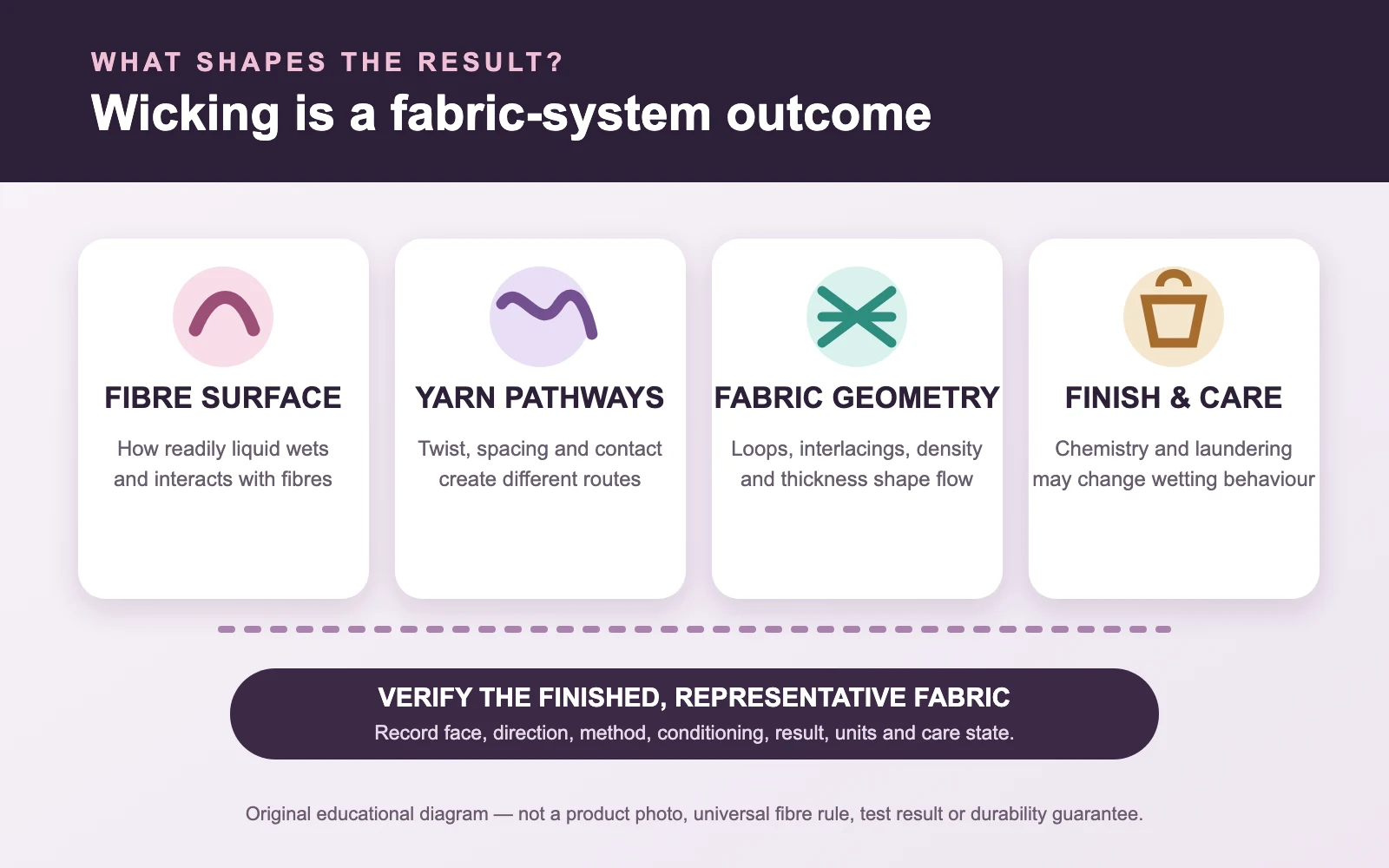
| Design level | How it can influence liquid movement | What not to assume |
|---|---|---|
| Fibre | Surface chemistry, cross-section and contact between fibres can affect wetting and pathways. | A fibre name alone does not prove wicking, drying or comfort. |
| Yarn | Twist, filament or staple arrangement, texture, size and packing can change spaces within and between yarns. | Two fabrics with the same fibre percentage need not behave alike. |
| Fabric structure | Loop or interlacing geometry, density, thickness and face/back design shape connected routes. | A visible hole or lightweight handfeel is not a measured result. |
| Finish or patterned treatment | A treatment can change where liquid wets, beads, spreads or transfers. | A finish is not automatically permanent or effective after laundering. |
| Garment system | Fit, panels, seams, linings and neighbouring layers influence where liquid goes next. | Fabric-only data does not prove the result of every garment zone. |
Cotton Incorporated’s WICKING WINDOWS technology is one named example of using a patterned treatment route. Its TransDRY technology is another named example that combines yarn treatment and construction choices. These examples are useful because they show that moisture management can be engineered in more than one way. They must not be generalized to all cotton, all finishes or any WellDoneTex fabric without exact evidence.
Why “polyester wicks, cotton absorbs” is too simple
Fibre-level tendencies can influence wetting and moisture retention, but real fabrics are more complex. Polyester fabrics can differ in filament shape, yarn construction, knit density, brushing, coating and finish. Cotton fabrics can also use engineered yarn or patterned-treatment approaches. Blends add further combinations.
So composition remains important, but it is not a substitute for testing. If two fabrics both say “100% polyester,” compare their actual construction and result. If a cotton-rich fabric carries a moisture-management claim, ask for the exact technology and production-quality evidence rather than rejecting or accepting it from fibre content alone.
Wicking, absorption, drying, airflow and water vapour are different
These terms are often compressed into one marketing sentence. Keep them separate:
| Property | Plain-language question | Evidence needed |
|---|---|---|
| Absorption | How much liquid enters or is held by the textile? | stated liquid, specimen mass or uptake procedure, time and result |
| Wicking | How far or how fast does liquid travel through or along the textile? | orientation, face, distance/time or transport result |
| Drying | How quickly does moisture leave under stated conditions? | starting moisture, airflow/temperature/humidity, endpoint and time/rate |
| Air permeability | How readily does air pass through under a stated pressure difference? | air-permeability method, area, pressure and units |
| Water-vapour transmission | How does water vapour cross the material system? | vapour method, temperature/humidity gradient and units |
AATCC’s moisture-management proficiency program lists liquid management, vertical wicking, horizontal wicking, drying and water-vapour methods separately. That separation supports a simple rule: one test result should not be presented as five properties.
For a broader explanation of matching claims to methods and reading reports, see the Technical Fabrics guide. For an example of why open structure and airflow do not prove liquid performance, see the Sport Mesh Fabric Guide.
What can change wicking performance?
Fabric face and back
Some textiles are designed with different surface characteristics on each side. A result can change when the application face is reversed. Mark the face, back, length and width before cutting specimens, and record which side received the liquid.
Knit, weave or nonwoven geometry
The number, size and connection of spaces affects the available pathway. Dyeing, heat setting, compacting, brushing, printing, lamination or coating can alter the original geometry or surface. Test a production-representative finished fabric rather than assuming greige results will remain unchanged.
Finish distribution
A uniform finish and a patterned finish can produce different movement. Contamination from oil, softener, detergent residue or soil can also change wetting. Record the fabric state and preparation before comparing samples.
Laundering and wear
A performance claim that is expected to survive washing needs after-care evidence. The number of cycles, wash procedure, detergent, drying route and test timing should be stated. A pre-wash result cannot prove durability after repeated care.
Colour and production lot
Dye recipe and finishing conditions can vary by colour or lot. If moisture performance is critical, do not test one laboratory colour and assume every bulk colour matches. Link the report to article, colour, lot and finish.
The complete garment
Seams, prints, bonded zones, logos, linings and compression areas can redirect or block liquid pathways. A garment may combine several fabrics with different functions. Fabric testing is still valuable, but critical zones may need garment- or assembly-level review.
Where are moisture-wicking fabrics used?
Moisture-management requirements often appear in activewear, teamwear, base layers, workwear, socks, underwear, linings, sleepwear and selected medical or protective systems. The required evidence depends on the product.
A running top may prioritize face-to-face liquid movement and drying under active conditions. A sock may need to manage liquid within a thicker multilayer structure. A uniform may balance moisture, durability, appearance and industrial-care needs. A bedding layer may face different pressure, contact and drying conditions.
Do not select a test simply because the product is called “activewear.” Define the user situation, liquid source, direction of desired movement, neighbouring layers, wash life and acceptable outcome first.
The WellDoneTex Activewear Fabric Supplier page is the commercial handoff for discussing constructions and sampling. It does not turn this general explanation into a claim that every listed fabric has the same moisture result.
Does fabric care affect moisture wicking?
It can. Care can alter finish, surface contamination, fabric geometry and residue. The exact effect depends on the textile and treatment.
Follow the product’s care label. Avoid inventing a universal “reactivation” treatment. Fabric softener, high heat, bleach or aggressive cleaning may be incompatible with some items, but no blanket prohibition should replace the exact care instructions.
For product development, compare the initial result with the result after the agreed care cycles. Record:
- the wash and dry procedure;
- detergent and any additives;
- number of cycles;
- specimen conditioning;
- whether the same face and direction were retested;
- visual or dimensional changes; and
- the moisture result and acceptance limit after care.
If a marketing claim includes “durable,” “long-lasting” or a specific wash count, the evidence must cover that duration. Do not infer it from an initial test.
What test evidence should support a moisture-wicking claim?
Choose the method that matches the claim. AATCC lists distinct routes for liquid moisture management, vertical wicking, horizontal wicking, drying time, drying rate and water-vapour transmission. The method number is only the start; the report still needs enough context to interpret the result.
At minimum, check:
- Sample identity: supplier, article, fibre declaration, construction, colour, lot and finish.
- Test side and direction: face/back, length/width, vertical/horizontal or face-to-face.
- Method and version: exact method designation and any documented deviation.
- Conditioning and preparation: laboratory atmosphere, pre-wash or ageing, detergent and drying route where relevant.
- Liquid and application: test solution, amount, placement and contact setup.
- Result and unit: distance, time, rate, index or other method-defined output.
- Acceptance limit: a limit agreed before reviewing results, not invented afterward.
- Issuer and date: laboratory or responsible internal method owner, report date and traceable record.
- Scope: fabric, laminate, assembly, garment or specific garment zone.
This guide explains testing methods; it does not present a product-specific moisture-wicking test report. Therefore this guide claims no “passed” result, supplier-wide performance, guaranteed quick-dry effect, cooling outcome or skin-dry result.
A practical sample-comparison workflow
You can improve a sourcing comparison before formal testing by making the screening process repeatable.
1. Define the claim
Write the exact behaviour required. “Moves liquid from the inner face toward the outer face within the agreed method” is more useful than “high wicking.” If drying also matters, list it as a second requirement.
2. Identify and condition specimens
Use samples from known articles and lots. Mark face, back, length and width. Keep specimen size, conditioning time and environment consistent.
3. Run only a bounded screening check
Apply the same liquid volume in the same place and photograph at fixed times. Record spread dimensions or visible face-to-face transfer without converting the observation into an industry-standard result. Use the screen to narrow choices, not to write a pass claim.
4. Test the final candidates
Send production-representative finished fabrics for the agreed method. If care durability matters, include the stated pre-treatment cycles.
5. Review the whole product
Sew the intended panels, seams, prints and linings. Check whether the fabric orientation and neighbouring layers support the design goal.
6. Preserve traceability
Keep the approved sample, report, colour/lot identity and acceptance decision together. A detached PDF with no sample match is weak evidence.
Buyer checklist for a moisture-wicking fabric
Before approval, ask for:
- exact fibre content and construction;
- technical face/back and intended garment orientation;
- mass, usable width and finish;
- defined liquid-movement claim and direction;
- method, conditions, unit and result;
- drying evidence separately if quick-dry language is planned;
- air-permeability or water-vapour evidence separately if those claims are planned;
- initial and after-care results when durability is required;
- colour/lot scope and production-representative sample identity;
- seam, print, lamination and lining review on the intended garment; and
- agreed acceptance limits before bulk approval.
The Fabric Specification Checklist helps place these items in a wider fabric specification. For laboratory and quality discussions, use the Tech and Quality page as a contact point, while still requiring the exact report behind any product claim.
Final takeaway
Moisture-wicking fabric is best understood as a textile that moves liquid through available fibre, yarn and structural pathways. The result can depend on fibre surface, yarn design, fabric geometry, finish, face/back orientation, processing, laundering and the complete garment system.
Keep neighbouring properties separate. Wicking is not absorption, drying, air permeability, water-vapour transmission or guaranteed comfort. Define the required direction and outcome, test the exact finished fabric, and preserve the sample-to-report link. That approach is more reliable than choosing a fabric from fibre name, handfeel or marketing language alone.
Frequently asked questions
What is moisture-wicking fabric?
It is fabric designed or selected to move liquid moisture through or along connected pathways in its fibre–yarn–fabric structure. The direction, test method and result should be stated; the term alone does not prove fast drying or comfort.
How does moisture-wicking fabric work?
Liquid first wets part of the textile, then capillary forces can draw it through small connected spaces within and between fibres and yarns. The fabric may spread the liquid or move it toward another face. Evaporation is a later, separate process.
Is moisture wicking caused by fibre type or fabric finish?
Both can contribute, together with yarn and fabric structure. A fibre name does not guarantee the result, and a finish is not automatically permanent. Test the final production-representative fabric.
What test evidence should support a moisture-wicking claim?
The report should identify the exact sample, face and direction, method/version, conditioning and liquid setup, result and units, acceptance limit, issuer/date and whether the test covered fabric, assembly or garment. Drying, airflow and water vapour need separate evidence.
Is moisture-wicking the same as quick-dry?
No. Wicking describes liquid movement. Quick-dry describes how moisture leaves under stated conditions. Wicking can support a drying design, but only a drying method can support a drying result.
Is every polyester fabric moisture-wicking?
No. Polyester fabrics vary in filament, yarn, structure, density and finish. Composition is one input, not a performance report.
Can cotton fabric be moisture-wicking?
Some cotton-based systems use engineered yarn, construction or patterned treatment routes to influence liquid movement. That does not mean every cotton fabric wicks; verify the exact technology and finished-fabric result.
Does washing remove moisture-wicking performance?
It depends on the fabric and finish. If wash durability matters, compare the initial result with the result after a defined number of stated care cycles. Follow the product label and do not assume a finish is permanent.
References
- NC State TPACC — Liquid Moisture Management
- AATCC TM195 — Liquid Moisture Management Properties of Textile Fabrics
- AATCC Moisture Management Proficiency Testing Program
- CottonWorks — WICKING WINDOWS Technology
- CottonWorks — TransDRY Technology
- WellDoneTex — Activewear Fabric Supplier
- WellDoneTex — What Are Technical Fabrics?
- WellDoneTex — Sport Mesh Fabric Guide
- WellDoneTex — Fabric Specification Checklist for Buyers