French terry and brushed sweatshirt fleece are two useful starting points for a hoodie, sweatshirt or jogger program. The first decision is the inside surface: do you want to retain a visible looped reverse, or specify a raised, fleecy reverse? Then agree the composition, finished weight, width and sample requirements.
This guide compares sweatshirt fabrics. It does not use “fleece” as a substitute for every polar fleece, coral fleece or sherpa construction.
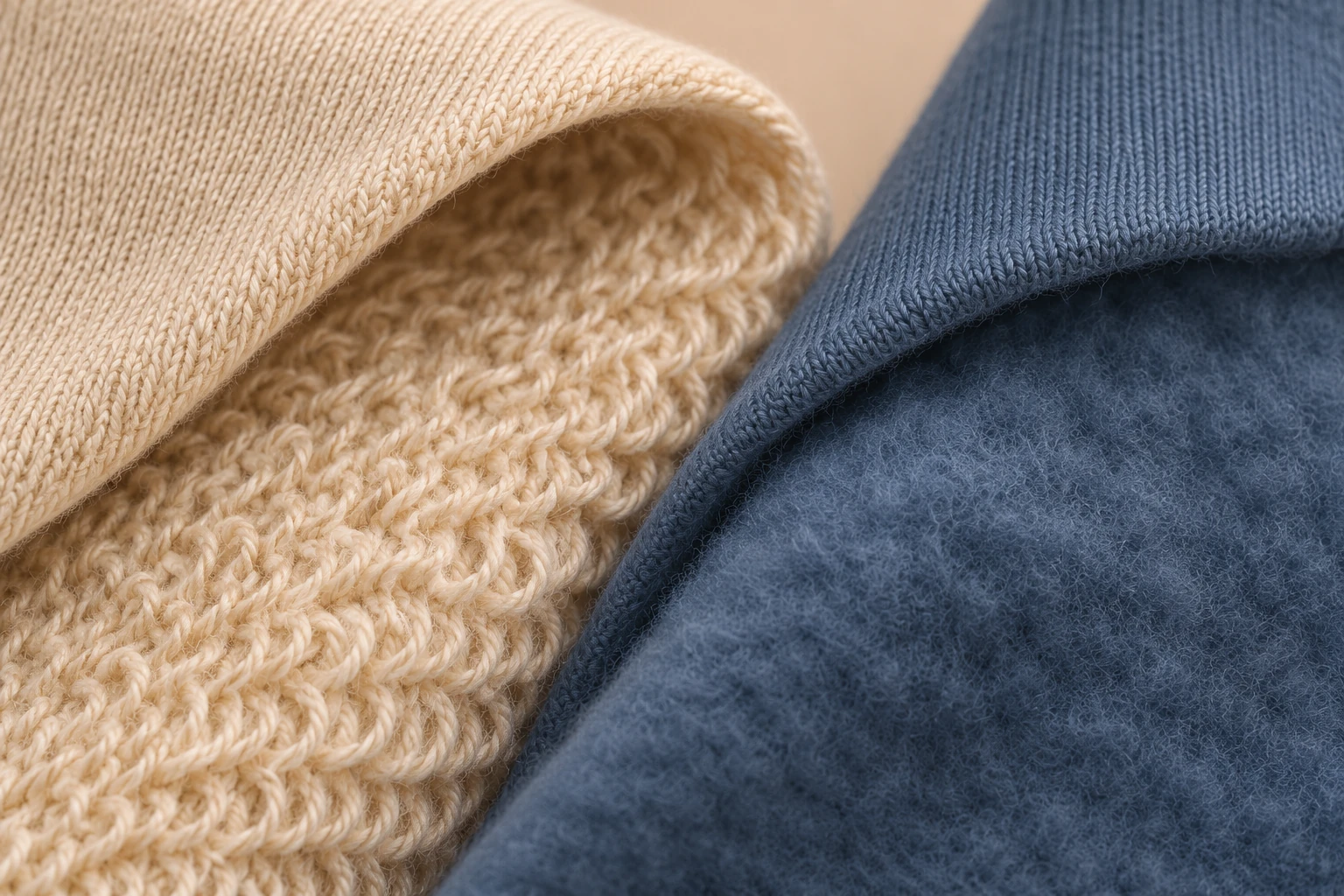
Image note: this AI-generated conceptual illustration compares loop-backed French terry and brushed fleece textures. It is not a photograph of a specific WellDoneTex product or evidence of fabric performance.
What is the difference between French terry and brushed fleece?
For this comparison, ask suppliers to identify an unraised loop-back candidate and a raised-back candidate against the same garment brief. Have them state the actual knit construction and reverse finish for each article; the commercial name alone is not a complete specification.
Australian Wool Education Trust teaching material describes raising or brushing as lifting fibers from the fabric surface into a pile or nap. Its discussion concerns wool finishing. For the sweatshirt fabric being offered, ask the supplier to identify the actual reverse finish and approve a physical reference for the intended effect.
Composition is a separate field. Record actual fiber percentages instead of interpreting “French terry” as a promise of all-cotton material or “fleece” as a promise of polyester. For the fiber-choice discussion, see cotton fleece versus polyester fleece.
Choose the inside surface before comparing offers
Start with the garment brief and a reference the design team can handle. If the visible reverse texture is part of the design, keep that feature explicit in the request. If a raised inside hand is essential, identify the accepted surface and its appearance after care. A photograph of the garment’s outside alone leaves this decision open.
Use two separate candidate lines when you want to explore both directions. Do not ask several suppliers for “hoodie fabric” and assume their quotations cover equivalent material.
| Decision | What to put in the brief |
|---|---|
| Reverse surface | Unraised loop-back or specified raised finish, with an identified reference |
| Garment appearance | Intended silhouette, drape and inside/outside presentation |
| Material specification | Fiber percentages, construction, finished GSM and usable width |
| Approval basis | Sample identity, agreed care route and requirements for the selected article |
Do not turn the names into universal warmth or breathability rankings. Define what the wearer needs and compare the actual candidates. A requirement such as low bulk under another layer is more useful to a development team than an unsupported claim that one entire fabric family is always best for a season.
Compare terry and fleece options
Ask for each submission to identify its article code, composition, finish and development stage. Note whether it represents the final proposed fabric or only a starting reference. Keep this information with the swatch throughout the review.
- Inspect both surfaces. Mark the intended garment outside and inside. Check that the reverse effect matches the brief rather than accepting a similar face as a complete match.
- Handle enough material. Agree a sample size suitable for the decision. A small cutting can help with surface review; drape, seam build-up and garment fit require an appropriate larger or sewn sample.
- Compare on one measurement basis. Request finished GSM and usable width for both candidates, with the agreed measurement conditions. Record measured results separately from targets.
- Review the intended assembled garment. Include the proposed cuffs, waistband, seams and decoration where they affect the decision. Keep fabric approval and garment approval as distinct records.
- Review after the agreed care route. Compare appearance, hand and dimensions with the retained original. Record what changed and whether it meets the buyer’s requirements.
Neither fabric name establishes a shrinkage result.
If dimensional-change evidence is required, agree the procedure and acceptance criteria before testing. ISO 5077 describes determining dimensional change after specified washing and drying procedures; naming it is not a claim that a particular sample has passed. Request the applicable results for the identified material.
Compare quotations for the approved specification
Once the preferred sample is clear, check that the quotation identifies the same composition, construction and finish. Include finished GSM, usable width, color allocation, quantity unit and the relevant sample reference. The fabric specification checklist covers the wider inquiry details.
Ask which parts of a comparison offer differ from your brief. A lower price accompanied by a different finish or width needs a technical review before it can be treated as an equivalent alternative. Keep any unresolved difference visible in the decision record.
Confirm sample preparation, required approvals, production timing and shipping arrangements for the actual program. Do not infer a standard delivery period from the fabric name, and do not copy a schedule from an earlier order without confirmation.
A practical development example
Hypothetical example, not a customer case: a buyer is choosing fabric for a casual hoodie. The team requests one loop-back candidate and one raised-back candidate against the same composition, finished-weight and width targets. Each submission receives its own reference. The team reviews both as sewn samples under the intended care route, selects the preferred result, then confirms the final specification and quotation. No performance result or production commitment is assumed in this example.
Common buyer questions
Can I approve the fabric from its front photograph?
A front photograph helps identify appearance, but it leaves the reverse, touch and measured requirements unresolved. Ask for both sides and a sample suitable for the decision.
Can two fabrics with the same GSM be treated as interchangeable?
GSM is only one field in the specification. Check the complete agreed construction, finish, composition, width and approval reference before accepting a substitution.
Does choosing French terry remove the need for care checks?
No. Keep the intended care route and acceptance requirements in the brief, and assess the actual material and garment rather than relying on the name.
Prepare a custom sweatshirt-fabric inquiry
WellDoneTex supplies made-to-order fleece and other knit fabrics, with no ready stock. Orders typically start at 1,000 kg in total, with a usual minimum of 400 kg per color. Confirm the selected specification and color allocation for your project; this guide does not offer exceptions or promise that different fabric lines can be combined toward one minimum.
Send the fabric team your development brief: garment use, intended reverse finish, composition, finished GSM, usable width, color references, quantity by color and target timing. Add an identified swatch or photos of both sides if available. Ask the team to confirm a suitable development route, sample arrangements and the quotation-specific schedule before proceeding.