Sport mesh fabric is a textile with deliberately open or visibly spaced areas, selected for sportswear, teamwear, linings, ventilation panels and other products where low coverage, visual texture or air passage may be useful. The word mesh describes the open structure—not one fibre, one knitting method or one guaranteed level of performance.
That distinction matters. A fine micro-mesh can look almost solid from a distance. A coarse mesh can have obvious holes. One sample may stretch because of its knitted architecture or elastic yarn; another may be stable. One may move air readily; another may be partly closed by yarn density, finishing, coating, print or a backing. Some products manage liquid sweat, but the presence of holes does not prove moisture wicking.
The practical way to choose sport mesh is to define its job, inspect the openings in a relaxed and stretched state, test the properties that matter and sew the intended garment construction. A product name or photograph is a starting point, not a performance report.
Quick answer
Sport mesh is commonly considered for:
- ventilation panels in jerseys, training tops, shorts and jackets;
- full garment bodies where the required coverage and handfeel are achieved;
- linings in shorts, jackets, bags or equipment;
- pockets, overlays, yokes and decorative panels;
- teamwear, bibs and reversible constructions;
- selected footwear or accessory components after application-specific testing.
Before approval, check the exact fibre content and construction, mass, usable width, opening shape and stability, stretch and recovery in both directions, opacity on the intended background, air permeability if it is a requirement, liquid-moisture behaviour if claimed, seam behaviour, snagging or abrasion risk, dimensional change and appearance after the agreed care route.
What makes a fabric “mesh”?
CottonWorks defines mesh broadly as fabric characterized by open spaces between yarns and loops. This useful definition avoids tying mesh to a single machine or fibre. A mesh may be knitted, woven or created through another engineered textile route. Within knits, open or cellular effects can be made in different ways. CottonWorks notes, for example, that tuck stitches can create holes and a cellular appearance, while pique is a recognizable micro-mesh structure.
Therefore, “mesh” does not automatically mean:
- warp knit;
- weft knit;
- spacer fabric;
- polyester;
- lightweight;
- four-way stretch;
- moisture-wicking;
- quick-drying;
- UV-protective; or
- suitable for direct skin contact.
The name tells you what kind of visual or structural family to expect. The technical specification tells you what the actual material is.
Openings, yarn paths and stability
Look at more than hole size. Observe the opening shape, spacing and repeat; the yarns or loops around each opening; the thickness of those surrounding areas; and whether the geometry changes when the sample is pulled, folded or released.
Two meshes can show similarly sized holes when relaxed yet behave differently. One may distort into long openings under widthwise stretch. Another may keep a more regular grid. Edges may curl, ravel or remain stable depending on construction. A printed, brushed, calendared or coated version may behave differently from its unfinished base.
Document the technical face and back. If the sides differ, record which side is intended to face outward or toward the body. Mark the length and width directions before cutting test pieces so stretch, shrinkage and appearance results do not become mixed.
How do hole size and knit structure affect airflow?
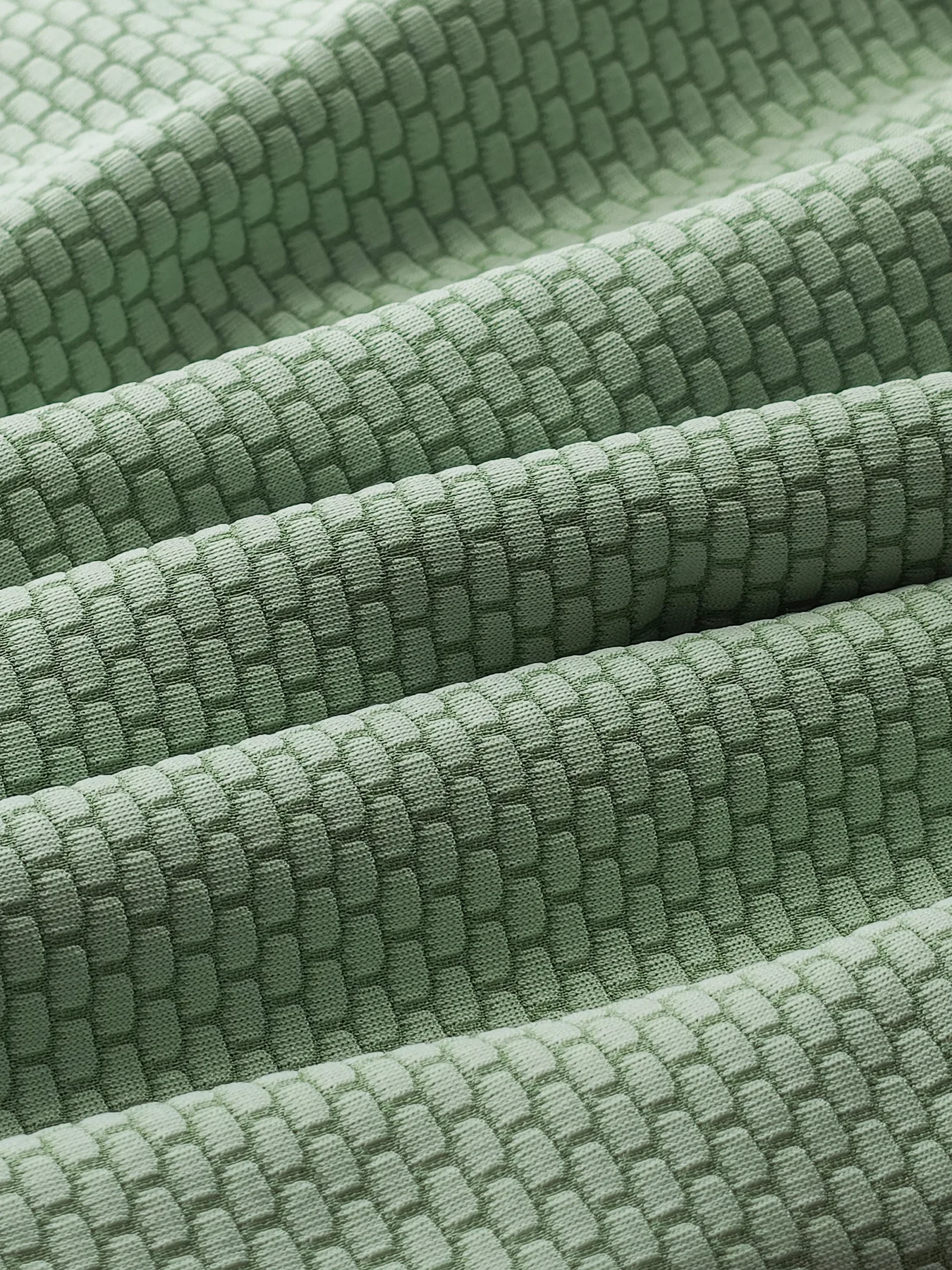
Open area can affect the route available for air to pass through a fabric, so hole size and spacing are sensible design variables. However, larger-looking holes do not guarantee a specific air-permeability result. The complete structure matters: yarn diameter, loop or interlacing pattern, fabric thickness, density, finish, printing, coating, backing, tension and deformation can all change the pathway.
The fair comparison is not “this hole looks bigger.” It is “these fabrics were tested by the same method under the same stated conditions.” ISO 9237 describes a method for measuring fabric air permeability, and ASTM D737 is another current method for measuring air passing through textile fabrics. A useful report identifies the method, test area, pressure differential, conditioning and units. Values produced under different conditions may not be directly comparable.
What a photograph can and cannot show
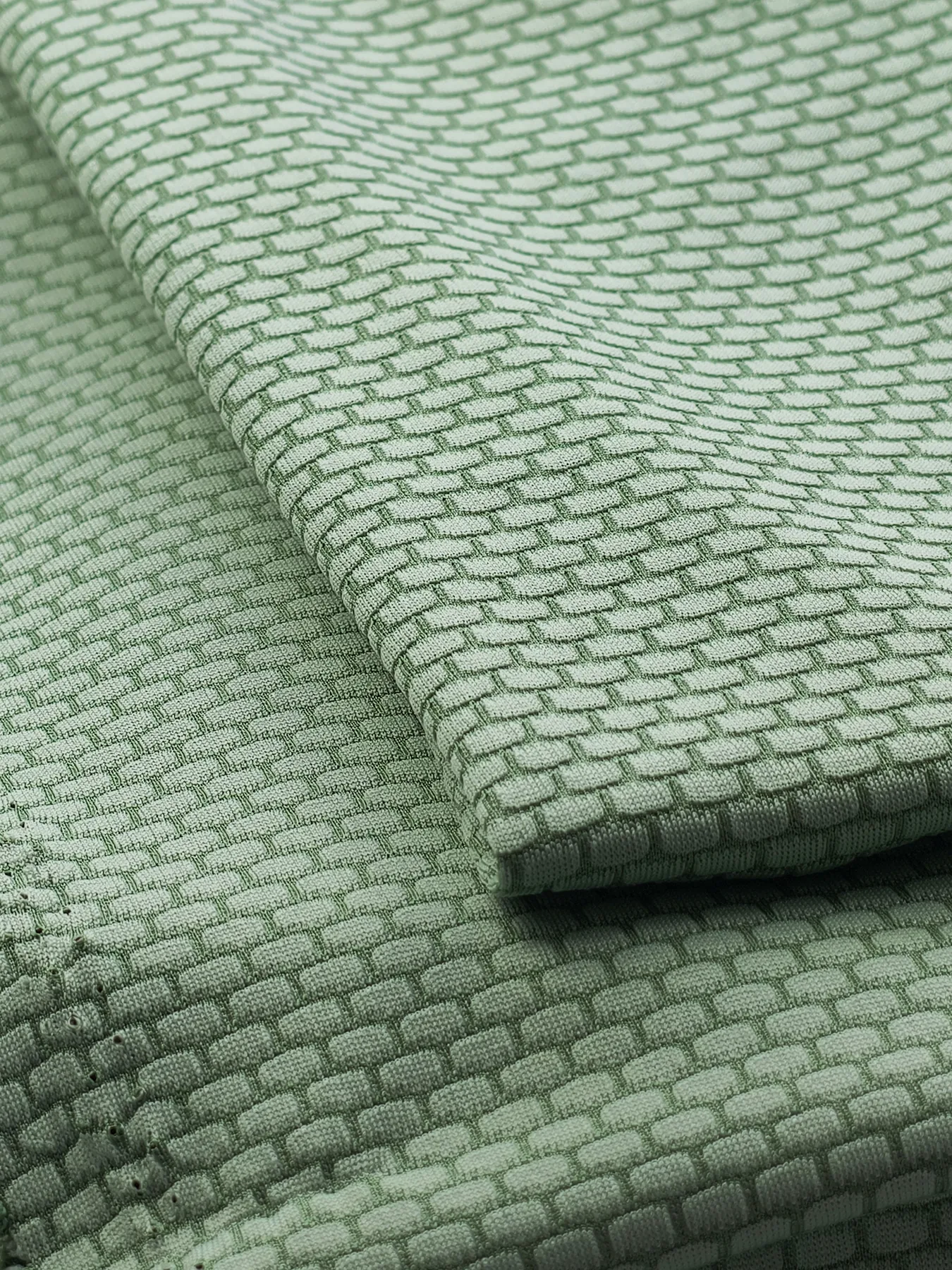
A close photograph can show the pattern, relative openness, yarn distribution and surface texture of the sample in that image. It cannot tell you a numeric air-permeability value. Nor can a hand held behind the fabric reproduce a controlled test; it is only a quick visual check of coverage under one light and distance.
If air passage is a core requirement, put a target and method in the purchase specification. Test the finished or production-representative fabric—not only an early greige or laboratory sample—because dyeing, heat setting, printing and finishing can alter the structure.
Airflow is not moisture wicking
Sportswear language often blends several different properties. Keep them separate:
| Property | Plain-language question | What to verify |
|---|---|---|
| Air permeability | How readily does air pass through the fabric under a stated pressure difference? | method, pressure differential, area, units and result |
| Liquid moisture management | What happens when liquid water or sweat substitute contacts the fabric? | wetting, absorption and transport behaviour under an agreed method |
| Vertical or horizontal wicking | How far or how quickly does liquid travel through or along the fabric? | test orientation, distance or time, and specimen direction |
| Drying time or drying rate | How does retained moisture leave under specified conditions? | starting moisture, airflow or heat condition, endpoint and result |
| Water-vapour transmission | How does water vapour pass through the material system? | method, temperature, humidity gradient and units |
AATCC lists separate methods for liquid moisture management, vertical wicking, horizontal wicking, drying time, drying rate and water-vapour transmission. That separation is important. A fabric can be open to air but manage liquid poorly. A relatively closed construction may use fibre or finish choices that influence liquid transport. Neither should be inferred from the other.
Use precise wording. If only air permeability was tested, report air permeability. If a supplier says “moisture-wicking,” request the method, result, test side and whether the result comes from the exact bulk quality. Do not replace missing evidence with “breathable,” “cooling” or “quick-dry.”
Does sport mesh stretch?
Some sport meshes stretch considerably; others move only a little. Stretch can come from knitted loop movement, elastic yarn, the pattern of open and closed zones, finishing, or a combination of these factors. Direction matters. The lengthwise result can differ from the crosswise result, and bias or multiaxial behaviour may be different again.
Stretch also changes appearance. Openings may widen, elongate or rotate. The fabric can become more transparent as solid areas move apart. Printed motifs may distort. A mesh used as a lining may need less extension than the shell, or it may need enough extension to avoid restricting movement.
Stretch is not recovery
Extension answers how far a specimen lengthens under a stated force or to a stated extension. Recovery asks how closely it returns after the load or extension is removed. A fabric that stretches easily but retains growth can bag at elbows, knees, seat areas or pocket openings.
ISO 20932-1 describes strip and loop methods for fabric elasticity and related properties. For a meaningful comparison, record:
- length and width direction;
- specimen dimensions and conditioning;
- load or fixed extension;
- hold time and number of cycles;
- immediate and delayed recovery interval;
- residual growth or recovery result;
- the condition of openings, surface and edges after cycling.
ASTM D2594/D2594M is another method direction for fabrics with high stretch and good recovery under low tension: it measures stretch under a known load and growth after a known extension is removed. Its public significance statement also says the method is not recommended for commercial-shipment acceptance because between-laboratory precision is poor, and it points to other methods for some support applications. Agree the method fit before writing it into a purchase contract.
A quick hand pull helps reveal obvious differences and opening distortion, but it is not a substitute for a repeatable measurement when fit or recovery matters.
Is sport mesh see-through?
Mesh often gives less coverage than a closed fabric, but “see-through” is not one fixed property. Perceived opacity changes with opening size, yarn coverage, colour, thickness, stretch, lighting, viewing distance, background and whether the material is wet. A dark fabric over a pale background may show openings differently from the same fabric over a similar colour.
Assess coverage in the conditions of use:
- Place the relaxed sample over the intended skin tone, lining colour or shell fabric.
- Repeat under indoor light, strong directional light and backlight.
- Stretch it to a realistic garment extension in both relevant directions.
- View it from the distances and angles likely in use.
- Wet a separate specimen only if wet appearance matters, then follow an agreed method rather than making a general claim.
- Repeat after the planned print, finish and care cycle.
Do not approve opacity from a folded swatch alone. Multiple layers hide the coverage of a single garment layer.
When does sport mesh need a lining?
A lining may be useful when the outer mesh does not provide enough coverage, feels rough against skin, requires pocket containment, needs seam protection, or must work with a more stable internal layer. It can also be part of a reversible or layered design.
But a lining changes the system. It may reduce the air pathway, change moisture behaviour, add weight, alter stretch and recovery, affect drape and shift the visual colour. A soft, dense lining behind an open shell will not behave like the open shell alone.
Select the two fabrics together. Check whether the lining restricts the shell at maximum garment extension and whether the seam joins create puckering. If airflow or moisture performance is claimed for a lined panel, test the assembled combination or production-representative garment zone rather than quoting a value for the outer mesh by itself.
Some applications need only localized lining or facing. Others may work with a double layer, self-lined section or no lining. The correct choice follows the coverage, comfort, stability, pocketing and design requirement—not the word “mesh.”
What is sport mesh fabric used for?
Jerseys and training tops
Mesh may form the body or selected ventilation zones in team jerseys and training tops. A body fabric needs acceptable coverage, handfeel, dimensional stability, seam behaviour and print compatibility in addition to any air-permeability target. A localized panel must move with the surrounding fabric without creating a tight band or weak seam.
Shorts, briefs and linings
Fine mesh is used in some short linings, pocket bags and internal support constructions. Direct-contact areas need attention to softness, seam placement, edge finish and recovery. Do not assume that a mesh chosen for an outer panel is comfortable or stable enough for a lining.
Jackets and panelled garments
Mesh can be used behind vents, inside lightweight jackets or as a pocketing material. The shell, mesh and trims should be tested as an assembly. If the shell blocks most air, the presence of an internal mesh does not make the jacket air-permeable.
Bibs, overlays and visual layers
Coarser meshes may provide recognizable texture and low visual coverage for training bibs or fashion-sport overlays. Check snagging, edge finishing, print legibility and whether the openings remain regular after use and care.
Bags, pockets and selected footwear components
Mesh can serve pockets, compartments, panels or shoe-upper components where its look and open structure are useful. These uses can place different loads on the material than apparel does. Abrasion, snagging, bursting, seam strength and dimensional stability should be specified for the actual component. An apparel result does not automatically qualify a footwear or bag application.
Sport mesh, power mesh and spacer fabric are not interchangeable
Category names can overlap in sales language, so identify the physical construction.
- Sport mesh is a broad use-oriented term for open fabrics considered for sportswear or related products. It carries no universal composition or stretch value.
- Power mesh usually signals an elastic, close-fitting mesh selected where stretch and recovery matter. The name alone still does not supply the percentage, direction, force or recovery result.
- Spacer fabric is a three-dimensional structure with two surface layers held apart by connecting yarns or elements. Not every raised or textured mesh is spacer fabric, and an ordinary single-layer mesh should not be described that way.
- Pique or micro-mesh can refer to a small-scale cellular knit appearance. Pique is one construction family, not the definition of all mesh.
If a supplier uses one of these names, request a cut-edge photograph, construction description, mass, thickness, stretch/recovery results and intended application. Rename the material in your internal library only after the structure has been confirmed.
What should activewear buyers check in a sport mesh sample?
Use a sample as a small technical investigation, not just a colour-and-handfeel decision.
1. Confirm identity and lot traceability
Record the supplier, article number, colour, lot or sample date, fibre content, construction, finish, nominal mass and usable width. Label every cut specimen. If the bulk fabric changes yarn, finish or heat-setting route, the approved sample may no longer represent it.
2. Map face, back and direction
Identify the intended face, technical back, fabric length and width. Photograph them with a scale. Count or describe the opening repeat, and note whether the structure is uniform across the width.
3. Inspect openings relaxed and stretched
Place the sample on contrasting backgrounds. Stretch it to the planned garment extension, then compare opening shape, spacing and recovery. Watch for yarn displacement, permanent distortion, edge curling, runs or localized thin areas.
4. Check mass, width and usable area
Verify mass per unit area and usable width under agreed conditioning. Inspect selvages and exclude damaged or structurally irregular zones when calculating usable area. A name such as “light mesh” is not a measurable specification.
5. Test the performance actually required
If airflow matters, use an agreed air-permeability method and state all conditions. If liquid moisture management matters, specify an appropriate separate method. If stretch and recovery matter, test both directions and the relevant cycling. Do not accept one test as proof of another property.
6. Review opacity and lining as a system
Check a single layer on realistic backgrounds, at planned extension and under strong light. Then repeat with the intended lining. Assess whether the lining changes air passage, stretch, colour and drape.
7. Sew the intended construction
Make a panel or garment trial with production needle, thread, stitch type, seam allowance, binding, elastic and companion fabrics. Inspect skipped stitches, seam grin, puckering, edge damage and opening distortion. Pull seams only within the agreed protocol; an uncontrolled hand pull cannot produce a comparable strength value.
8. Check snagging, abrasion and bursting where relevant
Open structures can expose yarns or loops to contact, but risk differs by material and use. Choose a method relevant to the product. ASTM lists separate methods for snagging, abrasion, bursting and other fabric properties. ASTM D4966 also cautions that abrasion results depend heavily on test conditions and should not be converted casually into exact wear-life predictions.
9. Apply the intended care route
Wash and dry specimens using the planned procedure. ISO 6330 provides standardized domestic washing and drying routes, while ISO 5077 addresses dimensional change after specified care. Mark reference lengths before care, then measure again after conditioning.
Inspect shrinkage, skew, curling, surface change, colour change, pilling or fuzzing, snagging, opening deformation, stretch recovery and seam appearance. Recheck air or moisture properties after care if durability of the claim is required.
10. Compare sample, pre-production and bulk
Keep an approved control. Compare shade, hand, mass, width, opening geometry and required test results at pre-production and bulk stages. Report method, units and tolerance. “Same as sample” is hard to enforce unless the sample and acceptance criteria are identifiable.
How should sport mesh be cared for?
There is no universal mesh care label. Care depends on fibre, dye, finish, elastic content, print, trim, lining and garment construction. Follow the confirmed product specification and finished-garment test route.
As a development practice, protect open structures from uncontrolled snagging, avoid using a hotter or harsher process than has been qualified, and test the actual wash and drying sequence before assigning instructions. A gentle process may be appropriate for some products, but it cannot be prescribed for every mesh without evidence.
After care, do not check shrinkage alone. Look at hole geometry, edge stability, yarn movement, surface snagging, stretch recovery and the interaction with seams and lining. A fabric can meet a dimensional tolerance yet still change visibly or functionally.
How to write a clear sport-mesh specification
A useful specification states:
- article identity and approved control sample;
- fibre content and construction description;
- intended face, colour and finish;
- mass, usable width and tolerance;
- opening geometry or visual standard where important;
- stretch and recovery requirements by direction;
- opacity or coverage evaluation setup;
- air-permeability method and target, if required;
- liquid-moisture, wicking, drying or vapour method separately, if required;
- seam, snagging, abrasion or bursting requirement appropriate to use;
- care procedure and post-care acceptance criteria;
- inspection level, reporting units and lot traceability.
Avoid standalone adjectives such as “breathable,” “high stretch,” “non-see-through,” “durable” or “quick-dry.” Replace each with a method, condition and acceptance target—or label it as an unverified design objective until testing is complete.
Final takeaway
Sport mesh is best understood as an open-structure textile category, not a guaranteed performance package. Its openings can influence air passage and visual coverage, but the complete construction and test conditions determine the result. Air permeability, liquid moisture management, wicking, drying and water-vapour transmission are related to comfort discussions but are different properties. Stretch must be paired with recovery, and opacity must be checked at realistic extension, lighting and background.
Choose the fabric by the job it must do. Identify the structure, test the required property, review it with the intended lining and companion fabrics, sew a realistic sample, and repeat critical checks after care. That process turns “mesh” from a broad product name into a controlled material decision.
Frequently asked questions
What is sport mesh fabric used for?
Sport mesh is used for jersey bodies or panels, training tops, shorts, linings, pockets, bibs, overlays, lightweight jacket interiors, bags and selected footwear components. Suitability depends on the exact construction, coverage, stretch/recovery, seam behaviour and tested performance; the name alone does not qualify every use.
How do hole size and knit structure affect sport mesh airflow?
Openings create possible pathways for air, and their size, number and shape can influence air permeability. Yet yarn size, fabric thickness, structural density, finish, coating, backing and stretch also matter. Compare fabrics with the same air-permeability method and stated conditions instead of judging from hole size or a photograph alone.
What should activewear buyers check in a sport mesh sample?
Confirm identity, fibre content and construction; mark face, back, length and width; inspect opening stability relaxed and stretched; verify mass and usable width; test air permeability and liquid-moisture behaviour separately when required; measure stretch and recovery in both directions; assess opacity with the intended lining; sew a production-style trial; and repeat critical checks after the agreed care route.
Is all sport mesh moisture-wicking?
No. Mesh describes open structure. Moisture wicking or broader liquid-moisture management depends on the fibre, yarn, structure and finish and should be verified with an appropriate test. Air permeability does not prove wicking.
Is all sport mesh four-way stretch?
No. Some mesh stretches mainly across the width, some in more than one direction and some very little. Ask for directional extension and recovery results for the exact quality.
Is mesh always more breathable than solid fabric?
Not automatically. An open mesh may offer a clearer air path, but the measured result depends on the whole construction and test conditions. A finish, print, coating, backing or lining can change the result.
Does sport mesh always need a lining?
No. The decision depends on coverage, skin feel, support, pocket containment, seam protection and design. If a lining is used, evaluate the two materials together because the lining changes stretch, drape, colour and air/moisture behaviour.
Is sport mesh the same as spacer fabric?
No. Spacer fabric has two surface layers kept apart by connecting yarns or elements, while many sport meshes are single-layer open structures. Confirm a cut edge and construction record before using the term “spacer.”
References
- CottonWorks Textile Encyclopedia: Mesh
- CottonWorks: Knit Basics
- CottonWorks: Single & Double Knits
- ISO 9237:1995, Textiles—Determination of the permeability of fabrics to air
- ASTM D737-18(2023), Air Permeability of Textile Fabrics
- AATCC TM195, Liquid Moisture Management Properties of Textile Fabrics
- AATCC test methods and procedures list
- ISO 20932-1:2018, Determination of the elasticity of fabrics—Strip tests
- ASTM Textile Standards
- ASTM D4966-22(2026), Martindale abrasion method
- ISO 6330:2021, Domestic washing and drying procedures for textile testing
- ISO 5077:2007, Determination of dimensional change in washing and drying
- WellDoneTex Football Mesh Fabric
- WellDoneTex Activewear Fabric Supplier
- Sportek: What Is Sport Mesh Fabric?
- Sportek: Sports Mesh vs. Spacer Mesh
- ASTM D2594/D2594M-21, Stretch Properties of Knitted Fabrics Having Low Power