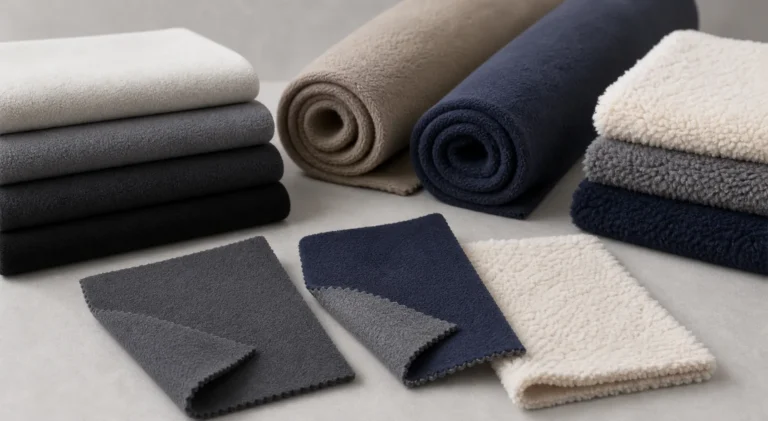
Image note: the featured coral fleece photograph illustrates a fabric surface. It is not a GSM measurement, width inspection or evidence of a tolerance result.
A knit fabric GSM and width specification needs more than two target numbers. Before bulk production, agree on the acceptance limits, the fabric condition being measured, the measurement method and the decision process for results outside those limits. A nominal GSM or quoted width alone does not tell the receiving team whether a shipment meets the order.
This guide helps apparel buyers turn weight and width requirements into a usable purchasing record. It does not recommend a universal tolerance percentage or establish a WellDoneTex production guarantee. The limits must be agreed for the actual fabric and garment program.
1. Separate the target from the acceptance limits
GSM means grams per square meter. A target describes the intended fabric mass per unit area; an acceptance range states which measured results are permitted under the agreed decision rule. Keep those two entries separate on the specification sheet.
For example, a request for “280 GSM” does not specify an allowed variation. If the buyer and supplier decide to express a tolerance as a percentage of the target, write the lower and upper limits in GSM as well. This makes the requirement easier to read without assuming that a percentage is an industry-wide rule.
Hypothetical arithmetic only: a target of 280 GSM with a separately agreed ±3% range would give 280 × 0.97 = 271.6 GSM and 280 × 1.03 = 288.4 GSM. The 3% figure is invented solely to explain the calculation. It is not a recommended tolerance, a test result or a WellDoneTex offer.
Also agree on rounding and how the result is used. A reported lot average within a range does not, by itself, show that every individual measurement or roll meets a requirement. State whether the agreed limits apply to individual readings, a roll result, a lot result or a defined combination.
2. Define which width the order requires
“Width 160 cm” can leave an important question unanswered: does it mean the overall measured fabric width or the width the cutting team can use? Record the required usable width and identify how edges or other excluded areas will be treated. Do not assume that the cutting marker can use the full quoted width.
For tubular fabric, identify whether the quoted number is a laid-flat tube measurement or an open-width measurement. Ask the supplier to confirm the basis rather than automatically doubling a number. Record the supplied form and the agreed measurement convention beside the width value.
The width requirement can be written as a lower limit, an agreed range or another clearly defined condition suited to the program. Ask the receiving factory which constraint its cutting plan actually needs. Do not convert a minimum usable-width requirement into a symmetric plus-or-minus range without that approval.
3. Match the measurement condition to the specification
Identify the fabric stage covered by the numbers: for example, the agreed finished construction rather than unfinished material. Include composition, construction, finish, article reference and specification revision so that the measurement refers to the intended fabric.
Ask the technical team or testing laboratory to specify the preparation and measurement conditions, including any applicable conditioning and relaxation requirements. Record whether the fabric is measured under the agreed tension or handling condition. A width value taken while a stretch fabric is pulled is not automatically comparable with a value taken under another condition.
Keep before-laundering measurements separate from after-laundering requirements. If dimensional change after washing matters to the garment, use a separate agreed laundering procedure and acceptance requirement. The knit fabric shrinkage report checklist explains what buyers should check in that record.
4. Agree on the method and the sampling plan
A method name is useful only when the selected procedure applies to the fabric and the question being answered. Ask the responsible technical team to identify the method, edition and applicable procedure. A standard used to measure a property is not automatically the buyer’s commercial acceptance limit.
Define which lots or rolls the evidence represents, where measurements are taken and how many results are required. Those decisions belong in the agreed sampling plan; this guide does not supply an invented number of specimens or a universal inspection frequency.
The published scope of ASTM D3776/D3776M-20(2025) covers mass per unit area for most fabrics and distinguishes different sample options. Its summary cautions that a small swatch does not necessarily represent the source lot. ASTM D3774-18(2024) covers width and usable width for woven and knitted fabrics. These references support specifying the measurement basis; their public summaries do not set the commercial tolerance for your order.
Keep the individual readings and the calculated result distinguishable. If a report gives only one average, ask for the information needed to apply the actual acceptance rule. A repeat measurement should follow an agreed process rather than becoming an informal search for a passing number.
5. Treat weight and width as separate decisions
A fabric may meet its agreed GSM range while failing the usable-width requirement, or the reverse. Do not let one acceptable property cancel an exception in the other. Record the outcome for each requirement before deciding whether material can be released.
If the supplied width changes, have the receiving team check the effect on its marker and consumption assumptions. If GSM changes, review the affected garment and purchasing requirements. Neither change should be accepted simply because a combined calculation looks similar.
For a custom knit program, connect these numbers to the wider fabric specification checklist. Weight and width do not replace composition, finish, color or the other agreed performance requirements.
6. Write the exception process before dispatch
When a result falls outside an agreed limit, identify the affected material and who can decide its disposition. The next step may involve clarification, an agreed repeat test or a written decision by the buyer’s authorized technical team. Do not treat a supplier’s explanatory message as automatic approval to use the material.
Keep any accepted deviation specific to the identified lot or rolls and the stated use. Record the approval date and decision-maker. Do not silently change the master specification to make an existing result appear compliant, and do not assume a one-off decision applies to the next order.
A practical specification handover checklist
- Fabric article, composition, construction, finish and revision.
- Target GSM and separately agreed lower and upper limits.
- Width definition: overall or usable, open width or laid-flat tube.
- Required width limit or range and any excluded areas.
- Fabric stage, preparation and measurement conditions.
- Method, edition and applicable procedure.
- Lot or roll sampling plan and required result records.
- Rounding and acceptance decision rule.
- Named authority and process for out-of-limit results.
Send the same revision to sourcing, the supplier and the receiving factory. If a requirement changes after quoting, request confirmation of the revised technical and commercial basis before relying on the old quotation.
Prepare a clear knit fabric inquiry
WellDoneTex supplies made-to-order knit fabrics and does not supply stock fabric. Its usual planning basis is 1,000 kg per order and typically 400 kg per color, subject to confirmation for the specific program. These quantity figures do not define GSM or width tolerances.
Send your fabric specification, intended use and proposed acceptance requirements. Include the target GSM, usable-width requirement, quantities and any method requested by your technical team. Ask which details need confirmation before the quotation and bulk approval can proceed.