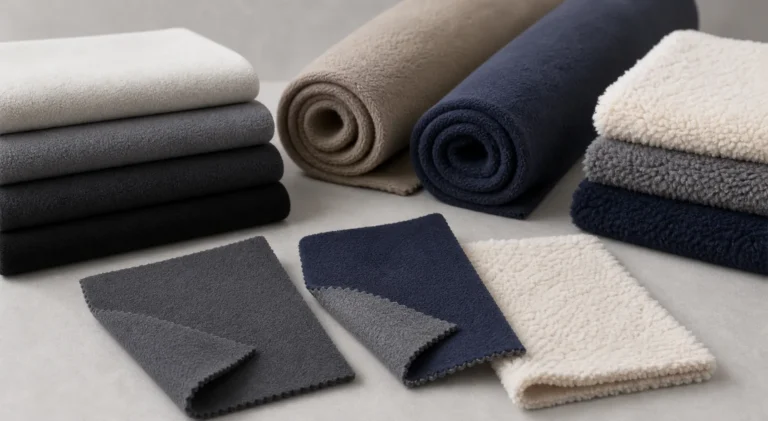
Image note: the coral fleece photo illustrates a fabric type. It is not a photograph of a shipment, roll label or packing-list verification.
A knit fabric roll packing list should let your receiving team match every roll to the order, identify its color and lot, and reconcile the quantities before material moves to cutting. Review the individual entries as well as the shipment total. A total that looks correct can still hide a missing roll, a duplicated number or a quantity assigned to the wrong color.
This guide is for buyers arranging made-to-order fleece, jersey or mesh for garment production, including programs delivered to Bangladesh. It is a practical document-review checklist; shipment-specific customs and transport requirements should be confirmed with the responsible forwarder and importer.
1. Agree what the packing list needs to identify
The International Trade Administration explains that a packing list itemizes package contents and includes weights and measurements. For a fabric buyer, ask for a roll-level detail sheet linked to the shipment packing list where the main document only summarizes packages.
Start with the purchase order number, shipment reference, document date and revision. Each fabric line should connect to the agreed style or article code and specification. A broad description such as “polyester fabric” may be inadequate when the order contains several constructions or finishes.
Use your fabric specification checklist as the reference for composition, construction, GSM, width and finish. Keep specification targets distinguishable from actual measurements: a target GSM printed in a heading is not a test result for every roll.
2. Separate roll identity, color and lot
Request a roll identifier that is unique within the agreed shipment or order scope. The same identifier should appear on the physical roll label and its list entry. If numbering restarts for each color, use a combined identifier that avoids ambiguity when rolls are received together.
Record the fabric article, buyer color reference and supplier lot reference separately. Ask what the lot code represents, such as a dyeing or production batch. A color name does not identify a production lot, and sharing a lot code does not by itself establish shade approval.
GS1’s traceability framework distinguishes product, batch and individual-item identification. That distinction is useful when designing your own roll records. This article does not require GS1 labels or claim that WellDoneTex uses a particular barcode system. Agree a readable identifier format that both teams can maintain.
If several rolls are inside one outer package or on a pallet, ask for the link between each roll and that package. Count rolls and outer packages separately so the receiving team knows what each total means.
3. Define the weight basis and length units
Ask the supplier to define net fabric weight, packing weight and gross weight on the document. In particular, clarify whether cores, bags and other packaging are excluded from the reported net figure. Review kilograms against kilograms on the same agreed basis rather than comparing a fabric-only figure with a wrapped-roll figure.
Where lengths are provided, show the unit explicitly for each column. State whether the lengths are measured or calculated. A conversion from weight using GSM and width is an estimate under those inputs; it does not establish the measured length of an individual roll. Keep that distinction visible in any worksheet used by merchandising or cutting teams.
Do not replace actual dispatch quantities with nominal roll sizes. If a roll is split or repacked, ask for an updated record linking the new identifiers to the original entry. Record the relevant quantities and avoid counting both the original and replacement entries in the total.
For freight planning, confirm the forwarder’s required weights and package measurements. Gross weight on a packing list should not automatically be treated as the carrier’s chargeable weight; the applicable transport method and charging basis need separate confirmation.
4. Reconcile from each roll to the order
Check the detail in a consistent sequence:
- Look for blank, duplicate or unreadable roll identifiers.
- Group entries by purchase-order line and fabric article.
- Within each group, total the quantities by color and lot using the agreed units.
- Compare those subtotals with the shipment summary and the physical roll count.
- Compare dispatched quantities with the order and any approved partial-shipment plan.
- Identify the balance still outstanding, if any, without presenting it as already shipped.
Ask for clarification of a difference before treating it as acceptable. The relevant shortage, overage and tolerance rules belong in the agreed order terms; there is no percentage recommended by this guide. Likewise, a correct overall weight does not resolve a shortage in one color if another color is over-supplied.
For a split order, distinguish this shipment’s quantities from cumulative shipped quantities and the remaining order balance. Use the same version of those figures in the handover to the receiving factory.
5. Keep packing review and quality release connected
A complete list supports traceability. Quality approval requires its own evidence. Link the relevant inspection or test records to the fabric, lot or rolls they actually cover rather than adding an unsupported “all passed” note to the packing sheet.
For color approval, use the agreed process described in the fleece lab dip and bulk shade guide. If some rolls are on hold pending review, identify them clearly and record who can authorize the next step. Do not let a document marked “final” override a separate quality hold.
Ask how labels will remain identifiable during handling and opening. A sample label photograph can help confirm the format, but a photograph of one roll cannot prove that every roll was labeled or inspected.
6. Give receiving a usable exception process
Before dispatch, send the agreed final list to the receiving team and make its revision clear. If a correction follows, identify what changed so staff do not reconcile against an obsolete copy.
At receipt, the team can match the outer-package count, record visible damage and check roll identifiers against the list. When a label is missing, a package is damaged or a quantity differs, record the affected identifiers, observed counts or measurements, and supporting photographs where appropriate. Keep questionable material identifiable and separate from released material until the responsible team decides what happens next.
Follow the agreed inspection, notification and claims procedure. This guide does not set a claims deadline or authorize a rejection, deduction or concession. Preserve the original dispatch record and the receiving observations instead of silently editing one to match the other.
A buyer-ready pre-dispatch checklist
- The document identifies the order, shipment and current revision.
- Every roll can be matched to one unambiguous list entry.
- Article, color and lot references have distinct fields.
- Net and gross weight definitions, length units and measurement basis are clear.
- Roll, package and quantity subtotals reconcile without double counting.
- Partial shipments and quantity differences have a documented disposition.
- Quality holds remain visible and linked to the relevant material.
- The receiving team has the final list and an agreed way to report exceptions.
Plan roll documentation with your fabric inquiry
WellDoneTex supplies made-to-order fabric programs and does not supply stock fabric. The total order minimum is 1,000 kg, with a typical minimum of 400 kg per color, subject to confirmation for the specific program. These order minimums do not define standard roll weights or lengths.
For a new knit fabric inquiry, share the end use, construction, composition, GSM, width, finish, total quantity and color breakdown. Include your receiving factory’s roll-label and packing-list format if one is required, and ask what can be agreed before order confirmation.
Send your fabric specifications and packing-list requirements for a quote discussion.