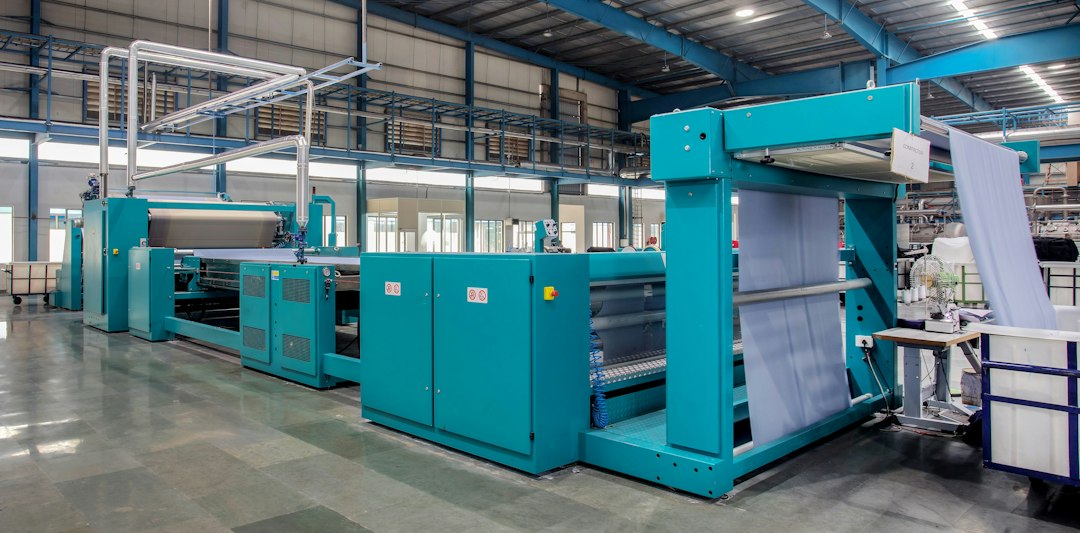
Image note: the featured stock photograph shows an open-width fabric finishing line. It is not a WellDoneTex facility, a tubular-to-open-width comparison or evidence of the delivered width of an order. Photo by Lalit Kumar on Unsplash.
When buying knit fabric, specify whether the finished goods must arrive open width or tubular before comparing quotations. The choice needs to fit the garment factory’s spreading and cutting process. A width number without a stated fabric form can leave sourcing and production teams planning around different material.
This guide focuses on choosing and handing over the supplied form. For fleece and other custom knit programs, ask which forms are feasible for the actual construction and finish; do not assume every article is available in both.
What do open width and tubular mean?
Tubular fabric forms a continuous tube. When flattened, it has two layers and folded sides. Open-width fabric is presented as a single full-width sheet. CottonWorks explains that a tubular fabric can be slit along one side and finished in open-width form. These terms describe the fabric form, not its fiber composition or a quality grade. See the CottonWorks open-width definition.
Also distinguish an open-width fabric folded for packing from a fabric that remains a continuous tube. A folded presentation alone does not identify the supplied form. Ask for an annotated cross-section or a photograph showing the edges if the wording is unclear.
Start with the cutting room, not the wider-looking number
Before requesting an alternative form, send the fabric reference and garment plan to the receiving factory. Ask these questions:
- Will the fabric be cut as an intact tube or opened into a single sheet?
- Which form can the spreading equipment and approved marker use?
- If slitting is required, who will do it, and at what stage?
- What usable width is needed after the agreed edge exclusions?
- Does the pattern layout require a particular face or pile direction?
A tubular delivery may fit a factory’s established tubular workflow. An open-width delivery may fit a single-sheet cutting plan. Neither choice establishes better garment yield on its own. Ask the cutting team to assess the actual supplied form, usable width and pattern layout rather than promising that one form always saves fabric.
Make the width label unambiguous
Write “finished open width,” “usable open cutting width” or “finished laid-flat tubular width” beside each number. Do not compare those labels as if they meant the same thing.
Hypothetical geometry only: a relaxed tube measuring 80 cm across when laid flat has approximately 160 cm of circumference. That does not guarantee 160 cm of usable finished open width after slitting, further processing or edge exclusion. This example is not a WellDoneTex specification or yield promise.
Ask the supplier to confirm the delivered width and measurement condition in the requested form. If the factory plans to slit after receipt, have it confirm the width it can actually use afterward. Keep that value separate from the width recorded on the supplier’s roll label.
For measurement conditions and acceptance limits, use the separate GSM and width tolerance guide. For unit-price calculations, see comparing coral fleece prices per kg and per meter.
Agree where slitting and finishing belong
If an option involves opening a tube, confirm whether the supplier’s quote covers slitting and the required final finishing. Ask whether the submitted sample represents that same processing route. A sample in one form should not silently approve a different delivery route.
Svegea’s tubular-slitting guidance identifies uneven tension as a potential source of knit distortion. Ask for checks on the proposed processing route rather than assuming a change of form has no effect.
For the proposed fabric, agree which sample and bulk checks will cover surface appearance, dimensional requirements and cutting suitability. Confirm any impact on cost and production timing in writing. Do not infer a fixed surcharge, lead time or performance advantage from the term “open width.”
Put the decision into the purchase specification
Use a short handover record shared by the buyer, supplier and receiving factory:
- Article: fabric reference, composition, construction, GSM and finish.
- Delivery form: open width or intact tubular; packing fold described separately.
- Width basis: named measurement, units, condition and agreed acceptance limits.
- Processing responsibility: who slits or performs additional finishing, if needed.
- Cutting approval: receiving factory’s confirmation of form and usable width.
- Sample reference: approved sample and the processing route it represents.
- Commercial basis: quantity, color breakdown, included operations and order-specific timing.
If the delivered form changes after quotation, obtain a revised technical and commercial confirmation before proceeding. Keep the earlier specification visible as a superseded version so the receiving team does not use it accidentally.
What should buyers check when rolls arrive?
Check that the roll identification and supplied form match the purchase specification. Confirm the width basis before entering values into the cutting plan. If the form or label differs, hold the affected material for clarification rather than slitting it immediately and losing the chance to document its received condition.
Keep any receiving measurements tied to the identified rolls and agreed method. A fabric photograph can help resolve a form question, but it does not replace the required measurements or cutting approval.
Prepare an inquiry for a custom knit program
WellDoneTex supplies made-to-order knit fabrics, including fleece, and does not supply stock fabric. The usual planning basis is 1,000 kg per order and typically 400 kg per color, subject to confirmation for the specific program.
Send your fabric reference, end use, composition, GSM, requested delivery form, usable-width requirement and kilograms per color. If the form is undecided, ask the receiving factory to review it and request clearly separated feasible alternatives. Send your knit fabric inquiry with these details for an order-specific discussion.