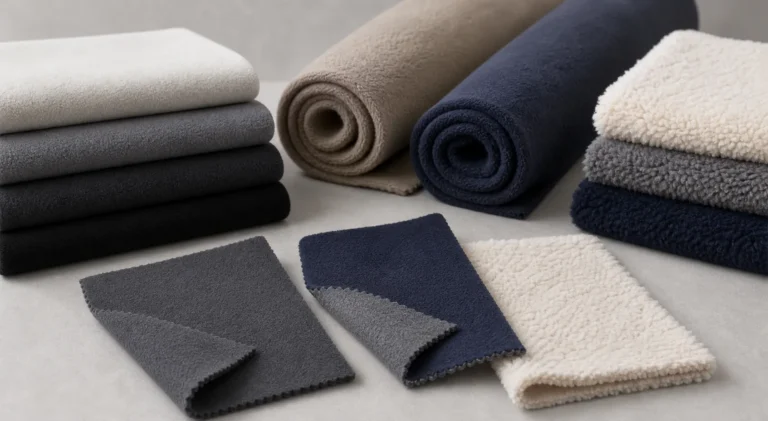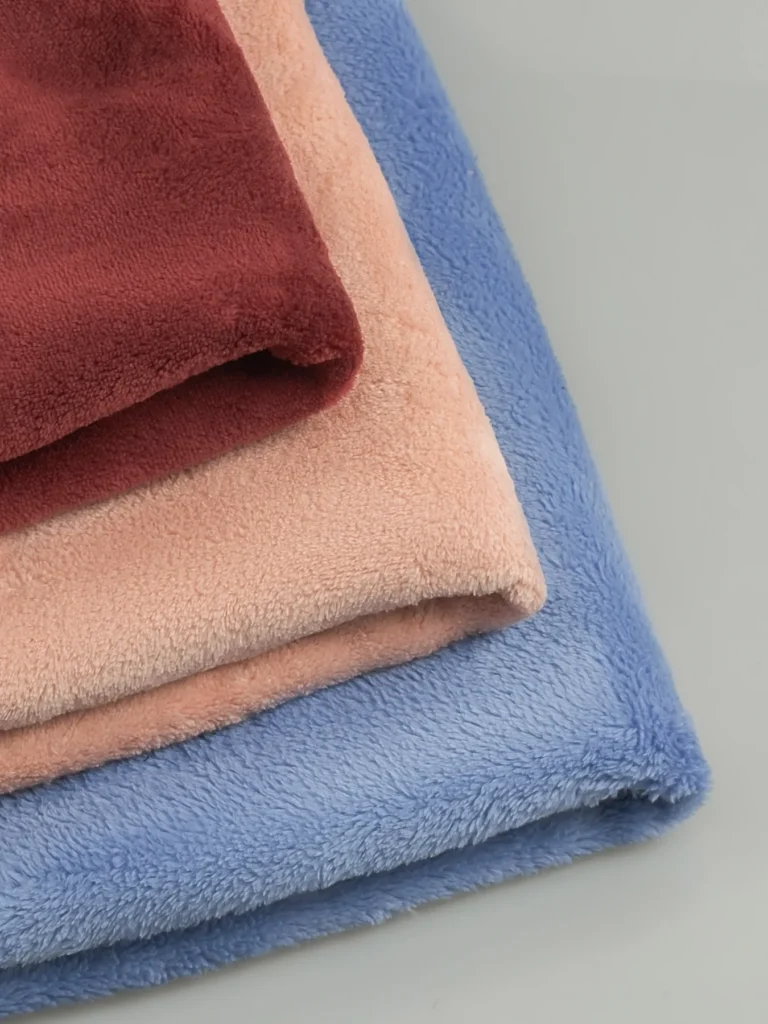
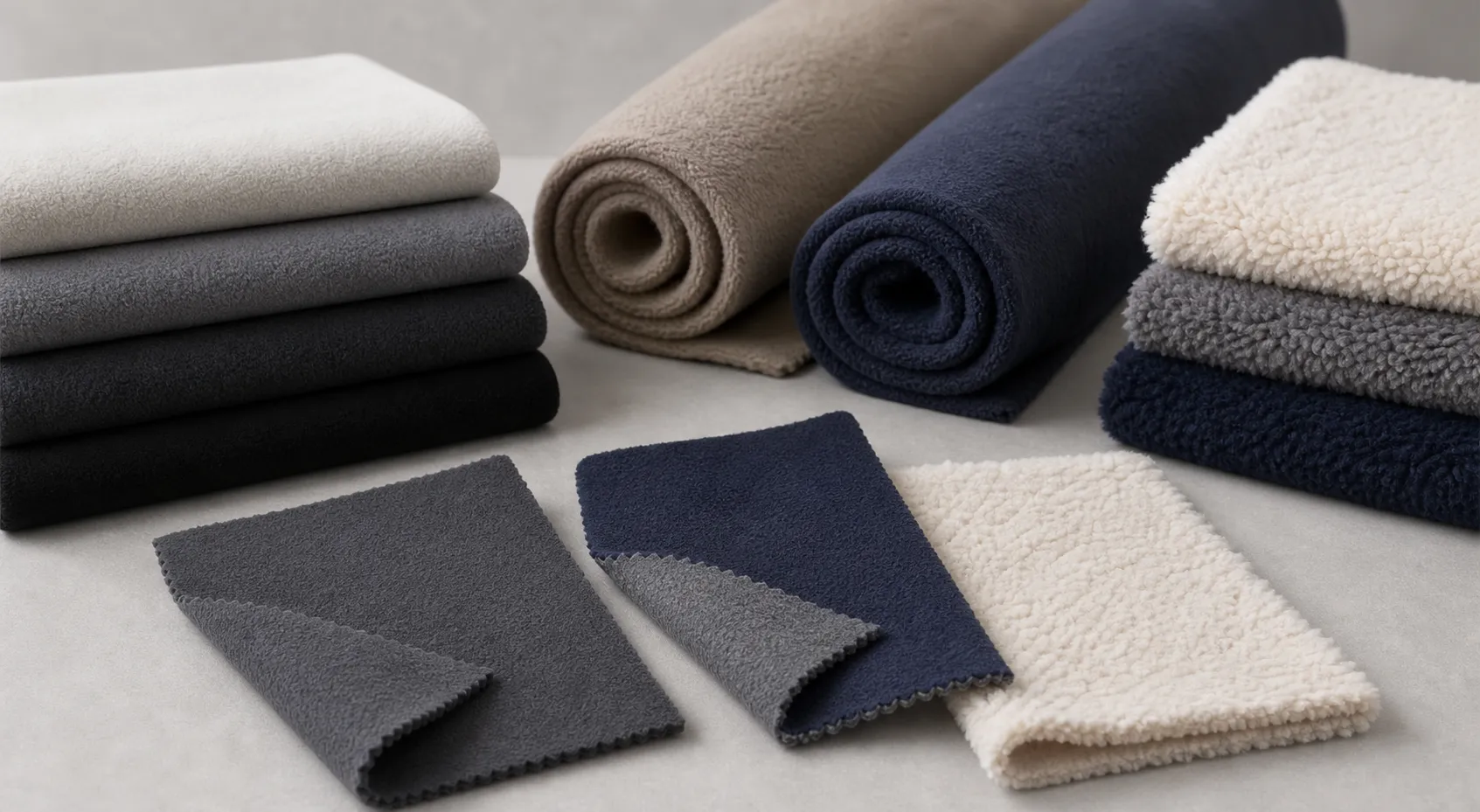
Fleece and flannel can both feel soft and warm, but they are not the same kind of fabric. Fleece usually refers to a knitted, raised-pile fabric, commonly made with polyester. Flannel is a woven fabric whose surface is brushed to lift fibers and create softness. That difference in structure changes how the fabrics handle, layer, dry, drape, and wear.
Neither fabric is automatically warmer, more breathable, or better for pajamas. A lightweight fleece can be less insulating than a heavy flannel, while a dense high-loft fleece can provide a very different result from a shirt-weight flannel. The right comparison starts with the real samples, their weight and construction, and the intended garment.
Quick answer
Choose fleece when the brief calls for a soft pile, knit flexibility, low-friction layering, or a lightweight synthetic insulation direction. Choose flannel when the brief calls for a woven appearance, a flatter brushed surface, shirt-like handling, or a familiar natural-fiber direction. Then verify fiber content, GSM, air permeability, dimensional change, pilling, colorfastness, and care on the exact samples. The names alone cannot approve the material.
Fleece and flannel are built differently
Most modern apparel fleece begins as a knit structure. The surface is raised, brushed, or otherwise finished to create a pile that traps air and produces the familiar soft hand. Polyester is common, but blends and alternative fibers exist. The word “fleece” therefore does not prove a specific composition.
Flannel is a woven fabric. CottonWorks defines it as a woven material brushed to raise surface fibers, creating cover and softness. Flannel can be brushed on one or both sides, and the underlying weave, yarn, density, fiber, and finish can vary. Cotton is common, but wool, synthetic fibers, and blends also appear in the market.
This construction difference matters more than the shared adjective “soft.” A knitted fleece and a woven flannel respond differently to stretch, seam design, edge behavior, bulk, drape, and laundering.
Fleece vs flannel comparison
| Everyday question | Fleece direction | Flannel direction | What to verify |
|---|---|---|---|
| Basic structure | Usually a knit with a raised pile | Woven base with a brushed surface | Construction, face/back, density |
| Common fiber direction | Often polyester; blends vary | Often cotton or wool directions; synthetics and blends also exist | Declared and tested fiber content |
| Surface | Lofty or fuzzy pile; many textures are possible | Flatter nap over a visible woven base | Pile/nap consistency and face change |
| Stretch | May have mechanical knit stretch; elastane is not automatic | Usually more dimensionally controlled; stretch variants exist | Width/length stretch and recovery |
| Drying direction | Polyester-rich fleece may be selected when faster drying is desired | Cotton-rich flannel may retain more moisture under the same care route | Actual drying test and garment conditions |
| Layering | Often used as a midlayer, lining, robe, jacket, or comfort layer | Often used in shirts, pajamas, overshirts, linings, and bedding | Bulk, seam design, next-to-skin feel |
| Care risk | Pilling, matting, heat sensitivity, or pile change may matter | Shrinkage, color change, nap change, and wrinkling may matter | Defined wash/dry method and cycles |
The table describes design directions, not guaranteed results. If warmth, drying time, or air permeability is critical, compare equivalent samples using defined methods.
Which is warmer: fleece or flannel?
There is no reliable answer without specifying the fabrics. Warmth depends on thickness, mass, loft, air trapped in the structure, air permeability, moisture, fit, wind exposure, and the rest of the garment system.
A lofty fleece is often chosen for insulation because its pile can hold air without requiring a rigid woven structure. A flannel may feel warm against the skin because the brushed surface reduces the cool first touch associated with a smooth fabric. But a dense heavy flannel can be warmer than a very light fleece, and a wind-permeable fleece may need an outer shell in exposed conditions.
When comparing clothes, check the fabric weight, thickness, fit, lining, and intended weather rather than asking only “Which one is warmer?” Product teams making a warmth claim should define a thermal method and compare complete garment systems.
Which is more breathable?
Breathability is often used loosely. It may refer to air passing through the fabric, water vapor moving through a garment system, or simply the wearer feeling less hot. Those are related but not identical.
ISO 9237 provides a method for measuring air permeability. A loose woven flannel may pass air differently from a dense flannel. The same is true for open, compact, or bonded fleece constructions. Fiber content alone does not settle the comparison.
If comfort in sleepwear or active use matters, define whether the priority is air flow, moisture handling, drying time, thermal insulation, or next-to-skin feel. Then test the correct property instead of using a broad “breathable” claim.
Fleece vs flannel for pajamas and loungewear
Flannel is a familiar direction for woven pajama sets because it can provide a soft brushed hand with shirt-like drape and construction. Fleece is often used for robes, lounge layers, one-piece garments, and cold-weather comfort products where loft and knit softness are desired.
The choice should account for more than warmth:
- Will the garment be loose or close to the body?
- Does the pattern require woven stability or knit flexibility?
- How much seam bulk is acceptable?
- Is the wearer likely to sleep in a warm indoor environment?
- What wash and drying method will the care label allow?
- Are there market-specific flammability, children’s product, or labeling requirements?
Do not claim that a fabric is safe or suitable for children’s sleepwear without the exact product, market, and compliance evidence.
Fleece vs flannel for blankets
Both fabrics can be used in blanket directions, but the product experience is different. Fleece can create a soft, pile-led blanket with simple edge finishing or layered construction. Flannel can create a flatter woven blanket or be combined with batting or another layer.
For a blanket program, compare finished weight, face and back, shedding, pilling, dimensional change, colorfastness, static behavior, edge finish, and laundering. A photo cannot show how the fabric changes after repeated care.
Moisture and drying
Polyester-rich fleece and cotton-rich flannel are often selected for different moisture expectations. However, marketing shortcuts such as “fleece does not absorb water” or “flannel always breathes better” are too broad. Fabric construction, finishes, weight, and garment design can change the result.
For an outdoor or travel layer, drying time and low wet weight may matter. For sleepwear, next-to-skin feel and comfort across a long wear period may matter more. Compare the actual items under realistic use rather than carrying a fiber stereotype into the decision.
Pilling, shedding, and surface change
Both fabrics can change at the surface. Fleece pile may pill, mat, flatten, or shed depending on the yarn, brushing, shearing, finishing, and care. Flannel nap may flatten, fuzz, pill, or lose its original appearance. “Anti-pill” should refer to a defined sample and test route, not a guarantee created by the name.
ISO 12945 methods can be used to assess pilling, fuzzing, or matting. Agree on the method, number of cycles, conditioning, rating scale, and acceptance level before relying on a report. A result from one method should not be presented as directly equivalent to another method without technical review.
Shrinkage and care
Fleece and flannel may both show dimensional change, but for different combinations of reasons. Fiber behavior, knitting or weaving tension, relaxation, heat, brushing, dyeing, and garment construction can all contribute. A generic number is not useful.
ISO 5077 addresses dimensional change after specified washing and drying procedures. The development file should record the test specimen, wash program, drying method, cycle count, and results in length and width.
For US-market garments covered by the FTC Care Labeling Rule, care instructions require a reasonable basis. Test the finished garment or a representative product, including trims and prints, before setting washing, drying, bleaching, or ironing instructions.
Quick checklist for choosing fleece or flannel
Before approving either fabric, record:
- Garment or product type
- Layer position and climate or indoor use
- Required fiber content and labeling market
- Finished GSM, thickness, and usable width
- Knit or weave construction
- Face and back appearance
- Stretch and recovery
- Air permeability or thermal requirement, if relevant
- Drying or moisture requirement, if relevant
- Pilling, shedding, abrasion, and surface-change criteria
- Dimensional change and care procedure
- Colorfastness and shade tolerance
- Seam, edge, and bulk concerns
- Sample and bulk approval reference
For everyday use, the first six points usually answer the question. The technical items are optional checks for designers and product teams developing a new garment.
Choose by use, weight, and care
Choose fleece when you want a knit pile layer; choose flannel when you want a brushed woven layer. Then compare weight, fit, climate, and care on the actual item. Read what fleece is or the Fleece GSM guide for more context. Designers with a specific fleece development brief can optionally continue to the Fleece commercial page or request a sample review.
FAQ
Is fleece the same as flannel?
No. Fleece is usually a knitted pile fabric, while flannel is a woven fabric with a brushed surface. Both can feel soft, but their structure and handling differ.
Is fleece warmer than flannel?
Not in every case. Warmth depends on weight, thickness, loft, air permeability, moisture, garment fit, and layering. Compare actual samples rather than fabric names.
Is flannel always cotton?
No. Cotton flannel is common, but flannel can use wool, synthetic fibers, or blends. Check the fiber label for the actual item.
Is fleece always polyester?
Polyester is common in modern fleece, but fleece can include blends or other fibers. The word does not prove composition.
Which is better for pajamas?
Flannel often suits woven pajama sets, while fleece often suits robes or warmer lounge layers. The decision depends on fit, indoor temperature, bulk, care, and applicable product-safety requirements.
Which fabric dries faster?
A polyester-rich fleece may dry faster than a cotton-rich flannel, but construction, weight, and finishing matter. Compare the actual items under the intended care and wear conditions.
Do fleece and flannel pill?
Either can show pilling or surface change. Follow the care label; product teams should use an agreed test method for the exact fabric.