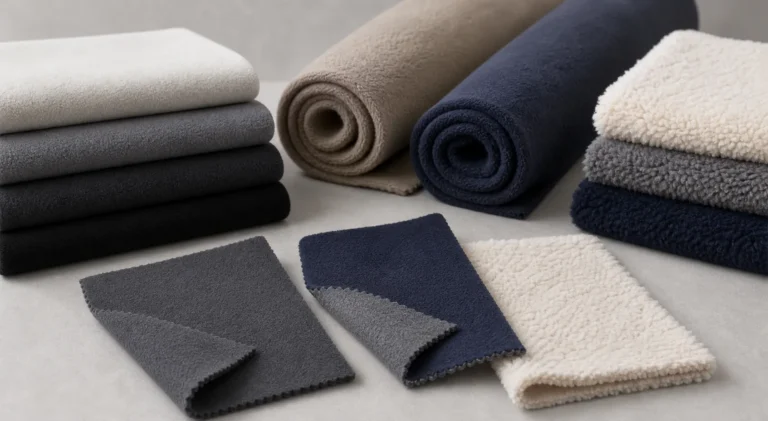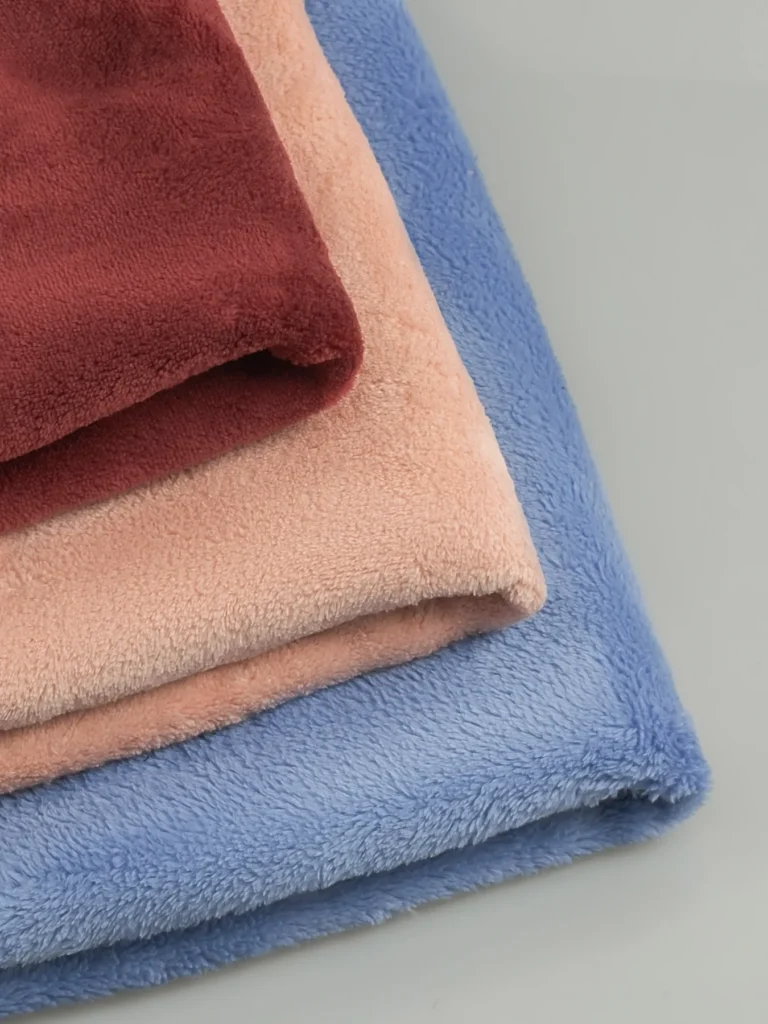
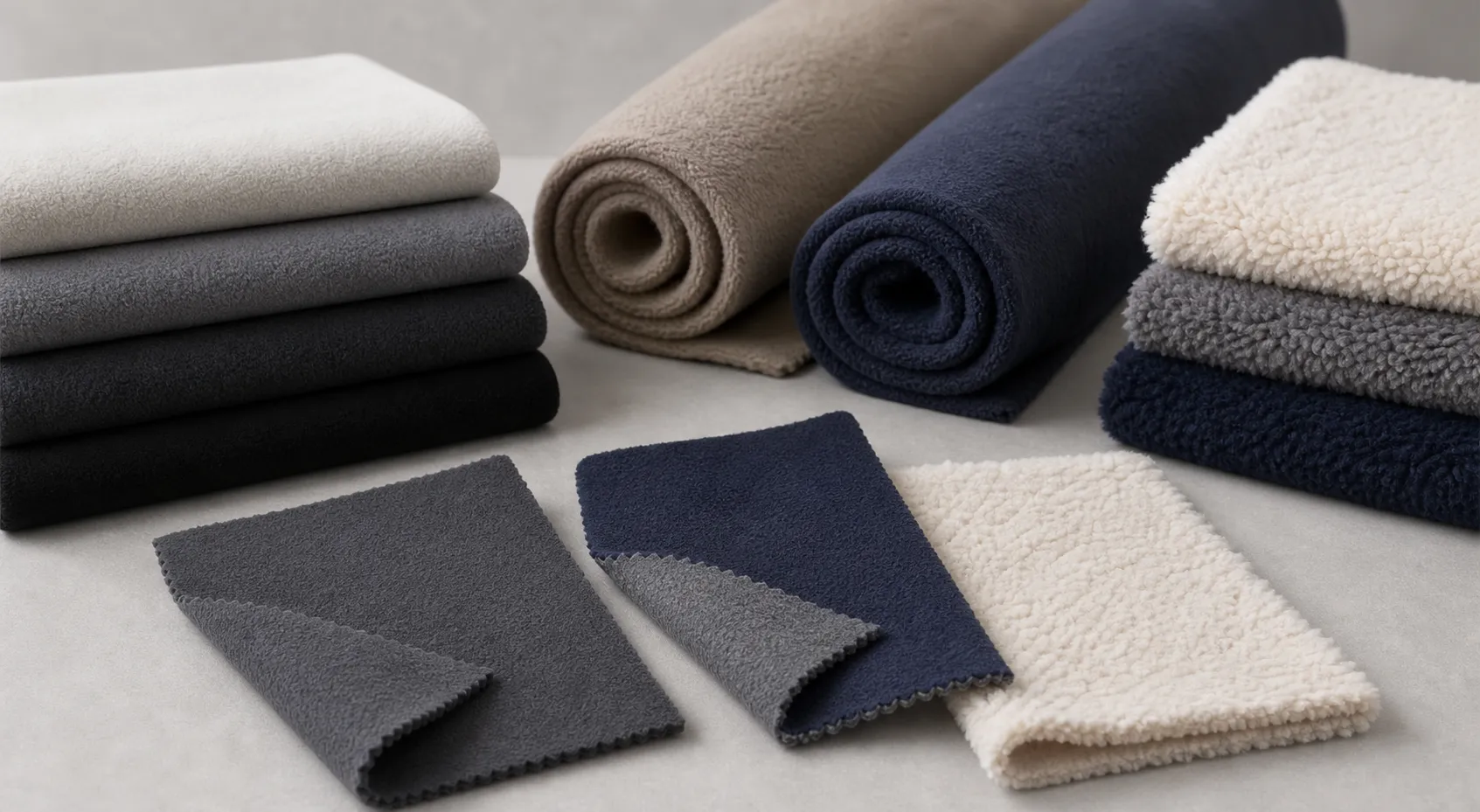
Cotton fleece and polyester fleece can both feel soft and warm, but the fiber choice changes how they handle moisture, dry, shrink, hold their shape, and feel against the skin. Cotton-rich fleece often has the familiar feel of a brushed sweatshirt. Polyester fleece is often chosen for lighter drying, loft, and easy-care layers. Neither direction is automatically better.
The first thing to check is the label. “Cotton fleece” may be 100% cotton, cotton-rich, or a cotton-polyester blend. “Polyester fleece” may describe several knit and pile constructions, not one fixed fabric. Weight, density, brushing, pile, stretch, finish, and garment design can outweigh the fiber name in a real side-by-side comparison.
Quick answer
Choose a cotton-rich fleece when you prefer a more absorbent, sweatshirt-like hand and do not mind a longer drying direction or a greater need to manage dimensional change. Choose a polyester-rich fleece when low moisture uptake, faster drying direction, light layering, or pile loft matters more. Then compare the actual items for thickness, air flow, pilling, shrinkage, recovery, heat sensitivity, and care.
If a product makes a precise claim—such as “quick drying,” “anti-pill,” “thermal,” or “recycled”—look for the construction, test method, and supporting evidence. The fiber name by itself is not the test result.
What does “cotton fleece” mean?
In apparel, cotton fleece commonly refers to a knitted fabric with a smooth or jersey-like face and a looped, brushed, or napped back. The soft inside of many sweatshirts and joggers is a familiar example. Some qualities leave loops visible, while others raise the loops into a fluffy surface.
Cotton may be the only fiber, the main fiber, or one part of a blend. Polyester can be added to change strength, drying, stability, price, or processing. Elastane may be added for recovery. That is why the name “cotton fleece” should be followed by the actual fiber percentages and construction.
Cotton fleece is different from sheep fleece. In this article, the term refers to an apparel fabric, not raw wool from an animal.
What does “polyester fleece” mean?
Polyester fleece is a broad family of synthetic knit fabrics whose surface is raised, brushed, sheared, or developed into a pile. It can be thin and low-pile, dense and compact, lofty, plush, bonded, or made with two different faces.
Many people associate polyester fleece with outdoor midlayers, blankets, jacket linings, robes, and cold-weather accessories. Those uses are directions, not specifications. A light microfleece and a deep-pile blanket fleece can both be polyester but behave very differently.
“Polar fleece” is commonly polyester-based, but it should not be used as a substitute name for every polyester fleece construction. Confirm the actual fabric rather than transferring one product’s characteristics to the entire fiber category.
Cotton fleece vs polyester fleece comparison
| Everyday question | Cotton-rich fleece direction | Polyester-rich fleece direction | What changes the result |
|---|---|---|---|
| Hand feel | Often soft, familiar and sweatshirt-like | Can range from smooth low pile to lofty plush | Yarn, brushing, pile, finish and density |
| Liquid moisture | Cotton fibers tend to take up more moisture | Polyester fibers take up less moisture, but surface transport depends on yarn and finish | Fabric structure, finish, sweat rate and layering |
| Drying | Often dries more slowly when it has taken up more water | Often selected for faster drying | Weight, thickness, spin, humidity and garment design |
| Warmth | Can feel comfortable and substantial | Can provide high loft at relatively low mass | Thickness, trapped air, permeability, fit and wind |
| Stretch | Knit structure may provide give; blends vary | Knit structure may provide give; elastane is not automatic | Stitch, direction, elastane and recovery |
| Shrinkage | Dimensional change may need closer control | May be more dimensionally stable in some setups, but heat and construction still matter | Processing, relaxation, care and trims |
| Surface change | Can pill, fuzz, flatten or abrade | Can pill, mat, flatten or shed | Yarn, finish, rubbing and care |
| Heat sensitivity | Care depends on the whole garment | Polyester can be sensitive to excessive heat | Dye, finish, print, trim and dryer setting |
These are comparison directions, not guarantees. Two fabrics should be compared at a similar finished weight and for the same end use.
Which feels softer?
Either one can feel softer. Cotton-rich sweatshirt fleece often has a dry, familiar softness on the skin. Polyester fleece can create a very fine, silky or lofty pile. Softness also changes after washing, rubbing, compression, and repeated wear.
Do not judge only the first touch of a new swatch. Rub the surface, bend it, compress the pile, compare the face and back, and review how it changes after the intended wash route. A soft finish can create an attractive first hand without proving long-term surface stability.
For sleepwear or next-to-skin loungewear, seams, fit, indoor temperature, static, and the wearer’s sensitivity matter alongside fiber content.
Which handles sweat and water better?
Cotton and polyester interact with moisture differently, but “wicking,” “absorbent,” and “quick drying” should not be treated as synonyms.
Cotton fibers can absorb moisture into the fiber. That can feel comfortable in some everyday situations, yet a saturated cotton-rich fabric may hold more water and take longer to dry. Polyester absorbs much less moisture into the fiber, but liquid movement across a polyester fabric still depends on filament shape, yarn, capillary spaces, knit structure, and any moisture-management finish.
A 2025 study of drying performance emphasized that fiber content, fabric structure, and stretch all affect the amount of water a fabric holds and how it dries. The practical lesson is simple: a fiber stereotype cannot replace a comparison of the finished items.
For travel or repeated outdoor use, compare wet weight and drying time. For loungewear, compare next-to-skin feel over the intended wear period. For a performance claim, record the test method and sample identity.
Which is warmer?
Warmth is not decided by cotton versus polyester alone. Insulation changes with fabric thickness, loft, density, trapped air, air permeability, moisture, garment fit, wind, and the layers above and below the fleece.
Polyester pile can create useful loft without a very heavy fabric, which is one reason it appears in many insulating layers. Cotton-rich fleece may feel substantial and comfortable in sweatshirts, but when it absorbs more moisture its comfort can change. A heavy cotton-rich fleece can be warmer than a very light polyester fleece; a lofty polyester fleece can be warmer than a thin cotton fleece.
For everyday shopping, compare thickness, coverage, fit, and whether the garment is intended as a midlayer or outer layer. For measured claims, compare the complete garment systems under the same method.
Which is more breathable?
People use “breathable” to mean several things: air passing through the fabric, water vapor leaving a clothing system, or simply not feeling overheated. Fiber choice matters, but the openness of the knit, brushing, pile, bonding, thickness, and garment fit can matter just as much.
A compact cotton-rich sweatshirt fleece may pass less air than an open polyester fleece, while a bonded polyester fleece may pass less air than an unbonded cotton fleece. If air flow is important, use a defined air-permeability test on the exact fabric. For daily comfort, also consider the next layer and the activity level.
Which pills more?
Both can pill. Pills form when loose or raised fibers become entangled under rubbing. The final appearance depends on fiber strength, yarn construction, brushing, shearing, surface finish, abrasion, and care.
Cotton-rich fleece may show fuzzing, abrasion or loose surface fibers. Polyester fibers can hold pills on the surface because the fibers are strong enough to keep the entangled ball attached. Those tendencies are not a universal ranking: a well-built sample can outperform a poorly built sample of either fiber direction.
For a product comparison, specify the applicable pilling method, cycle, conditioning, rating scale, and acceptance level. ISO 12945-3 is one possible method for applicable fabrics. “Anti-pill” does not mean “cannot pill.”
Which shrinks more?
Cotton-rich knit fleece often receives more attention for shrinkage, but no universal percentage is safe. Dimensional change depends on the fiber, loop geometry, knitting tension, dyeing, relaxation, compaction, brushing, heat, garment construction, and wash and dry route.
Polyester-rich fleece can also change size or shape, especially with heat, tension, bonding, or mixed components. A garment with rib cuffs, zippers, prints, interlinings, or blended panels should be checked as a complete item.
ISO 5077 covers determining dimensional change after specified washing and drying procedures. Record the method, number of cycles, drying route, and results in both length and width. Percentages from different procedures are not directly comparable.
Best uses for each fleece
Cotton-rich fleece is often considered for:
- Sweatshirts, hoodies and joggers
- Casual loungewear
- Soft everyday layers
- Items where a familiar cotton-rich hand is important
Polyester-rich fleece is often considered for:
- Lightweight or lofty midlayers
- Jacket and glove linings
- Travel blankets and accessories
- Garments where faster drying direction or lower wet weight matters
Blends can be a useful middle route. A cotton-polyester fleece may balance hand, drying, stability, surface appearance, and cost. The right blend still has to be evaluated as a complete fabric; percentages do not predict every result.
How to care for cotton and polyester fleece
Start with the care label. Cotton-rich and polyester-rich fleece can use different dyes, finishes, prints, elastane, trims, and garment constructions, so one generic wash rule is not reliable.
Low-risk habits include keeping abrasive hook-and-loop fasteners away from the raised surface, washing with similar colors, avoiding unnecessary heat, and drying only as directed. Excessive heat can affect polyester fibers, prints, elastic components, or bonded layers. Cotton-rich garments may need a care route chosen to manage dimensional change.
For US-market products covered by the FTC Care Labeling Rule, manufacturers and importers need a reasonable basis for care instructions. Product teams should verify the complete garment or a representative construction before finalizing the label.
A simple decision checklist
Ask these questions before choosing:
- Is the item for indoor comfort, daily wear, travel, or active layering?
- Do you prefer absorbent cotton-rich hand or lower-moisture polyester direction?
- How important are drying time and wet weight?
- What thickness and bulk fit the garment?
- Does the fabric recover after stretch and compression?
- How does the surface change after rubbing and washing?
- What care route can the finished item tolerate?
- Does the fiber label confirm the actual percentages?
Design and sourcing teams can add finished GSM, usable width, construction, pile, stretch and recovery, dimensional change, pilling, colorfastness, air permeability, and the approval-sample reference.
Choose the fabric, not the stereotype
Cotton fleece and polyester fleece are useful in different situations, and blends cover much of the ground between them. Let the intended use, actual construction, care route, and sample behavior lead the decision. Read the general fleece guide and Fleece GSM guide for more context. Designers with a defined end use can optionally review the fleece fabric range or send a sample brief.
FAQ
Is cotton fleece 100% cotton?
Not always. The term may describe a cotton-rich fabric or a cotton-polyester blend. Read the fiber label or specification for the actual percentages.
Is polyester fleece always polar fleece?
No. Polar fleece is one common polyester-based direction, but polyester fleece includes multiple weights, piles and constructions.
Which fleece dries faster?
Polyester-rich fleece often has the faster-drying direction because polyester takes up less moisture into the fiber. Weight, structure, finish and drying conditions can change the result, so compare actual items.
Which fleece is warmer?
Neither fiber is always warmer. Thickness, loft, trapped air, permeability, moisture, fit and layering determine the result.
Does cotton fleece shrink?
It can. The amount depends on construction, processing and care. Use a defined washing and drying method rather than a generic percentage.
Does polyester fleece pill?
It can pill, mat or flatten. Surface durability depends on yarn, brushing, finishing, friction and care; “anti-pill” is not permanent immunity.
Is a cotton-polyester blend a good compromise?
It can balance hand, drying, stability and cost, but the blend percentage alone cannot approve the fabric. Compare the finished sample for the intended use.