Rib knit fabric is a knitted structure with alternating face and back wales that form visible lengthwise ridges. Those ridges can open across the width, so a basic rib usually stretches more easily sideways than a comparable jersey. “Rib” describes the construction, not the fibre: a rib fabric may be cotton, wool, polyester, viscose or a blend, with or without elastane.
That distinction matters when selecting fabric. A fine rib for a fitted summer top, a firm neckband and a chunky sweater rib may share the same structural family but behave very differently. Before approving one, check the actual composition, mass, gauge, stretch under a defined load, growth after release, dimensional change after the agreed care cycle and the intended placement in the garment.
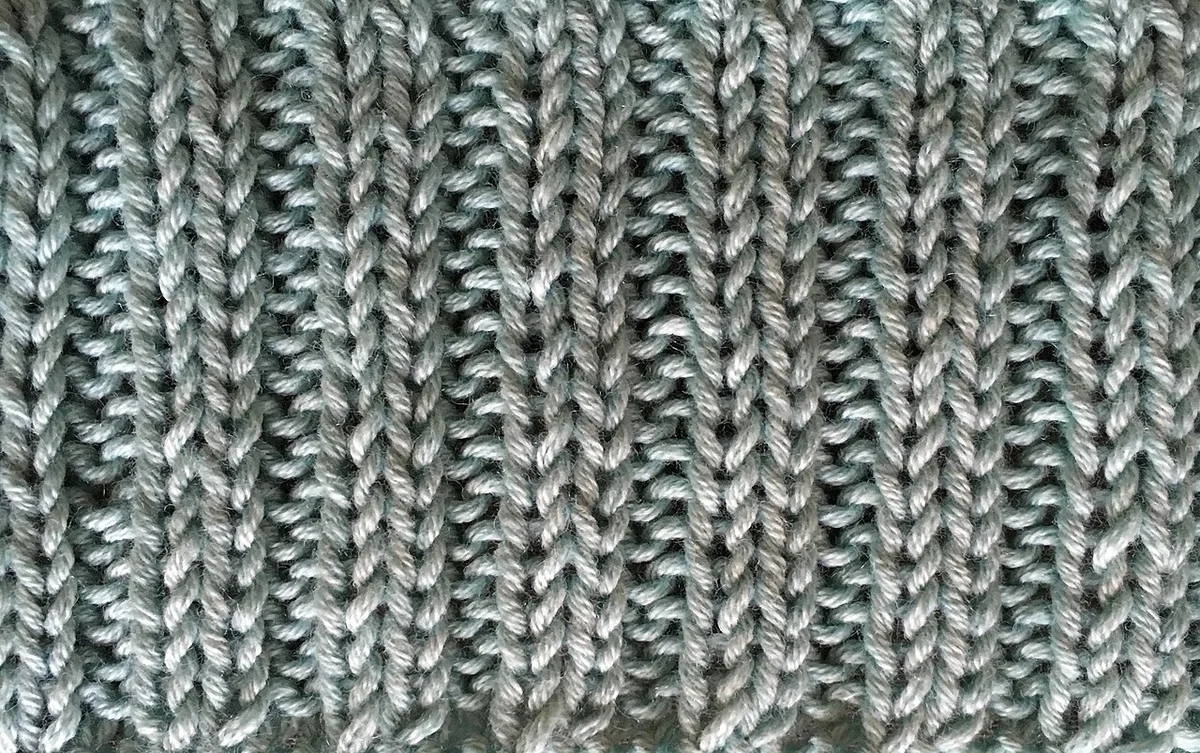
A hand-knitted 2×2 rib swatch—two knit stitches alternating with two purl stitches—shown as a clear structure reference. Photo: Hobbsansak, CC BY-SA 4.0, via Wikimedia Commons. Resized and converted to WebP; no material detail was generated or retouched. The source does not document the fibre composition. This is a hand-knit reference, not an industrial product, WellDoneTex sample, machine-gauge record or bulk-performance result.
Quick answer: what makes a fabric rib knit?
A basic rib knit alternates wales of face loops and back loops within the same course. In industrial circular knitting, two needle beds—the cylinder and dial—make those alternating wales. In the relaxed fabric, some back wales sit behind the face wales; when the fabric is pulled across its width, the structure opens like an accordion and more of the back wales become visible.
This loop arrangement creates the familiar vertical-ridge appearance and useful widthwise extensibility. It does not automatically guarantee strong recovery, a particular fibre percentage, a specific weight, coolness or low shrinkage. Those are separate questions.
CottonWorks classifies basic ribs as double knits because they require two needle beds. It also notes that correctly knitted ribs do not curl like single jersey edges, although they can run or unravel from the last knitted course. These structural tendencies help explain why rib is common in shaped garment edges and close-fitting pieces.
Do rib, ribbed fabric and ribbing mean the same thing?
They overlap, but context matters.
- Rib knit names the knitted construction family.
- Ribbed fabric is common buyer language for fabric with visible ribs. It may refer to true rib knit, but a visual ridge alone does not prove the exact knit structure.
- Ribbing often means either the rib stitch itself or a separate rib-knit trim used at a neckline, cuff or waistband.
- Rib is frequently used as shorthand for both the fabric and the trim component.
This is why an image-only request such as “I need this ribbed material” is not a complete specification. In reader discussions, people may recognise the vertical columns but still be unsure whether a seller’s “8×4” means a stitch repeat, a visual description or another convention. The linked Reddit thread documents that kind of reader naming question only. It is not evidence for textile construction, performance, market demand or search volume, and its comments and images are not a technical standard.
For sourcing, translate the visual request into measurable fields: exact construction name, face/back reference, wale repeat or supplier notation, gauge, fibre content, elastane percentage if any, mass, usable width, colour, finish, stretch direction, recovery or growth method, and care cycle.
What do 1×1 and 2×2 mean in rib knit?
The numbers describe the repeating groups of face and back wales in a basic rib structure; they are not millimetres. In a 1×1 rib, one face wale alternates with one back wale. In a 2×2 rib, two consecutive face wales alternate with two consecutive back wales.
CottonWorks describes 1×1 rib as an alternating cylinder-and-dial sequence in which all needles knit, while its 2×2 definition specifies two consecutive cylinder needles followed by two consecutive dial needles in the repeat. Suppliers may use different notation conventions, so a construction diagram or approved physical swatch should settle any ambiguous label.
| Label | Plain-language repeat | Typical visual reading | What the label does not tell you |
|---|---|---|---|
| 1×1 rib | One face wale, then one back wale | Fine, closely spaced vertical ribs | Fibre, gauge, GSM, elastane level, recovery or shrinkage |
| 2×2 rib | Two face wales, then two back wales | Broader paired ridges and valleys | Fibre, thickness, softness, stretch percentage or end-use suitability |
| Wider or uneven rib | Larger or unequal wale groups | More pronounced or directional rib effect | A universal naming system; confirm the supplier’s notation and sample |
The notation is structural, not a ranking. A 2×2 rib is not inherently better, heavier or more elastic than every 1×1 rib. Yarn size, stitch length, machine gauge, finishing and elastic-fibre content can change the hand and performance.
Is ribbed fabric always cotton?
No. “Rib” describes how loops are arranged; “cotton” describes fibre content. A rib can be made from one fibre or a blend. CottonWorks’ own Fabricast examples include a plated 1×1 rib made with cotton, nylon and spandex and a 2×2 rib made with cotton and spandex. Those examples demonstrate construction independence; they are not WellDoneTex inventory claims.
Composition changes the decision:
- Cotton-rich ribs may be selected for familiar hand and absorbency, but their dimensional behaviour still depends on yarn, structure, wet processing, finishing and care.
- Polyester or nylon can be blended for different strength, drying, surface or cost targets, depending on the exact specification.
- Elastane can be added to increase elastic response, but its presence alone does not define recovery after repeated wear or laundering.
- Wool, viscose and other fibres may be used in sweater or fashion ribs, each with its own care and performance questions.
Never infer a percentage from appearance. Ask for a composition record and, when the claim matters commercially or for labelling, use the agreed verification route.
Why is rib knit stretchy, and does it always recover well?
Basic rib knit has structural extensibility because its alternating face and back wales can unfold sideways. CottonWorks says this accordion-like opening produces greater widthwise extension than single knit structures. That explains why a rib can feel stretchy even when the yarn contains no elastane.
But stretch and recovery are not the same property. Stretch describes extension under a specified force. Recovery describes how closely the fabric returns after the force is removed; retained enlargement is often discussed as growth. ASTM D2594/D2594M-21 treats fabric stretch and fabric growth as separate measurements for low-power knitted fabrics.
Constructional stretch may be enough for a relaxed T-shirt neckband or loose top, but a close-fitting body garment can need better control of growth. CottonWorks notes that stretch yarn is sometimes added to ribs to help the fabric recover its shape. Whether that is sufficient depends on elastane type and percentage, knitting tension, finishing, repeated extension, seam construction and care.
Do not approve recovery by pulling one corner once. Use the agreed specimen direction, dimensions, load or extension, hold time, relaxation time and method, then compare the result with the garment requirement.
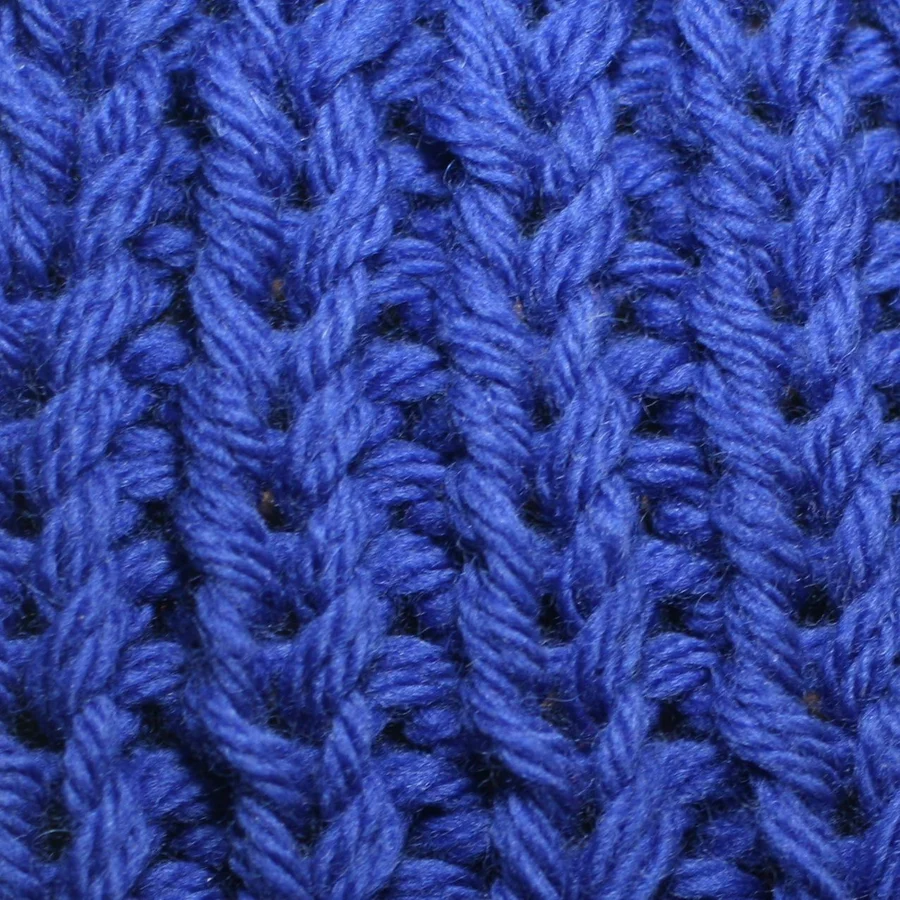
A close view of ribbing used only to show raised columns and recessed channels in a relaxed knit. Photo: Mollie Taylor, CC BY 2.0, via Wikimedia Commons. Resized and converted to WebP; no material feature was generated or retouched. The source does not identify the fibre, exact repeat, production method or industrial gauge. It is not a WellDoneTex product or performance result.
When is rib used for neckbands, cuffs and waistbands?
Rib is useful at garment edges because its widthwise extension can help an opening pass over the head or hand, while its relaxed width can hold the edge closer to the body. CottonWorks lists neck collars, wristbands and waistbands among standard rib applications.
For trim, the decision is not simply “use rib.” Match the trim to the body fabric and garment pattern:
- Confirm the rib can extend enough for the opening without excessive sewing force.
- Check recovery after the intended extension so the edge does not flare or stay enlarged.
- Set the trim-to-body ratio through sample sewing; no universal ratio fits every rib, neckline, seam and body fabric.
- Test seam appearance and seam stretch, especially where a firm rib meets a lighter jersey or fleece.
- Launder the assembled sample using the intended care cycle to detect differential shrinkage, twisting or puckering.
For sweatshirts and fleece garments, rib trim is a component rather than proof of the body fabric. A sweatshirt body may use French terry or fleece while the collar, cuffs and waistband use a separately engineered rib. Buyers comparing those systems can review our French terry fabric supplier page without treating it as evidence for a particular rib SKU.
Can rib knit be used for the whole garment?
Yes. Basic ribs are also used in fitted tops, tanks, dresses, sweaters, loungewear and base-layer styles. A full-garment rib selection generally needs more attention to growth, opacity, cling, seam stability and dimensional change than a narrow trim.
Fine ribs can create a close, flexible silhouette. Heavier or chunkier ribs can provide visual depth and warmth. Wider ribs may read more prominently, while a fine 1×1 can appear more understated. These are tendencies, not guarantees: compare actual relaxed and extended swatches under the intended colour, light and fit.
For a body fabric, approve both appearance and performance after a realistic wear-and-care sequence. If the fabric recovers slowly or retains growth, a fitted garment may bag at elbows, seats or hems even though the first hand stretch felt strong.
Is ribbed fabric good for summer?
It can be, but “ribbed” alone is not enough to decide. Summer comfort depends on the whole fabric-and-garment system: fibre blend, fabric mass, gauge and density, rib depth, finish, colour, fit, layering, air movement and moisture management.
A lightweight, fine-gauge rib in a loose or moderately fitted garment may work well in warm conditions. A dense, heavy, deep rib or tight body fit can feel warmer, regardless of the name. Cotton content does not make every cotton rib equally cool, and elastane does not by itself make a fabric unsuitable for summer.
If air permeability is important, specify and test it with an agreed method such as ASTM D737 or ISO 9237 rather than promising “breathable” from a photograph. If drying or moisture transport matters, define that property separately. Wear trials should use the intended fit and end-use because lab fabric results do not reproduce every wearer or climate.
Rib knit vs jersey vs interlock: which should you choose?
All three are knitted structures, but they solve different problems. Single jersey usually has a smoother technical face and a different-looking back, with edges that tend to curl. Basic rib alternates face and back wales, opens readily across its width and can look similar on both sides. Interlock is formed by interlocking two 1×1 rib structures; CottonWorks describes it as more rigid and stable than basic rib.
| Decision | Single jersey | Basic rib knit | Interlock |
|---|---|---|---|
| Surface | Smooth face; different technical back | Visible lengthwise ribs; often similar face/back appearance | Smooth, similar-looking faces with a subtle structure |
| Edge behaviour | Cut edges tend to curl | Correctly knitted basic rib resists curling | Generally stable and does not curl |
| Widthwise extension | Natural knit stretch, amount varies | Structure opens readily; usually more extensible than comparable jersey | More restrained because the interlocked structure limits wale mobility |
| Common role | T-shirts and everyday body fabric | Neckbands, cuffs, waistbands and fitted or sweater bodies | Stable close-to-body garments and structured knit applications |
| Approval focus | Curl, skew, opacity, growth | Repeat, stretch, recovery, growth, trim ratio | Weight, stability, hand, recovery and bulk |
No row is a universal quality ranking. Yarn, gauge, stitch length, finishing and elastic fibres can reverse a casual expectation. For a deeper construction comparison, see our current Modal Interlock Fabric Guide; its modal-specific statements do not automatically apply to generic rib.
Does rib knit shrink?
Rib knit can change dimensions, but no responsible fixed percentage applies to every rib. CottonWorks identifies fibre, yarn, stitch type, stitch length, wet processing, finishing, cut-and-sew conditions, care and laundering as influential factors in knit dimensional stability. Its technical Q&A also highlights stitch length and finishing width as important controls for cotton 1×1 and 2×2 ribs.
Approve dimensional change on the exact fabric or assembled garment after the agreed conditioning and care cycles. Record length and width separately. For a neckband or waistband, also inspect the seam and compare the trim’s change with the body fabric; two acceptable fabrics can still create puckering if they change differently.
A practical rib-knit approval checklist
Before bulk approval, freeze the fields that control the actual decision:
- Supplier construction name and a diagram or approved swatch for 1×1, 2×2 or another repeat
- Fibre percentages, yarn details and elastane type or percentage where applicable
- Machine gauge, stitch length or other agreed construction control
- Finished mass and usable width with tolerances
- Relaxed and extended appearance, including opacity and rib definition
- Stretch direction and result under the agreed method
- Recovery or growth result after the agreed hold and relaxation time
- Dimensional change after the specified care cycle, measured lengthwise and widthwise
- Colour, finish, hand and shade continuity
- End use: trim or body, target opening, fit, seam type and body-fabric pairing
- Pilot garment result after sewing, wear simulation and laundering
For a first sample request, name the use instead of asking only for “rib fabric.” A useful brief might say: “2×2 rib for a sweatshirt cuff; composition and elastane open for recommendation; match this approved body-fabric colour; submit mass, usable width, stretch/growth method and post-care dimensions.” That still requires sample and specification approval; it is not an order or a claim that WellDoneTex holds a matching stock item.
Frequently asked questions
What is rib knit fabric?
Rib knit is a knitted structure made by alternating face and back wales, creating vertical ridges and useful widthwise extensibility. The name describes construction, not fibre content.
What is the difference between ribbing and rib knit?
Rib knit names the fabric structure. Ribbing can mean the stitch pattern or a separate rib-knit trim used at collars, cuffs and waistbands. In a purchase request, specify which meaning you intend.
What do 1×1 and 2×2 rib mean?
They describe the wale repeat. A 1×1 rib alternates one face wale with one back wale; a 2×2 rib alternates groups of two. The numbers are not millimetres, and supplier notation should be confirmed with a diagram or swatch.
Is ribbed fabric always cotton?
No. Rib describes loop arrangement. The yarn may be cotton, wool, polyester, viscose, nylon or a blend, and it may include elastane. Verify composition separately.
Is ribbed fabric stretchy?
Basic rib usually stretches readily across its width because the alternating wales open like an accordion. The exact extension depends on construction, yarn and finishing, and easy stretch does not guarantee good recovery.
Is rib knit good for summer?
Some lightweight, fine-gauge ribs can suit summer garments, but comfort also depends on fibre, mass, density, finish, fit and moisture behaviour. Test the exact fabric instead of relying on the rib label.
Is rib knit used only for cuffs and neckbands?
No. Rib is common in trims because it can extend and contract around openings, but it is also used for fitted tops, dresses, sweaters, loungewear and other full garments.
References and evidence boundary
- CottonWorks — Single & Double Knits — rib gaiting, 1×1/2×2 structure, widthwise extension, edge behaviour and uses.
- CottonWorks Textile Encyclopedia — 1×1 Rib — concise industrial definition.
- CottonWorks Textile Encyclopedia — 2×2 Rib — concise industrial definition.
- CottonWorks — Shrinkage & Skewing — variables affecting knit dimensional stability.
- CottonWorks — Sourcing the Best Cotton Products Q&A — cotton 1×1/2×2 rib shrinkage-control factors; external guidance, not a product result.
- ASTM D2594/D2594M-21 — separate measurement concepts for stretch and growth in low-power knitted fabrics.
- ISO 9237:1995 — air-permeability test method; cited only as a verification route, not a result.
- Reddit r/sewing terminology discussion — evidence only of a reader’s identification/search-language question; not textile-fact, demand or search-volume evidence. Comments and images are not technical authority and were not copied.
These sources explain general construction and test concepts. They do not prove any unlisted WellDoneTex composition, stock position, certification, MOQ, stretch, recovery, shrinkage, air permeability or end-use result. Exact bulk claims require an approved specification and comparable sample or test evidence.