
Cotton jersey is a knitted fabric made with cotton or a cotton-rich yarn. The word cotton identifies fiber content; jersey identifies the knit construction. Basic jersey uses knit stitches in each course, giving the fabric a smooth technical face with vertical wales and a different-looking technical back with horizontal loop crowns.
That construction can stretch even when the composition contains no spandex. But natural knit stretch is not the same as strong recovery, and “cotton jersey” does not automatically mean 100% cotton. For a T-shirt or other close-to-skin product, buyers should confirm the exact composition, weight, width, stretch and growth, dimensional change after laundering, finish and intended care cycle—not choose from the fabric name alone.
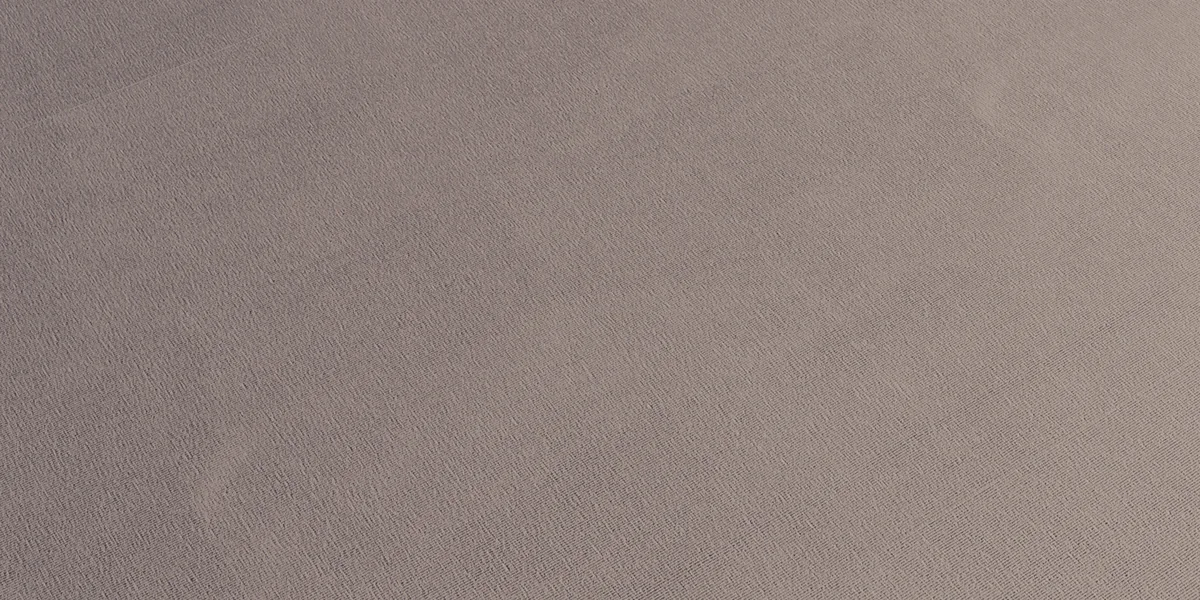
A photographic material scan identified by its source as cotton jersey. It is a surface reference, not a WellDoneTex sample or proof of a particular composition, GSM or finish. Photo: colormass; processing: Rico Cilliers; source and CC0 licence.
Quick Answer: What Is Cotton Jersey?
Jersey is a single-knit structure widely used for T-shirts, underwear and other garments worn close to the body. According to CottonWorks’ single- and double-knit guide, jersey uses knit stitches across each course. Its technical face shows columns of wales, while its technical back shows rows of loop crowns.
Cotton jersey is therefore not a separate cotton species. It is jersey fabric in which cotton is all or part of the declared fiber content. A product may be 100% cotton jersey, cotton-elastane jersey or a cotton-polyester jersey blend. Each is still jersey if it uses the jersey knit construction, but each can behave differently in stretch, recovery, drying, dimensional stability and handfeel.
The Cotton Incorporated consumer fabric guide describes cotton jersey as soft and naturally elastic because of the way it is knitted. That is a useful starting point, but a sourcing decision still needs the actual material specification and sample evidence.
How Can You Recognize Jersey Knit?
A basic single jersey normally has two visibly different sides:
- Technical face: vertical columns of knit loops, often described as a series of small “V” shapes when viewed closely.
- Technical back: horizontal rows of loop crowns or curved arcs.
- Cut-edge behavior: an unfinished single jersey edge can curl, and the direction of curl may differ at the lengthwise and crosswise edges.
- Directional stretch: jersey usually extends more across the width than along the length, although yarn, stitch length, finishing and added elastic fiber can change the result.
These checks identify construction, not fiber. A visual loop pattern cannot prove whether the yarn is cotton, polyester, viscose or a blend. Fiber content should come from the specification, label or a suitable material analysis rather than appearance alone.
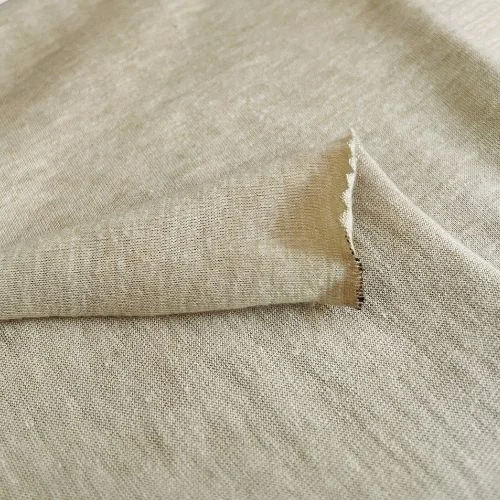
The source documents this actual swatch as 65% polyester and 35% cotton single jersey. It is included specifically to show that a jersey construction can use a blend; it is not presented as 100% cotton or as a WellDoneTex product. Photo: Hasan Mahedi; source and CC BY-SA 4.0 licence. This converted WebP derivative is offered under the same CC BY-SA 4.0 licence.
Is Cotton Jersey Always 100% Cotton?
No. “Cotton jersey” may refer to a 100% cotton fabric or to a jersey in which cotton is blended with another fiber. The exact percentage matters. A buyer should not infer composition from a listing title, handfeel or photograph.
| Jersey version | What it is | Why it may be chosen | What can still vary |
|---|---|---|---|
| 100% cotton jersey | Cotton is the declared fiber; jersey is the knit | Cotton handfeel and a familiar T-shirt surface | GSM, stitch density, residual shrinkage, stretch, growth, skew, finish and care |
| Cotton-elastane jersey | Cotton is blended with an elastic fiber | More engineered stretch and recovery for closer fits | Exact blend, stretch by direction, force, recovery/growth, heat sensitivity and dimensional change |
| Cotton-polyester jersey | Cotton and polyester share the jersey structure | A different balance of handfeel, drying, stability, appearance or cost | Exact blend, pilling, stretch/growth, shrinkage, color behavior and care |
These are development directions, not guaranteed rankings. A cotton-elastane jersey is not automatically better than 100% cotton jersey, and a cotton-polyester jersey is not automatically more stable. Yarn type, knit settings, wet processing, finishing and garment construction can outweigh a simple blend label.
Why Does Cotton Jersey Stretch Without Spandex?
The stretch comes first from the looped knit structure. Under a pulling force, the loops can change shape and redistribute yarn, especially across the fabric width. That is different from stretching an elastic fiber itself. The Cotton Incorporated jersey guide specifically notes that jersey has natural elasticity because of how it is knitted, even without elastane.
Natural structural extension can be enough for a relaxed T-shirt, sleepwear or loose base layer. A close-fitting garment, fitted neck opening or performance style may need a more controlled stretch-and-recovery profile. Adding elastane is one possible route, but its percentage alone does not define the result; yarn placement, stitch density, finishing and garment pattern also matter.
Stretch is not the same as recovery
Stretch asks how far a fabric extends under a defined load. Growth asks how much unwanted extension remains after that load is removed. Recovery describes the fabric’s movement back toward its original dimensions.
A fabric may feel easy to stretch by hand yet remain baggy at elbows, necklines or seat areas after wear. Another fabric may offer less extension but return more consistently. ASTM D2594/D2594M treats fabric stretch and fabric growth as separate measurements for low-power knitted fabrics. Use a method suitable for the end use and compare results only when specimen direction, load, extension time, recovery time and laboratory conditions are aligned.
For a sourcing brief, specify both the movement required and the acceptable residual growth. “Stretchy” by itself is not a complete acceptance criterion.
Does Cotton Jersey Shrink?
It can. There is no responsible universal shrinkage percentage for every cotton jersey. Dimensional change depends on fiber, yarn size and type, stitch construction, stitch length or density, wet-processing tensions, relaxation, compaction or other finishing, cut-and-sew steps, and the washing and drying procedure.
CottonWorks’ shrinkage and skewing resource explains that yarn is bent into loops during knitting and that fabric openness and stored processing stresses affect dimensional change when those stresses are released. It also lists fiber, yarn, construction, wet processing, finishing, apparel manufacturing and care as connected variables. This is why two fabrics described as “100% cotton jersey” can return different results.
For consumers, the direct answer is to follow the finished product’s care label. Do not assume that hot washing or high-heat drying is safe from the word “cotton” alone. Product developers should confirm the exact sample and care cycle; the detailed approval checklist appears later in this guide.
Is Cotton Jersey Good for Summer and T-Shirts?
Cotton jersey is a common T-shirt construction, and it can work well for warm-weather garments. However, “cotton” and “jersey” do not by themselves prove that a fabric will feel cool in every climate or garment.
For a summer T-shirt, review these variables together:
- Fabric mass and thickness: a lighter jersey may feel less bulky, while a heavier jersey may provide more coverage and structure.
- Stitch density and openness: these affect coverage, stability and air movement.
- Fit and pattern: a close fit reduces the air space around the body, while a relaxed fit changes how the garment ventilates.
- Color and finish: dye and finishing choices can change surface feel and thermal experience.
- Moisture and drying expectations: cotton-rich and blended versions can behave differently, so test the actual fabric instead of relying on a generic fiber comparison.
- Stretch and growth: a lightweight fabric still needs enough stability for the neckline, shoulder and hem design.
If air movement is a critical product requirement, request air-permeability evidence for the exact construction rather than publishing a broad “breathable” claim. If opacity is critical, review it at the intended color, stretch level and garment layer—not only on an unstretched swatch.
Cotton Jersey vs. Interlock: When Should You Compare Them?
Jersey and interlock are both knitted fabrics, but their constructions are different. Basic jersey is a single knit with distinct technical face and back. Interlock is a double-knit construction formed by interlocking two 1×1 rib structures; it normally has a more similar appearance on both sides and greater structural stability.
| Decision point | Basic single jersey | Interlock | Buyer check |
|---|---|---|---|
| Surface | Technical face and back look different | Face and back look more alike | Inspect both sides, not only the selling face |
| Edge behavior | Cut edges can curl | Typically lies flatter and curls less | Cut-panel trial and sewing test |
| Weight and structure | Often chosen where a lighter, familiar T-shirt drape is wanted | Often chosen where a fuller, more stable knit is wanted | Match GSM, yarn and finish before comparing |
| Natural extension | Generally more across width than length | Stretch and recovery depend on the exact interlock construction | Directional stretch/growth test |
| Typical decision | Tees, underwear, relaxed close-to-body garments | More structured close-to-body garments, dresses, layers or stable panels | Garment fit, opacity, seam and care trials |
This table is a construction guide, not a claim that every interlock is heavier, better or less breathable than every jersey. Compare like-for-like composition, weight and finish. For a current application-focused example, see the WellDoneTex modal interlock guide; its modal construction is not proof of a cotton jersey specification.
A Practical Cotton Jersey Sample Checklist
For a reliable dimensional-change check:
- Define the specimen: fabric only, washed fabric, or finished garment.
- Define the laundering and drying sequence that matches the intended care label and market.
- Measure length and width before and after the agreed number of cycles.
- Report lengthwise and widthwise change separately, including any growth rather than describing every change as shrinkage.
- Check skew or garment twist where side-seam appearance matters.
- Confirm that bulk fabric uses the same yarn, construction, dyeing and finishing route as the approved sample.
ISO 5077:2007 describes determination of dimensional change after an appropriate combination of specified washing and drying procedures. The method name is not a result: an actual report must identify the specimen, procedure, cycles and measured values.
Before approving a fabric or garment sample, also record:
- exact fiber composition and tolerance;
- knit construction, yarn count or specification, gauge or stitch-density information where available;
- finished GSM and usable width;
- technical face and back reference photos;
- stretch and growth by direction under an agreed method;
- dimensional change and skew after the defined care cycles;
- pilling, bursting strength, colorfastness or other tests required by the end use;
- handfeel, drape, opacity and surface appearance in the intended color;
- garment sewing behavior, including edge curl, seam appearance, neckline recovery and hem performance;
- exact care instruction supported by the approved fabric and finished-garment evidence.
The purpose of this checklist is to replace an ambiguous request such as “soft cotton jersey” with a comparable specification. It does not imply that every listed test is necessary for every program.
FAQ
What is cotton jersey fabric?
Cotton jersey is a jersey-knit fabric made with cotton or a cotton-rich yarn. Cotton identifies the fiber content; jersey identifies the knit construction.
Is cotton jersey the same as 100% cotton?
Not necessarily. Some cotton jersey is 100% cotton, while other versions blend cotton with elastane, polyester or another fiber. Read the exact composition rather than treating the name as a percentage.
Is cotton jersey stretchy without spandex?
Yes, a basic jersey structure can extend because its yarns form flexible knit loops. The amount of stretch and how well the fabric returns depend on the exact construction, yarn and finish.
Are stretch and recovery the same?
No. Stretch is extension under a defined force. Recovery is the movement back after the force is removed; residual extension is often evaluated as growth. A hand-pull test does not replace agreed measurements.
Does cotton jersey shrink?
It can, but there is no single percentage for all cotton jersey. Fiber, yarn, stitch settings, processing tension, finishing, garment construction and the wash/dry procedure all affect dimensional change. Ask for results from the exact sample and care cycle.
Is cotton jersey good for summer T-shirts?
It can be, especially when the weight, density, fit and finish suit warm-weather use. A dense or heavy jersey can feel different from a light one, so approve the exact fabric and garment rather than relying on the name alone.
When should I choose interlock instead of jersey?
Compare interlock when you need a fuller, more stable knit with similar-looking faces and less edge curl. Choose from matched samples because composition, GSM and finish can change the result.
References
- Cotton Incorporated, What is jersey knit?
- CottonWorks, Single & Double Knits
- CottonWorks, Shrinkage & Skewing
- ASTM International, ASTM D2594/D2594M-21: Stretch Properties of Knitted Fabrics Having Low Power
- ISO, ISO 5077:2007: Determination of dimensional change in washing and drying
- WellDoneTex, Modal Interlock Fabric Guide
- Wikimedia Commons, Cotton Jersey material scan by colormass and Rico Cilliers
- Wikimedia Commons, 65% polyester / 35% cotton single jersey photograph by Hasan Mahedi


.webp)
