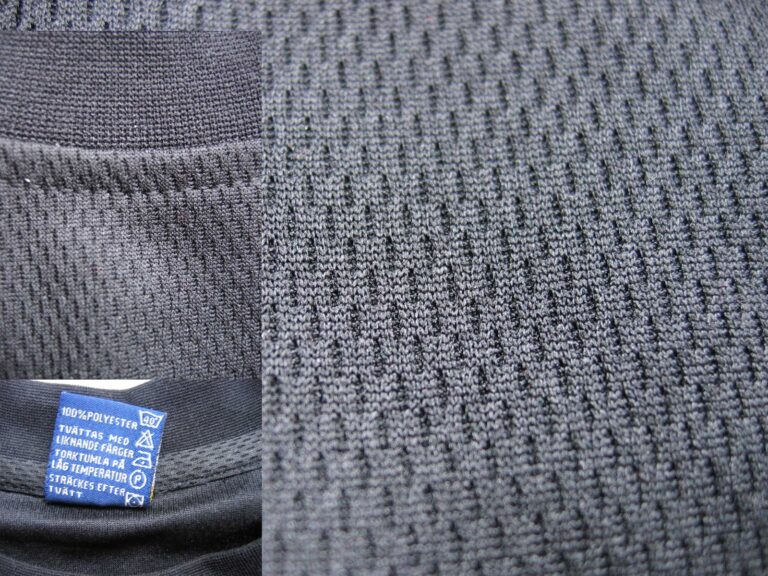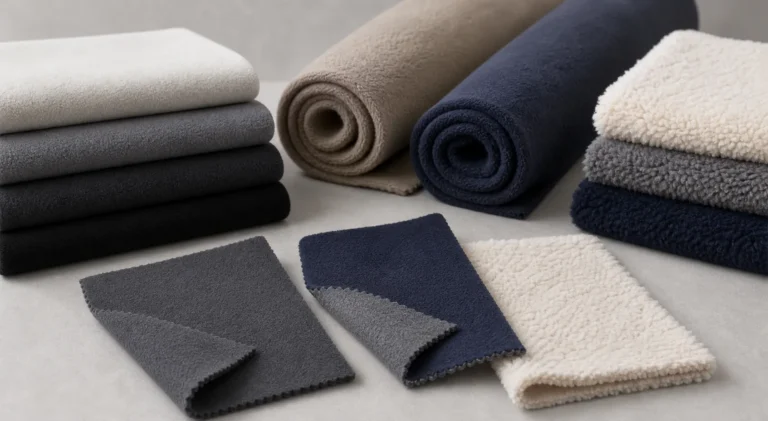
A polyester garment may feel rigid, gently flexible or highly elastic. All three can be genuine polyester products. The label names the fibres, but it does not tell you the fabric construction, direction of movement, force needed to stretch it or how well it returns after being pulled.
The short answer is: polyester can be part of a stretchy fabric, but “polyester” alone is not a stretch rating. A 100% polyester knit may gain useful movement from its loops or engineered yarns. A stable woven polyester may move very little. Adding spandex or elastane can increase elastic stretch and recovery, but the percentage still cannot predict the finished garment by itself.
Quick answers
| Question | Practical answer |
|---|---|
| Is polyester stretchy? | Sometimes. Check the finished fabric, not only the fibre name. |
| Can 100% polyester stretch? | Yes, some 100% polyester fabrics move through knit loops, yarn texture, crimp or engineered construction. Others are intentionally stable. |
| Is polyester-spandex stretchy? | It is normally designed for stretch, but actual extension, direction, force and recovery depend on how the blend is built and finished. |
| Does stretch mean recovery? | No. Stretch is extension under force; recovery is how the material returns after the force is removed. |
| Should you size up or down? | Do not decide from “polyester” alone. Use the garment measurements, intended ease, construction and a return test. |
What does “stretchy” mean?
In everyday shopping, “stretchy” may describe several different things:
- a fabric extends when gently pulled;
- a garment accommodates body movement;
- a close-fitting item applies support;
- the material returns quickly after being released; or
- a garment keeps its shape after repeated wear.
Those are related, but they are not interchangeable. A fabric can extend easily yet remain enlarged or distorted afterward. Another fabric may resist the first pull, extend under a higher force and recover well. Direction matters too: movement across the width does not prove equal movement along the length or on the diagonal.
ISO 20932-1 uses strip tests to measure fabric elasticity and related properties. ISO 20932-2 covers surface deformation through multiaxial tests and defines elasticity as the ability to recover original size and shape immediately after the deforming force is removed. This is why a useful specification should separate extension, force, direction, growth and recovery instead of reporting only “stretchy.”
Does polyester fibre itself make a fabric stretchy?
Not by itself. Fibre content is only one design layer. Yarns can be continuous filament or staple spun, flat or textured, tightly or loosely packed. Those yarns can then be knitted into loops, woven through warp and weft, or combined with an elastic component. Dyeing, heat setting, brushing, coating and other finishing steps can change the final response.
The US FTC textile-label guidance treats polyester and spandex as distinct generic fibre names and requires covered products to state constituent fibre percentages. That makes a label useful for identifying composition. It does not turn the percentage line into a test report for extension or recovery.
Think of the label as the ingredient list, not the movement result. Two garments can both say “100% polyester” while using different yarns, structures, weights and finishes. They should not be assumed to stretch alike.
How can 100% polyester stretch?
Knit loops can open and change shape
Knitted fabrics are made from intermeshing yarn loops. When the fabric is pulled, those loops can change shape and orientation, allowing movement even when the yarn contains no spandex. Cotton Incorporated’s Knit Basics explains that knitted loops provide flexibility and that many weft knits show more horizontal stretch.
This does not mean every polyester knit is highly elastic. Stitch type, loop length, gauge, yarn size, density, finishing and the direction of pull all matter. A compact double knit may feel much firmer than a light jersey. A warp knit may behave differently across length and width from a weft knit.
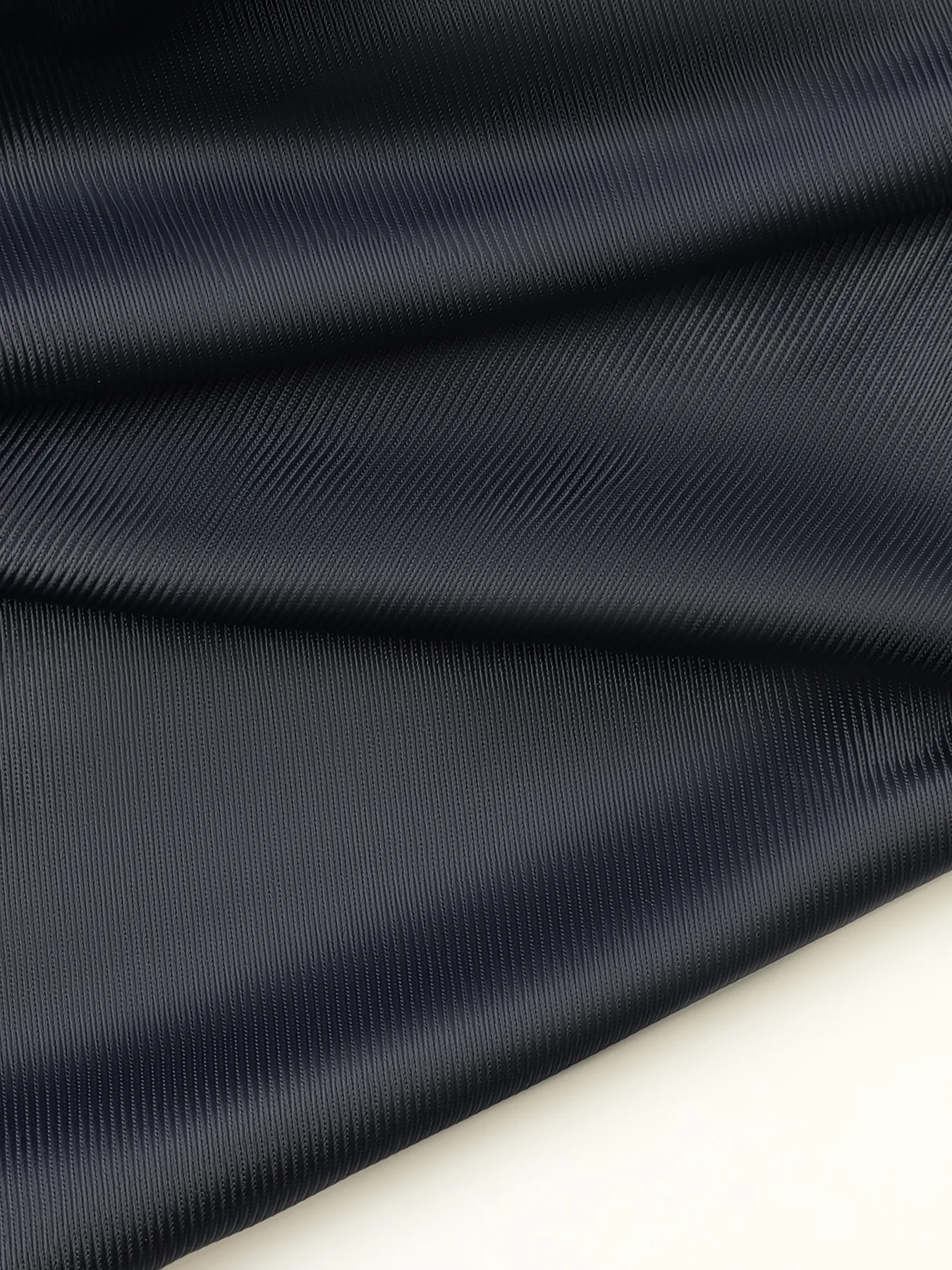
A real WellDoneTex tricot sample photographed for the product-media library. The visible surface illustrates that “polyester fabric” can have a specific knit geometry. The photo is not a composition certificate or stretch-and-recovery result. See the separate Tricot Fabric Guide for construction-specific detail.
Woven construction can provide limited mechanical movement
Woven fabric is formed by interlacing warp and weft yarns, as described in Cotton Incorporated’s Weaving Basics. Conventional tightly constructed wovens are often more stable than knits, but “woven” does not mean absolutely immovable.
Movement can come from yarn crimp, weave geometry, textured yarns, bias direction or an engineered mechanical-stretch process. Cotton Incorporated documents a woven mechanical-stretch construction made without synthetic elastic fibre; that example is cotton-specific, but it demonstrates the broader point that fabric geometry can produce movement without spandex. It does not establish a stretch percentage for polyester.
“Mechanical stretch” therefore needs a specimen and method, not a universal number. Ask which direction was tested, what load or extension was used, how long the specimen was held and what happened after release.
Textured or engineered polyester yarns can change the response
Polyester yarns can be engineered into non-straight configurations or combined in structures intended to open under force. That may provide movement without a separate spandex percentage. The result still belongs to the finished yarn-and-fabric system. A buyer should not transfer a result from one textured yarn, knit or finish to every 100% polyester fabric.
The practical conclusion is narrow: 100% polyester does not mean zero stretch, and it does not promise useful elastic recovery. Both require inspection or test evidence from the exact material.
Knit polyester versus woven polyester
| Construction | Where movement may come from | What to verify |
|---|---|---|
| Weft knit | Loop deformation, stitch design, textured yarn or added elastane | Width and length extension, force, edge curl, growth and recovery |
| Warp knit | Loop geometry, lapping pattern, yarn system and optional elastane | Directional difference, power, recovery and surface stability |
| Conventional woven | Yarn crimp, weave geometry and some bias movement | Warp versus weft, bias movement, seam stress and residual growth |
| Stretch woven | Stretch yarn, elastane, engineered construction or finish | Exact fibre content, tested direction, load, recovery and care state |
This table is a screening guide, not a ranking. Construction names still cover many variants. For example, a tricot lining, compression warp knit, polyester jersey and structured scuba knit can all be knitted yet serve different movement goals.
What changes when spandex or elastane is added?
Spandex—also called elastane in ISO terminology—is used when designers want elastic extension and recovery beyond what a stable base construction would normally provide. The FTC allows a small amount of spandex to be identified by name when it has functional significance, using elasticity as its own example in its labeling guidance.
In a polyester-spandex fabric, the polyester portion can provide much of the surface, colour, strength or handling character, while the elastic yarn contributes to movement and return. How that yarn is inserted matters. It may be plated into a knit, fed into selected courses, covered by another yarn or used mainly in one woven direction.
That is why 5% spandex is not a universal performance recipe. Two 95/5 fabrics can differ because of:
- knit versus woven construction;
- how the elastic yarn is distributed;
- yarn count, gauge and density;
- weight and thickness;
- widthwise versus lengthwise design;
- heat setting and other finishing;
- the force used during measurement; and
- fabric condition before and after laundering.
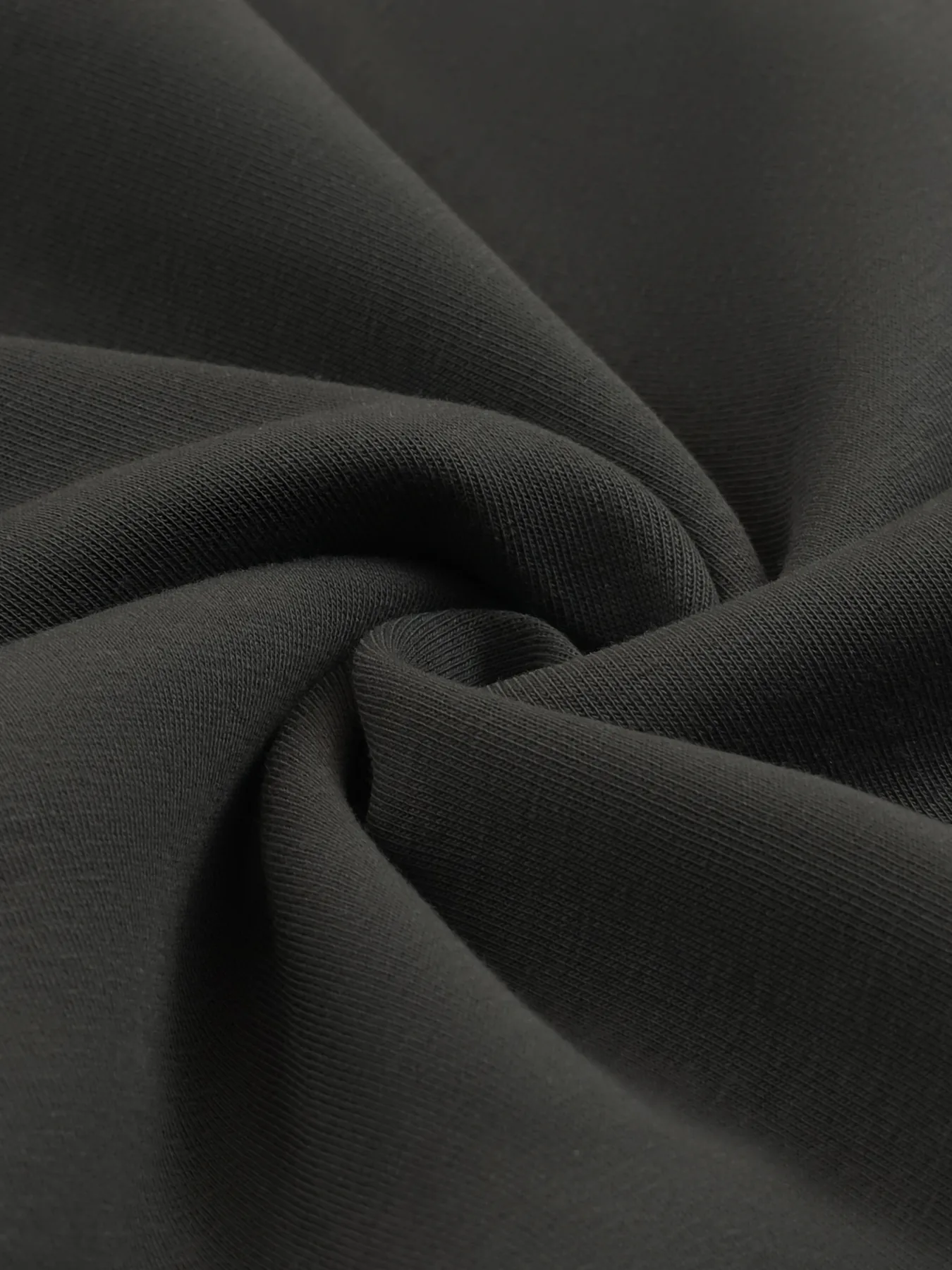
A real WellDoneTex scuba construction sample from the project media library. It shows a thicker knit presentation, not a universal scuba composition or a measured stretch claim. Compare actual construction and test data rather than judging recovery from a photograph.
Stretch and recovery are different
Stretch describes how far a material extends under stated conditions. Recovery describes how it returns after the force is removed. Growth or residual deformation describes the change that remains after loading and a stated recovery period.
A wearer can notice the difference at knees, elbows, waistbands and seat areas. A material may feel generous during movement but form a temporary bag after prolonged sitting. Another may extend less but return more completely. Neither behaviour can be summarized by fibre content alone.
ASTM keeps the properties separate. ASTM D2594/D2594M-21 addresses stretch and growth in knitted fabrics having low-power stretch. ASTM D3107-26 addresses stretch, growth and recovery for fabrics woven from stretch yarns. The standards use defined procedures; a casual hand pull is useful for comparison, but it is not an equivalent test report.
What do two-way and four-way stretch mean?
Retail labels often use “two-way” and “four-way” as directional shorthand. The language is not enough on its own because sellers may count directions differently. One may call widthwise movement “two-way” because the fabric moves left and right; another may reserve “four-way” for meaningful movement in both length and width.
Ask for the actual directions:
- stretch across the fabric width;
- stretch along the fabric length; and
- any relevant diagonal or multiaxial result.
Also ask whether the claim describes easy hand movement, a specified extension under load or a complete stretch-and-recovery test. ISO 20932-2 warns that results from its two multiaxial methods cannot be compared directly; the chosen method should be agreed and stated. A direction label without method details is therefore only a first screen.
Should you size up or down with polyester?
There is no reliable polyester-only sizing rule. Use four checks instead:
- Read the exact garment measurements. Compare chest, waist, hip, rise, inseam or length with a similar garment that fits—not only with a body-size label.
- Identify intended ease. Compression leggings, a fitted base layer, a regular T-shirt and a structured woven jacket are designed with different amounts of space.
- Check construction and lining. A stretchy outer knit can still feel restrictive if the lining, seam, waistband, print or bonded panel moves less.
- Check recovery and return policy. If the garment stays enlarged after a gentle pull, sizing down may create distortion rather than a better fit. If it is firm and stable, sizing down may simply restrict movement.
Online, use the brand’s current size chart and product measurements. In person, move through the positions relevant to the garment: sit, reach, bend or raise the arms without forcing the item. Do not use a fibre name as a medical, compression or universal-fit recommendation.
Does polyester fit tight or loose?
Either. Fit comes from the pattern, measurements, ease, fabric construction, seams and elastic components. Polyester describes fibre content, not the cut of the garment.
A loose polyester shell and a compression polyester-spandex legging can use the same dominant fibre while fitting very differently. Even two items marked the same size can differ in finished measurements. The useful evidence is the size chart plus the actual garment specification, not the word “polyester.”
Is 95% polyester and 5% spandex stretchy?
It is reasonable to expect that this blend was designed to provide elastic movement, because the label confirms an elastic fibre is present. But 95/5 does not tell you how much the fabric stretches, in which direction, how much force it needs or how well it recovers.
Check whether it is knit or woven, whether the stretch works across width and length, and whether the fabric returns after being held. For sourcing or product claims, request results on the exact finished material. Do not borrow a percentage from another supplier’s 95/5 fabric.
What does 100% polyester feel like?
There is no single polyester handfeel. It can feel smooth, crisp, brushed, soft, slick, textured, dense, light or structured. Filament or staple yarn, yarn size and texture, knit or weave, weight, brushing, coating and other finishing choices all influence the surface and drape. Cotton Incorporated’s overview of mechanical finishing shows how processes such as sueding can make knit or woven surfaces feel softer and more textured.
The label can confirm 100% polyester, but it cannot tell you whether the garment will feel like tricot lining, fleece, mesh, satin or a structured double knit. Use a swatch, close view and intended-use sample. If heat, sweat or airflow is the real concern, the existing Moisture-Wicking Fabric Guide explains why liquid transport is a separate property from stretch.
A practical stretch check before buying or approving fabric
For a quick comparison—not a laboratory claim—use the same routine on each sample:
- Mark the fabric length and width directions.
- Hold an equal-width section without stretching the edge alone.
- Pull gently across the width, then along the length.
- Note how much force is needed and whether movement is smooth.
- Hold briefly, release, and look for residual growth or rippling.
- Repeat only if the sample can be handled without damage.
- Inspect seams, prints, laminations and lining separately.
This can reveal useful differences, but it does not create a publishable percentage. Hand force, specimen size, holding time and judgement vary. When a specification or claim matters, agree on the method, conditioning, specimen direction, load or extension, number of cycles, recovery time, units and acceptable result.
What should a buyer ask a supplier?
- Is the fabric knit or woven, and what is the construction?
- What is the exact fibre content, including elastane or spandex?
- Which directions are designed to move?
- Is the result mechanical stretch, elastic-yarn stretch or both?
- Which method was used for extension, growth and recovery?
- What load or fixed extension, hold time, cycles and recovery time were used?
- Was the specimen greige, finished, prewashed or tested after care?
- Are the report and sample linked to the same article, colour, finish and production lot?
- Does the complete garment include a less-stretchy lining, print, seam or bonded zone?
If the application is sport mesh, the Sport Mesh Fabric Guide explains why open structure, airflow and stretch must still be evaluated separately. For technical claims more generally, use the Technical Fabrics Guide to match each claim to its evidence.
Frequently asked questions
Should you size up or down with polyester?
Neither automatically. Compare garment measurements, intended ease, construction, lining and return after stretch. Polyester content alone cannot determine size.
Does polyester fit tight or loose?
It can fit either way. The pattern, finished measurements, ease and fabric structure determine fit; polyester only identifies the fibre category.
Is 95% polyester 5% spandex stretchy?
It is usually designed for elastic movement, but the blend ratio does not specify extension, direction, force or recovery. Verify the exact finished fabric.
What does 100% polyester feel like?
It can feel smooth, crisp, soft, brushed, slick, light or structured depending on yarn, construction, weight and finish. The fibre percentage does not define one handfeel.
Bottom line
Polyester is not automatically rigid and it is not automatically elastic. A 100% polyester knit can move through its loop structure or engineered yarns, while a stable woven version may move very little. Spandex can add elastic extension and recovery, but even a 95/5 label is not a test result.
Choose by the finished fabric and garment: construction, direction, force, extension, growth, recovery, fit and care state. When performance matters, ask for claim-matched evidence from the exact material instead of relying on a fibre slogan or a universal percentage.
References
- ISO, ISO 20932-1:2018 — Determination of the elasticity of fabrics, Part 1: Strip tests, confirmed current in 2024.
- ISO, ISO 20932-2:2018 — Determination of the elasticity of fabrics, Part 2: Multiaxial tests, confirmed current in 2024.
- ASTM International, ASTM D2594/D2594M-21 — Stretch Properties of Knitted Fabrics Having Low Power.
- ASTM International, ASTM D3107-26 — Stretch Properties of Fabrics Woven from Stretch Yarns.
- Federal Trade Commission, Threading Your Way Through the Labeling Requirements Under the Textile and Wool Acts.
- Cotton Incorporated, Knit Basics.
- Cotton Incorporated, Weaving Basics.
- Cotton Incorporated, NATURAL STRETCH Technology, cited only as a construction-specific example of mechanical stretch without spandex.
- Cotton Incorporated, Mechanical Finishing.