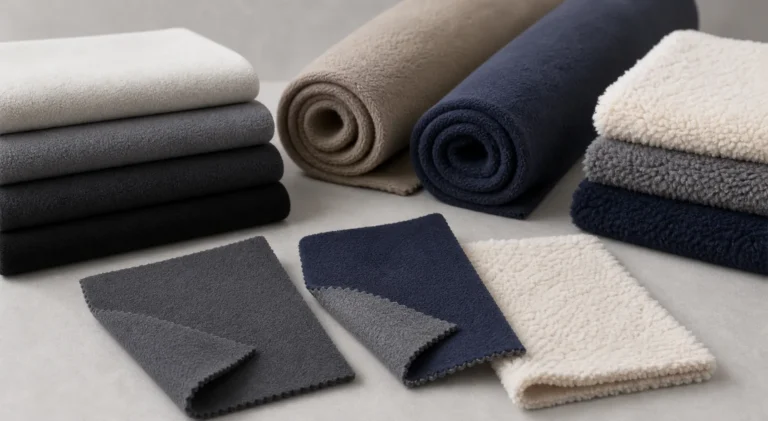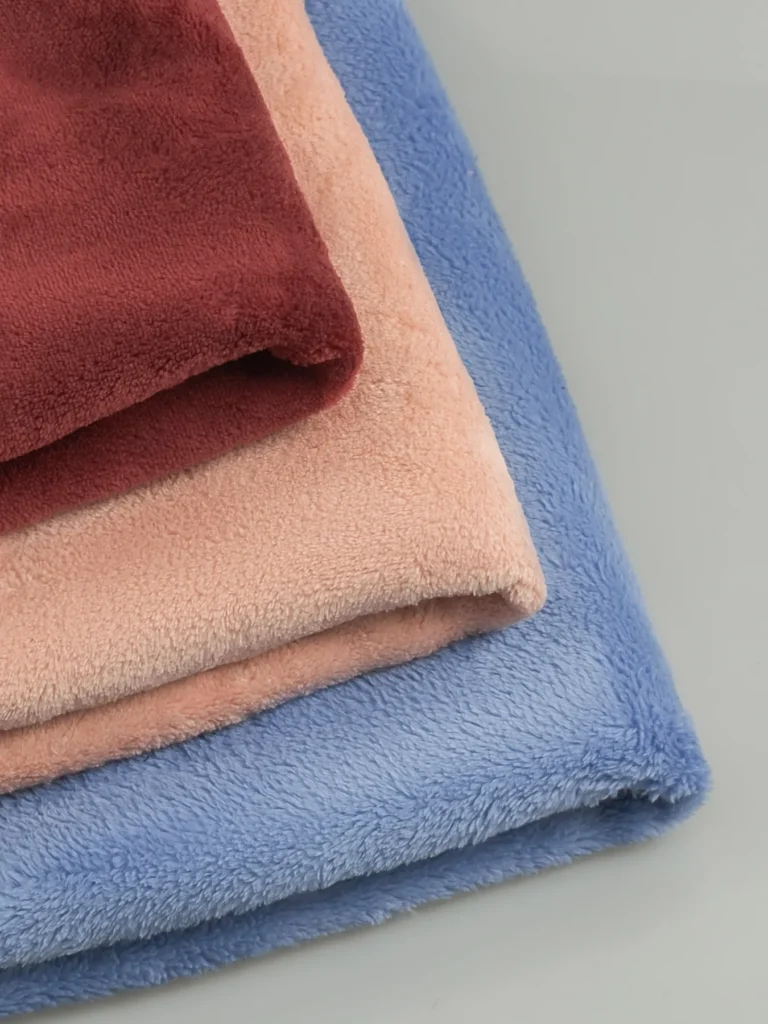
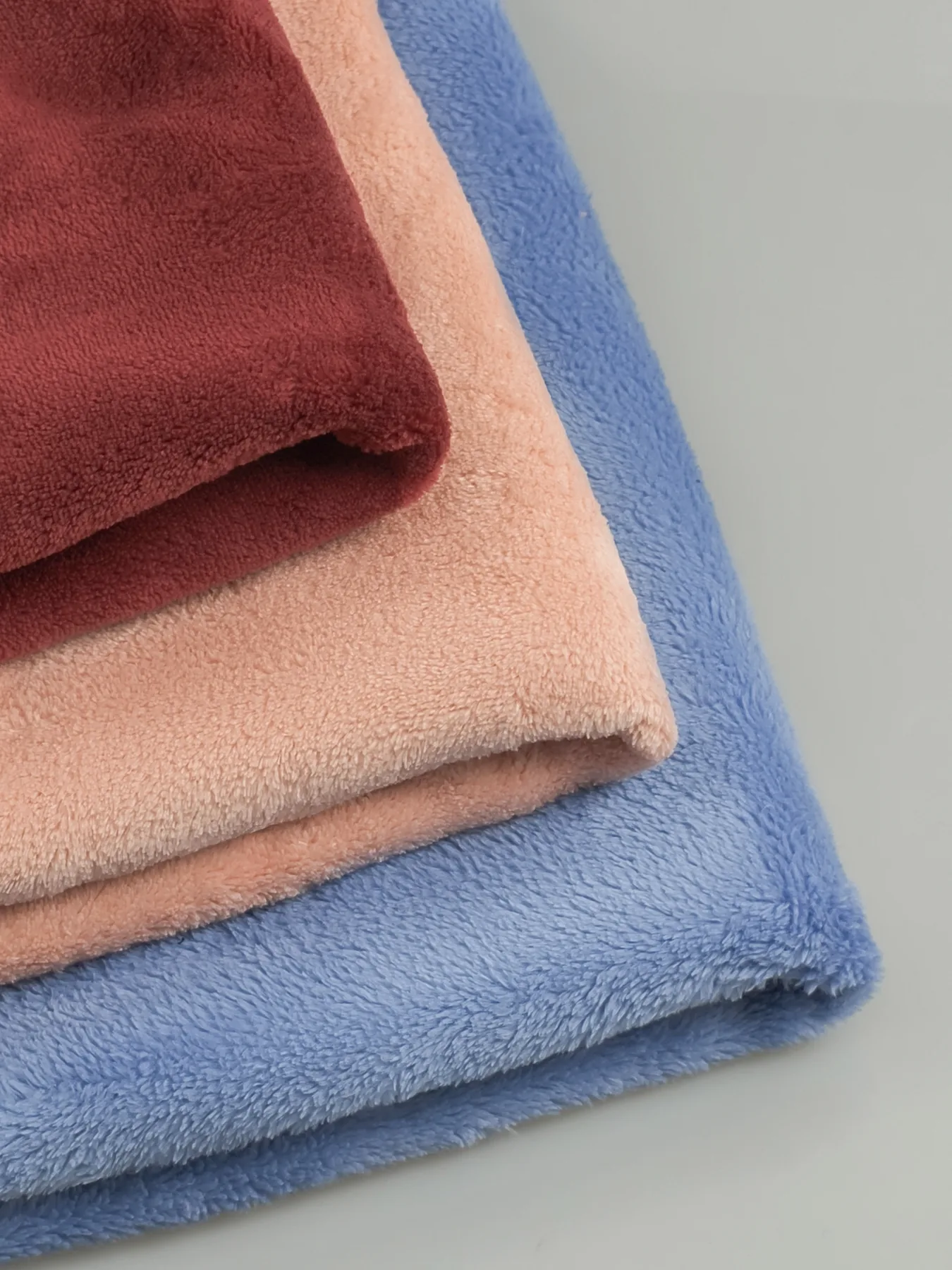
Image note: the featured coral fleece fabric is an illustration from our fabric range, not a shrinkage test specimen, test report or evidence of a measured result.
A knit fabric shrinkage test report is useful for bulk approval only when the tested sample, laundering procedure and acceptance requirement match the order. Read the length and width results separately, confirm the number of wash-and-dry cycles, and record what the report allows your team to approve.
For a sourcing team preparing a Bangladesh garment program, a headline such as “shrinkage passed” leaves too much unanswered. The buyer needs to know which fabric was tested, under which conditions, and whether the result supports the next production decision. This guide is a procurement checklist, not a laboratory test procedure.
1. Match the report to the fabric you intend to buy
Start with traceability before reading the percentage. Ask for the report number and date, laboratory identity, sample reference and the supplier’s link between that sample and your purchase specification. Record composition, knit construction, finished GSM, width, finish and color or lot reference where relevant.
A development swatch can help select a construction. It does not automatically represent every later bulk lot. Ask whether the tested material was unfinished, development-finished or taken from the finished production lot. If the finishing route or construction changes, have the responsible technical team decide whether the existing evidence still applies.
Use the fabric specification checklist to establish the order reference. Keep a retained, identifiable sample with the report so merchandising, quality and cutting teams discuss the same material.
2. Read the method and the selected conditions
The method number alone is not a complete comparison. AATCC TM135 addresses length and width changes in fabrics after home laundering. Its public scope includes different washing and drying options. Ask for the edition and the procedure actually used.
For an ISO-based report, distinguish three roles:
- ISO 3759 addresses specimen preparation, marking and measurement.
- ISO 6330 supplies domestic washing and drying procedures for textile testing.
- ISO 5077 addresses determination of dimensional change after specified washing and drying.
Ask the laboratory to identify the applicable method combination and editions. A statement that a sample was washed using ISO 6330 does not, on its own, establish that it meets your dimensional-change limit.
Compare the selected wash procedure, machine type, temperature, drying procedure, number of cycles and any reported deviations. Where needed, ask the laboratory to clarify detergent, ballast and conditioning details under the applicable method. ISO 6330’s public scope specifically notes that machine, detergent and dryer parameters can affect results.
Do not rank two suppliers by percentages obtained under different procedures without technical review. Do not assume an AATCC result and an ISO result are directly interchangeable. Agree a common test basis or document why the available evidence is suitable for the decision.
3. Keep length, width and sign conventions visible
Request separate results for the length and width directions, with those directions identified on the sample. Avoid reducing both to one “shrinkage” number. One direction may shrink while another extends.
For a simple signed dimensional-change calculation:
Dimensional change (%) = (measurement after treatment − measurement before treatment) ÷ measurement before treatment × 100
Illustrative arithmetic only: if a marked distance changes from 500 mm to 485 mm, the result is (485 − 500) ÷ 500 × 100 = −3.0%. Under this convention, the negative sign indicates shrinkage. A change from 500 mm to 505 mm is +1.0%, indicating extension.
These are hypothetical numbers, not WellDoneTex test results or acceptance limits. Some reports present shrinkage as a positive magnitude instead. Read the report’s definitions before entering a value into a comparison sheet. Ask how individual readings, averages and rounding were handled under the stated method; this example does not replace the method’s specimen or reporting requirements.
4. Agree acceptance limits before interpreting “pass”
The buyer’s specification should identify the required test basis and acceptance criteria for each direction and required cycle endpoint. Avoid adding a universal percentage because a fabric is called cotton jersey, fleece or polyester knit. The relevant requirement depends on the product and the agreed evaluation.
If a report says “pass,” locate the requirement used to reach that conclusion. Confirm that it is the version accepted for your order. If it reports only measurements, ask the responsible buyer or quality reviewer to document the acceptance decision separately.
For a result near an agreed limit, request clarification of rounding, any applicable decision rule and measurement uncertainty where relevant. Do not change the limit after seeing an unfavorable result. Record any approved specification revision and its scope.
5. Separate fabric evidence from garment approval
A fabric report answers a fabric-level question. Garment fit also involves patterns, seams, trims and assembly. AATCC lists separate methods for fabric dimensional change, garment dimensional change, fabric skew and garment seam twist. These are distinct evaluations.
For a T-shirt, for example, your technical team may need both fabric evidence and a finished-garment wash evaluation using the agreed care route. Decide which garment measurements and appearance checks matter before approving cutting or shipment. A satisfactory length-and-width result alone does not establish acceptable twisting, surface appearance or fit.
Do not apply one shrinkage percentage as an automatic pattern adjustment. Give the measured directional results and the exact test conditions to the pattern and garment teams, then validate their proposed adjustment with the agreed sample process. For construction background, see the cotton jersey guide.
6. Connect development approval to bulk release
Write down what each review authorizes. “Suitable for the next sample” and “approved for bulk cutting” are different decisions. Identify who can approve each step and which records they need.
Before the order advances, agree a bulk verification plan covering the relevant lots or colors, sampling responsibility, required tests, timing and treatment of a nonconforming result. The plan should reflect the program’s risk and requirements rather than an invented universal sample count.
If evidence is missing, place the relevant approval on hold and state what would close the gap. If a result does not meet the agreed requirement, record the lot identity and next action. Any reprocessing, retest or concession should remain traceable; a later report should not erase the earlier result.
7. Use this seven-point report review
- The sample and report can be traced to the intended fabric specification and production stage.
- The method, edition, wash-and-dry procedure and cycle count are clear.
- Length and width results are separate, with sign conventions understood.
- The acceptance criteria match the agreed order specification.
- Missing conditions, deviations and borderline-result questions have been resolved.
- Any necessary garment, skew or appearance checks are identified separately.
- The approval record states who approved what, which lots it covers and the next permitted step.
A practical review record can use these fields: report ID / sample and lot reference / method and edition / wash and dry procedure / cycle endpoint / length result / width result / requirement / decision / unresolved items / approver and date.
Common buyer questions
Is “less than 5% shrinkage” enough information?
No. You still need the direction, test conditions, cycle count, sample identity and the applicable order requirement. This guide does not recommend 5% or any other universal limit.
Does “pre-shrunk” replace a test report?
A finishing description is not a measured result for the order. Ask for the residual dimensional-change evidence under the agreed conditions and confirm which sample or lot it represents.
Can a development report approve every bulk color?
Do not assume that coverage. Agree the bulk verification and color or lot coverage with the technical team and supplier, then document the evidence needed for release.
Prepare a custom knit fabric inquiry
WellDoneTex works with made-to-order fabric programs and does not supply stock fabric. The order minimum is 1,000 kg in total, with a typical minimum of 400 kg per color, subject to confirmation for the specific construction and color program.
Send the end use, composition, knit construction, GSM, width, finish, total kilograms, color breakdown and intended care route. Include your test methods and acceptance criteria if already defined. Where a requirement is undecided, mark it for technical discussion rather than inserting a guessed threshold.
Send your fabric specifications for a quote discussion, including the dimensional-stability evidence your team needs before approval.