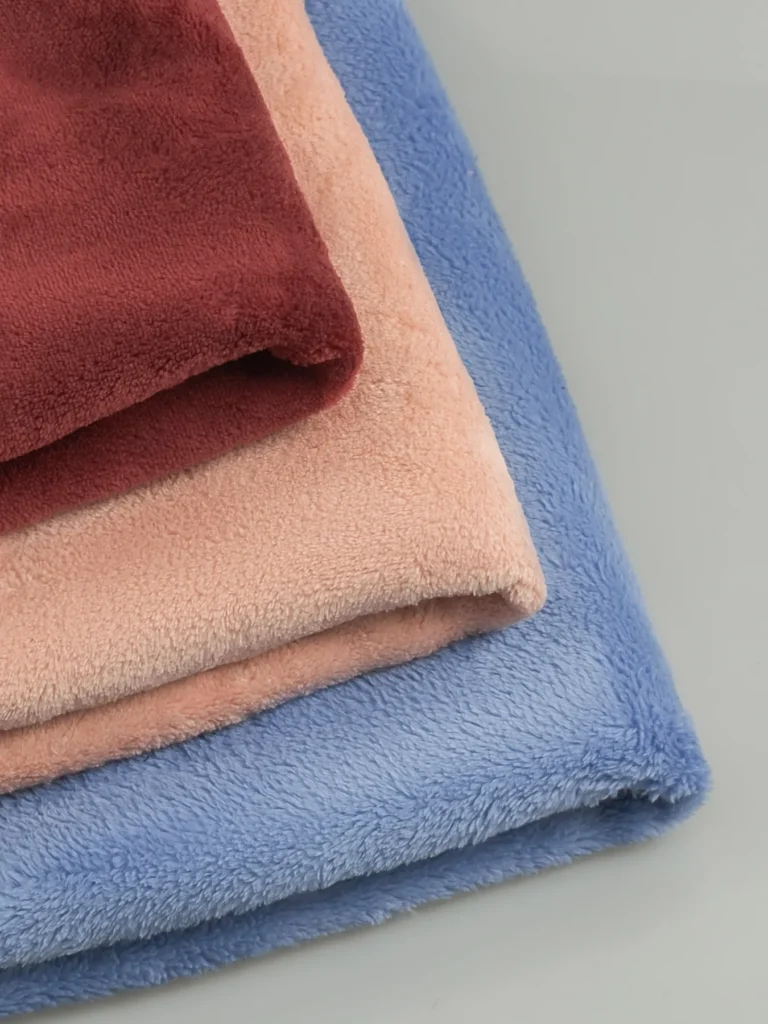
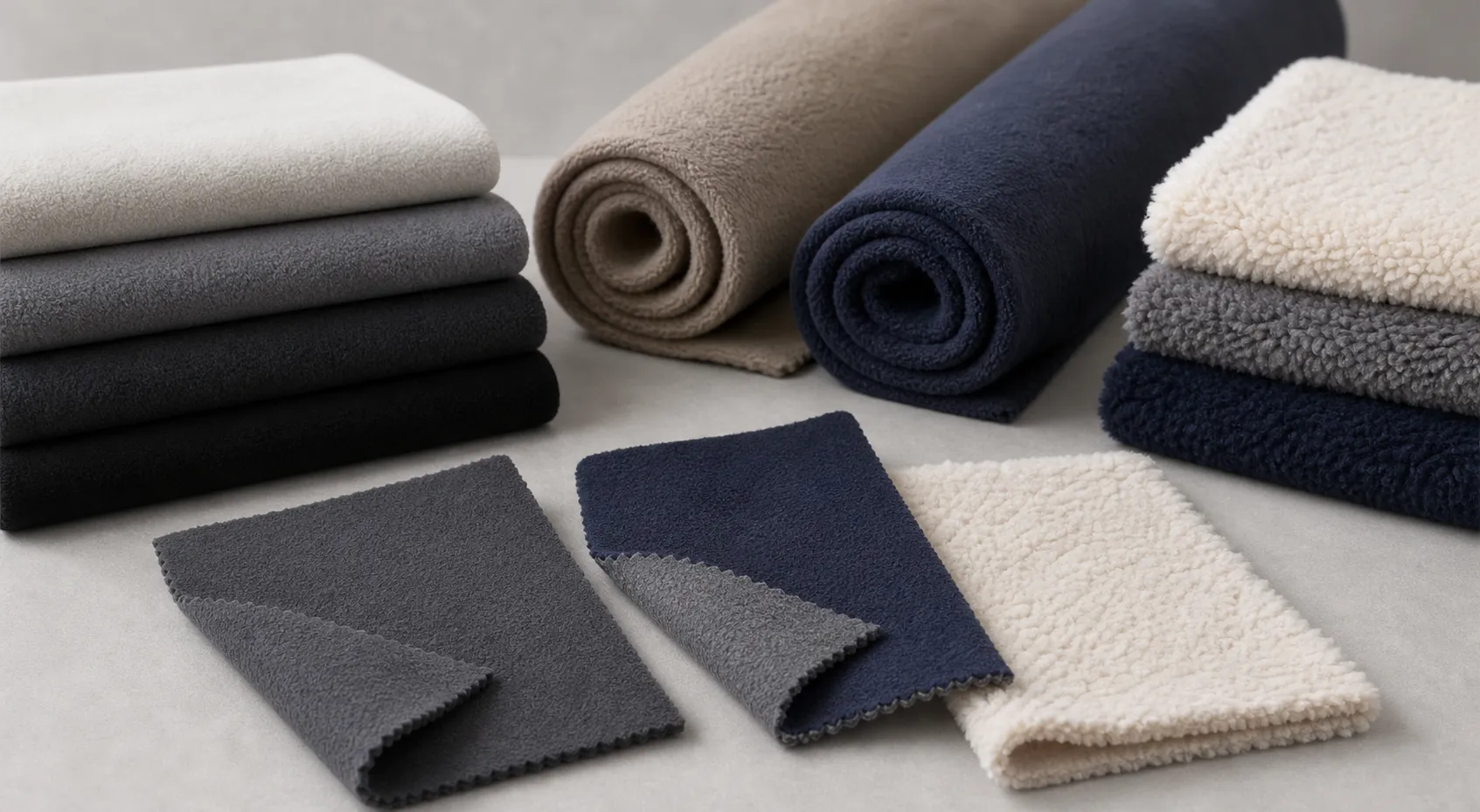
Image note: the featured fleece rolls and swatches are an illustration. They do not show a colorfastness test, an approved production lot or measured results.
To review a fleece colorfastness test report, first match the tested sample to the fabric and color you are buying. Then check the method, selected procedure, separate results and agreed acceptance requirements. A summary marked “pass” is not enough if the report covers a different finish, omits wet rubbing or cannot be linked to the bulk lot.
This guide focuses on resistance to washing and rubbing in custom knit fleece programs. It is a purchasing checklist, not a test procedure or a statement of WellDoneTex test performance.
Start with four separate questions
- Washing, color change: how did the tested specimen’s own color change under the specified laundering procedure?
- Washing, staining: what staining was recorded on the adjacent fabric used in that test?
- Dry rubbing: what color transfer was recorded using the dry rubbing cloth?
- Wet rubbing: what color transfer was recorded using the wet rubbing cloth?
Keep these results separate in the buying specification and approval record. A good result for one does not supply a missing result for another.
1. Confirm exactly which fleece was tested
Check the report number, issuing laboratory, issue date and sample description. Match the buyer and supplier article codes, composition, construction, color reference and finish to the current specification. Record whether the sample came from development material or identified finished production.
For fleece with different face and reverse surfaces, ask the technical team to identify the surface covered by the requested rubbing assessment. If both surfaces matter to the intended garment, state that in the test request instead of assuming one reported result covers both.
A report for another color or an earlier development sample can be useful background. Ask the responsible technical team what evidence is needed for the actual color and production lot before treating that earlier report as bulk-release evidence.
2. Read the laundering procedure, not just the method number
ISO 105-C06:2010 covers resistance to domestic or commercial laundering using a reference detergent. Its published scope distinguishes single and multiple test procedures, with greater mechanical action in the multiple procedures. “Tested to ISO 105-C06” therefore leaves an important detail unresolved if the selected procedure is missing.
Ask the laboratory or technical team to identify the method edition and procedure, including the applicable temperature, detergent, bleaching conditions and any stated deviations. Compare those entries with the agreed requirement and intended care route. This checklist does not prescribe those settings.
Keep accelerated laboratory testing distinct from a claim about garment life. If a supplier gives a number of equivalent washes, ask for the method-specific basis and its limitations. Do not turn a test summary into an unrestricted promise that every garment will retain its color for that many consumer washes.
3. Separate color change from staining
A washed specimen may have one assessment for its own color change and another for staining of adjacent material. ISO 105-A02 addresses the grey scale for assessing color change; ISO 105-A03 addresses the grey scale for assessing staining. They answer different questions.
Where the report lists staining results for several fiber components of an adjacent fabric, review each required entry. A single overall “washing grade” can hide which assessment was made or which component produced the lowest result. Ask for the complete result labels and the adjacent-fabric identification rather than trying to infer them from a summary.
Write the required minimum result for each relevant assessment in the specification. Have the buyer’s technical team agree those requirements before testing. This guide does not recommend a universal passing grade for fleece.
4. Check dry and wet rubbing independently
ISO 105-X12:2016 evaluates resistance to color rubbing off textiles and staining other materials. Its scope distinguishes dry and wet rubbing tests. If your specification requires both, the report should make both outcomes identifiable.
Check the method edition, specimen identity, tested surface and reported test conditions. If the report records direction-specific results or a departure from the specified procedure, retain that information when transferring the results into your approval sheet.
Do not substitute a washing result for rubbing evidence. Likewise, a dry-rubbing result alone does not establish the wet-rubbing result. When a required entry is missing, record it as missing rather than silently treating the overall report conclusion as permission to proceed.
5. Keep shade approval and colorfastness approval separate
A buyer may accept the appearance of a lab dip while still waiting for performance evidence. Keep the identified color standard and shade decision in the lab dip and finished-bulk shade approval record, and record washing and rubbing outcomes alongside their own requirements.
If the supplier proposes a color correction or finishing change after testing, ask which previous approvals remain applicable and which checks need repeating. Identify the revised sample or lot. Avoid leaving two versions with different processing histories under the same unqualified “approved” label.
6. Link the report to the shipment before releasing material
Ask which production lot, color and rolls the submitted sample represents, and how that representation was established under the agreed sampling plan. Neither a laboratory logo nor a recent report date supplies that link by itself.
Carry the relevant article, color and lot references into the roll packing list and receiving records. The receiving factory should be able to distinguish material covered by the accepted evidence from material awaiting clarification.
If a required result is outside the agreed limit, identify the affected material and follow the agreed review process. Keep the original report, any clarification or retest, and the authorized disposition together. A result on one property should not cancel an unresolved requirement on another.
Buyer checklist for colorfastness documentation
- Report number, issuing laboratory, issue date and complete pages are available.
- Article, composition, construction, finish and color match the current specification.
- The tested sample is identified as development or production material.
- Method edition and selected laundering or rubbing procedure are stated.
- Washing color change and staining are separately labeled.
- Required dry and wet rubbing results are present.
- Required results are compared with the buyer-agreed limits, with deviations visible.
- The sample-to-lot link and relevant roll records are clear.
- The decision names what is accepted, what remains on hold and who authorized the next step.
Use the same checklist when comparing reports from two suppliers. If the methods or procedures differ, ask the technical team whether a meaningful comparison is possible; do not rank fabrics solely by the largest grade printed on each report.
Include colorfastness requirements in your fleece inquiry
Share the intended garment use, fleece construction, composition, GSM, usable width, finish, color references and quantities by color. Add the required test methods, procedures and acceptance criteria if your technical team has specified them. Where they remain undecided, identify the open questions before sample approval.
WellDoneTex supplies made-to-order knit fabrics, including fleece, and does not supply stock fabric. The usual planning basis is 1,000 kg per order and typically 400 kg per color, subject to confirmation for the specific program. The MOQ and color-split guide helps align the quantity plan with the color brief.
Send your fleece specification and colorfastness requirements for a quotation discussion. Any testing scope, sample requirements, timing and commercial terms need confirmation for the actual program.