Faux fur can release loose fibres, get caught in rain and look clumped while wet. None of those events has one universal fix. The safest response depends on whether the loose fibres came from a fresh cut or from the fabric itself, how wet the item became, and what its own care label permits.
Start with one rule: the sewn-in label or the fabric supplier's instructions control the care method. “Faux fur” describes a family of pile textiles, not one construction. The pile may be attached to a knitted or woven backing, and a finished product may also contain lining, interfacing, adhesive, elastic, print, hardware or detachable trim. A method that is safe for one washable blanket can damage a structured coat.
This guide explains how to distinguish normal cutting debris from continuing pile loss, what to inspect before trying to “stop” shedding, how to respond when faux fur gets wet and how to dry it without inventing a universal machine-wash or high-heat solution.
Quick answer
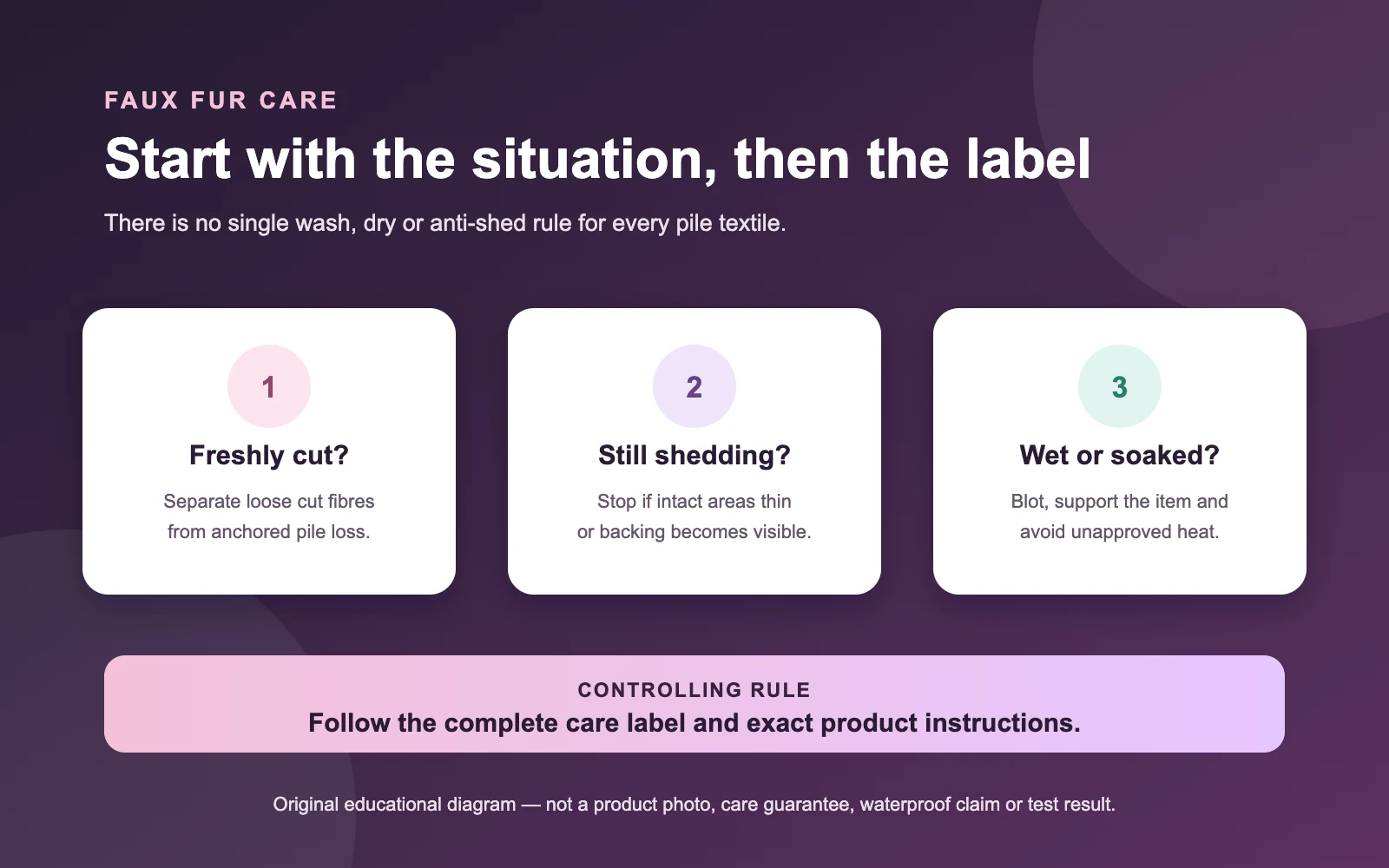
- A small burst of loose pile immediately after cutting can be cut debris. Cutting only the backing helps avoid slicing through more pile.
- Fibre release that continues away from cut edges, creates thin patches or exposes backing is not something to hide with repeated aggressive brushing. Stop and document it.
- Faux fur can become damp, but dampness does not prove that the item is waterproof, machine-washable or safe to tumble-dry.
- Blot or press gently rather than rubbing, twisting or wringing. Support the wet item and follow its label.
- When the label permits natural drying, use a ventilated place away from direct heat. Do not assume a radiator, iron, heated dryer or hot hairdryer is safe.
- Brush only when the product instructions permit it, normally after the pile is fully dry, and stop if brushing pulls out anchored fibres.
- Contact the seller or an experienced professional when shedding is persistent, the item is saturated, dye transfers, the backing distorts, bonded parts lift, or the care label is missing or conflicts with the item's construction.
What is faux fur made of?
Faux fur is a textile engineered to create a fur-like pile without using animal fur. The visible surface consists of raised fibres or yarns. Under that pile is a base fabric that holds the surface in place. Depending on the product, the backing may be knitted or woven and may receive a coating or other treatment.
That construction explains why care is about more than the soft surface. Heat, water, detergent, agitation and hanging weight can affect the pile and backing differently. In a finished coat or blanket, seams, lining, interlining, adhesive, print and trim add more variables.
The fibre name alone cannot select a safe care method. GINETEX specifically says maximum treatment temperature must be chosen from the care label rather than from fibre content alone. The US FTC Care Labeling Rule likewise requires covered manufacturers and importers to provide supported regular-care instructions and relevant warnings.
Why does faux fur shed after cutting or sewing?
Freshly cut faux fur can leave a dramatic-looking cloud of loose fibres even when the pile is otherwise secure. The reason is often mechanical: if scissors slice across both backing and long pile, the cut severs surface fibres along the pattern line. Those short pieces are no longer anchored. They fall out when the pieces are moved or sewn.
That cut debris is different from anchored pile being pulled out of intact backing. The difference is important:
| Observation | More consistent with cut debris | More concerning for continuing pile loss |
|---|---|---|
| Where fibres appear | mainly along newly cut edges and work surface | across uncut face areas, seams or repeated handling zones |
| Timing | strongest immediately after cutting | continues after loose cut fibres have been removed |
| Fabric appearance | pile remains even away from the cut | thin spots, channels or backing become visible |
| Handling response | decreases after gentle cleanup | returns with light handling or worsens with brushing |
This is a practical distinction, not a universal laboratory threshold. Some loose surface fibre may remain after manufacture or packing, and different piles behave differently. Record what you observe instead of promising that shedding will “completely stop.”
How to cut with less loose pile
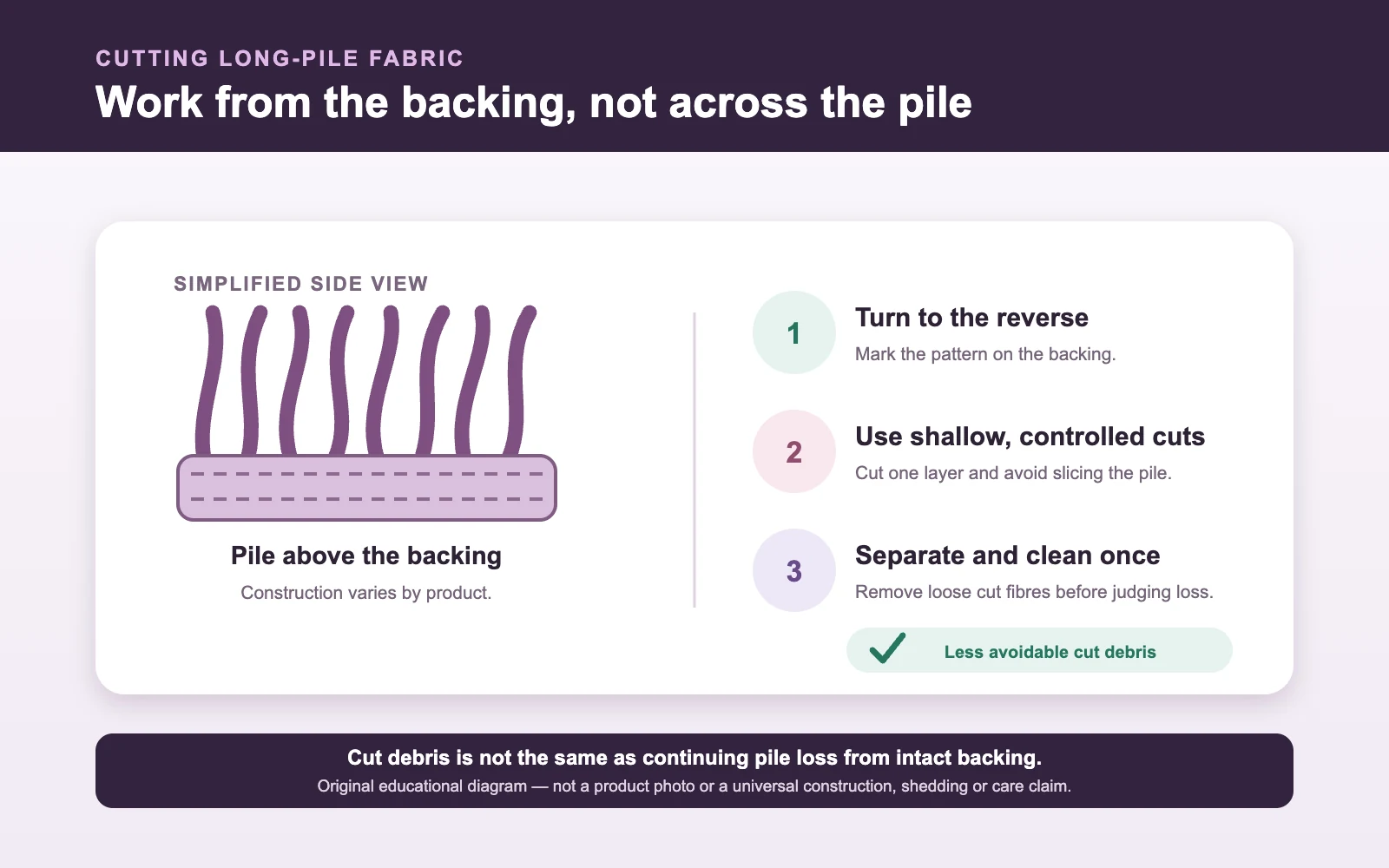
JOANN's apparel field guide advises tracing on the wrong side, cutting a single layer and cutting through the backing rather than through the fur itself. A sharp tool is used carefully from the back so the pile is separated rather than given a blunt haircut. The guide then recommends shaking the cut pieces outside to remove loose cut fibres.
For safer, cleaner work:
- Identify the nap direction before laying out every pattern piece.
- Mark the pattern on the backing and cut one layer at a time.
- Use the tool and protective surface appropriate to your skill and project; keep hands out of the cutting path.
- Cut the backing with controlled shallow passes and separate the pile at the cut line instead of chopping through it.
- Move loose cut fibres away from food, children, pets, fans and heating equipment.
- Clean the work area and gently remove only loose debris from the pieces.
- Inspect the finished cut edge before sewing.
This method reduces avoidable cutting mess. It cannot repair weak pile anchorage or guarantee a no-shed final product.
How can faux fur shedding be reduced?
First identify the source. If shedding began immediately after cutting, remove loose cut fibres gently and finish the seam or edge according to the construction plan. If an uncut garment or blanket releases fibres, treat it as a product-care or quality question rather than a sewing-cleanup problem.
For newly cut fabric
- Shake out cut pieces in a controlled outdoor or easy-to-clean area if safe to do so.
- Use a lint roller or gentle surface pickup only if it does not pull at the anchored pile.
- Free pile trapped in a seam carefully instead of tugging a whole section.
- Test brushing on an offcut before brushing the project.
- Keep an approved uncut control swatch for comparison.
For a finished item
- Read the care label before adding water, detergent, heat, steam or a chemical treatment.
- Start with the least aggressive handling: gentle shaking, hand removal of obvious loose fibres or a light pass with a suitable soft tool.
- Stop if the tool catches loops, draws out bundles, changes the nap or exposes backing.
- Do not spray adhesive, hair products, fabric softener, solvent or an improvised “anti-shed” chemical onto the pile unless the product maker explicitly approves it for that exact item.
- Do not wash an item merely to see whether shedding improves. Washing is a care process, not a universal shedding cure.
There is no credible one-step promise to make every faux fur stop shedding permanently. Fibre security depends on the pile, backing, manufacturing process, edge treatment, sewing and later use.
When should you stop treating it and contact the seller?
Pause home treatment and document the condition when:
- fibres keep releasing from intact areas after obvious loose debris is removed;
- light handling produces bundles rather than a few loose ends;
- the pile develops bald or visibly thinner patches;
- backing becomes visible where it was previously covered;
- a seam, cut edge or coated backing is opening;
- lining, adhesive, trim or surface finish is separating;
- the care label is missing, unreadable or inconsistent with supplied instructions;
- the item changed after a method that its label explicitly allowed.
Take clear photographs of the overall item, affected area, backing or seam, care label and proof of purchase or sample identity. Save some released fibres in a clean bag if a supplier needs to assess them. Avoid repeated brushing or washing after a defect becomes visible; further treatment can make it harder to distinguish the original problem from handling damage.
For a valuable, structured or heavily soiled garment, use a cleaner experienced with faux fur and provide the exact label. “Professional clean” is not a universal instruction either: the professional still needs the material and construction information.
What should buyers inspect when a faux fur sample sheds?
Buyers need to separate incoming loose fibre, cutting debris and ongoing pile loss before approving a fabric or garment.
1. Identify the sample
Record supplier, article number, colour, lot, date, fibre declaration, backing construction, pile height, mass, usable width and any finish or backing coating. Mark face, back and pile direction. Do not compare anonymous swatches.
2. Inspect the uncut surface
Place the sample over a contrasting clean surface. Photograph several areas under the same lighting. Look for uneven pile, thin channels, backing visibility, colour variation and damaged edges. Handle the middle of the sample gently before cutting and record any fibre release.
3. Separate edge and face observations
Cut an identified specimen using the backing-only method. Clean away obvious cut debris once. Then observe the cut edge, sewn trial and uncut face separately. If all fibres are collected in one pile, the test cannot show where they came from.
4. Use a repeatable internal handling check
If no contractual test method exists, define a simple comparison procedure: same specimen size, same conditioning, same number and direction of gentle passes, same tool, same backing colour and same assessor. Photograph the surface before and after. Do not convert this internal comparison into an unsupported industry pass/fail standard.
5. Make the intended seam and edge
Sew with the planned needle, thread, stitch, seam allowance, lining and edge finish. Check whether pile pulls out at needle holes, the backing ladders or frays, the seam shows thin bands, and trapped pile can be freed without damage.
6. Test the actual care route
Apply only the proposed label procedure to a representative fabric and finished-construction sample. ISO 6330 provides defined domestic washing and drying procedures for textile testing, and ISO 5077 covers dimensional change after specified care. Also inspect pile appearance, shedding, matting, backing distortion, seam condition, lining and bonded details; a dimensional-change result alone is incomplete.
7. Agree an acceptance record
Keep a signed or otherwise identifiable control sample and write what counts as acceptable for the intended use. Include appearance and fibre-release observations before cutting, after sewing and after the agreed care cycles. A phrase such as “no shedding” is difficult to enforce unless the method and observation limit are defined.
Can faux fur get wet?
Faux fur can physically become wet, but that does not answer whether the product should be immersed, washed or used in rain. “Can get wet” and “safe to wash” are different questions. “Safe to wash” and “waterproof” are different again.
A few raindrops may only dampen the pile. A soaked blanket can load the backing with water. A coat can contain lining, interfacing, adhesive, fasteners and trim that react differently. Even when the visible pile is synthetic, the whole item may not tolerate the same treatment as loose yardage.
Check the complete label before acting. The FTC rule requires supported washing or dry-cleaning directions for covered products and relevant warnings about harmful procedures. GINETEX symbols distinguish washing, natural drying, tumble drying, ironing and professional care. Read the whole sequence—not one symbol in isolation.
If it gets lightly wet
- Move the item out of rain or spray.
- Check the care label and any removable-trim instructions.
- Shake off loose surface droplets gently if the shape allows.
- Blot with a clean, absorbent, colourfast towel. Do not rub the pile.
- Arrange the item in its natural shape with adequate support.
- Let it dry by the label-approved route in good ventilation.
- Keep it away from direct heat unless the label specifically permits a controlled drying process.
If it is soaked
Do not lift a heavy wet blanket or long garment from one narrow point; the water weight can strain backing, shoulders or seams. Support the item broadly. Press with towels rather than twisting or wringing. If dye transfers, glue softens, backing stretches, trim swells or a structured garment loses shape, stop and contact the seller or an experienced cleaner.
How should wet faux fur be dried?
The safest general principle is controlled, supported drying according to the label—not forced high heat.
Big Z Fabric's guidance recommends removing excess water gently with towels, supporting yardage or garments appropriately and air-drying in a cool, ventilated place. Fakefurshop likewise describes towel removal of excess water and drying away from direct heat for its faux-fur family. Auter's product care tells users to blot wet faux fur and let it dry naturally away from direct heat.
Use these as a cautious framework only when they do not conflict with the actual care label:
- Remove surface water gently. Blot or press. Do not scrub, twist or wring.
- Support the wet weight. Lay flat when hanging would stretch the backing or garment. If the label permits hanging and the item holds its shape, use a broad, sturdy hanger.
- Separate folds. Arrange the pile and backing so trapped wet areas receive air.
- Choose ventilation, not heat. Use an indoor drying rack or shaded ventilated space as appropriate.
- Reposition carefully. Turn or rearrange a flat item if needed so both sides dry, without pulling the wet backing.
- Wait until fully dry. Wet pile often looks darker, flatter or clumped; that appearance alone does not prove permanent damage.
- Finish only if permitted. When fully dry, test a gentle brush on a hidden area or offcut. Brush in small sections and stop if fibres pull free.
What to avoid unless the label expressly allows it
- radiator, heater or heated drying cabinet;
- hot hairdryer or heat gun;
- ironing or pressing directly on the pile;
- heated tumble drying;
- aggressive rubbing, beating, twisting or wringing;
- brushing while the backing is stretched and saturated;
- fabric softener, solvent or “restoring” chemical chosen without product approval.
Some specific products permit low-temperature tumble drying; others say do not tumble dry. That disagreement is exactly why the label controls. GINETEX notes that dryer symbols indicate whether tumble drying is allowed and at what severity, while a crossed dryer symbol means do not tumble dry.
High heat can shrink a backing or kink, mat or melt some synthetic pile fibres. National Fiber Technology gives this warning for its performance-fur material. It is a strong reason to avoid improvised heat, but it is not a numeric temperature limit for every faux fur.
Can faux fur be machine-washed?
Only when the care label or fabric supplier instructions for that exact article permit it. Do not decide from softness, colour, price or a generic “100% polyester” description.
Care directions genuinely vary. Fakefurshop prefers hand washing or specialist cleaning for its materials and warns against machine risk. Some other manufacturers publish gentle-machine routes for particular faux-fur products. Obermeyer instructs owners to remove detachable faux-fur trim before laundering certain garments. These are product examples, not contradictions to solve with one universal rule.
Before washing, confirm:
- whether the item is loose fabric, blanket, garment or detachable trim;
- hand or machine route;
- maximum water temperature;
- permitted detergent and bleach warning;
- spin or agitation limit;
- natural or tumble-drying instruction;
- whether lining, adhesive, print and trim share the same care route.
If the label says dry-clean only, choose a professional familiar with faux fur and show the label. If the label says do not dry-clean, do not treat professional cleaning as automatically safer.
Can faux fur be worn in rain?
Light rain exposure may be manageable for some faux-fur garments, but faux fur is not automatically rainwear. The pile appearance, backing, seams, lining, adhesive and trim determine how the whole garment responds. A soft surface can shed droplets without being waterproof, and water can reach the backing through seams or prolonged exposure. ISO 4920 explicitly says its surface-wetting spray test is not intended to predict resistance to rain penetration; ISO 22958 addresses water penetration by impact as a different test route. A surface-beading result therefore cannot establish that an untested garment is rain-ready.
Before wearing it in rain, ask:
- Does the label or product description permit wet-weather use?
- Is the faux fur detachable from the shell?
- Is the backing exposed at cuffs, hem or seams?
- Could dye transfer onto clothing or furniture when damp?
- Can the item be dried promptly by its approved method?
- Would saturation overload a long pile or structured garment?
For a brief unexpected shower, move under cover, blot gently and dry as directed. For heavy rain, prolonged exposure or an item sold without wet-weather performance, use a genuinely weather-rated outer layer instead. “It survived once” is not evidence of waterproofness or a repeatable care claim.
Stop normal drying and seek help if the backing stretches, colour transfers, seams distort, bonded parts lift, odour persists after complete drying or the pile hardens, mats or releases fibres in bundles.
Blankets, garments and trims need different decisions
A blanket may look simple but can still contain a second face, binding, quilting thread, adhesive or different backing. Its large wet weight makes support and thorough drying important. A garment may include structured shoulders, lining, closures and mixed materials. A detachable trim may have its own care instruction separate from the shell.
Do not copy a blanket's washable label onto a coat. Do not launder a complete jacket because a loose faux-fur swatch tolerated water. And do not assume a detachable trim can be reattached before both trim and shell are completely dry.
For buyers, qualify both material and construction. A passed yardage care trial does not automatically approve the finished product if seams, lining, adhesive or hardware change the response.
A safe pre-care checklist
Before cleaning or drying faux fur, answer these questions:
- Is this definitely faux fur rather than real fur, shearling, Sherpa, Minky or another pile fabric?
- Can I read the complete care label?
- Is the fur a full body fabric or detachable trim?
- Are there linings, glued areas, prints, trims or structured parts?
- Is the problem loose cut fibre, ongoing shedding, dirt, a stain or water exposure?
- Is the item damp or saturated?
- Has colour transferred to a white towel?
- Can I support the item while wet?
- Do I have a ventilated, label-approved drying place away from direct heat?
- Is there a hidden area or offcut for testing?
If key information is missing, pause. The cost of asking the seller or an experienced cleaner is often lower than the cost of trying a universal internet fix.
Final takeaway
Good faux-fur care begins with diagnosis. Loose fibres at a new cut edge may simply be severed pile, while fibre release across intact areas can signal a material, manufacturing or damage issue. Reduce cutting debris by working from the backing and cleaning gently; do not promise a permanent no-shed cure.
Water exposure also needs a precise response. A damp pile is not proof of washability or waterproofness. Follow the actual label, blot instead of rubbing, support wet weight and use the approved drying route. Natural ventilation away from direct heat is a cautious default only when the label allows it. Machine washing, tumble drying, professional cleaning, brushing and any chemical treatment remain product-specific decisions.
For sourcing and product development, keep an identified control sample, separate cut-edge debris from intact-face shedding, test the proposed care route on representative material and finished construction, and write measurable acceptance criteria. The aim is not to make every faux fur behave the same; it is to choose and care for the exact material responsibly.
Frequently asked questions
How can faux fur shedding be reduced?
Identify where the fibres come from. For fresh cut edges, cut only the backing, remove loose cut debris gently and finish the seam or edge appropriately. For a finished item, start with light handling approved by its label and stop if brushing or rolling pulls out anchored pile. There is no universal treatment that guarantees faux fur will stop shedding permanently.
Why does a faux fur blanket shed after cutting or sewing?
Scissors can sever long pile when they cut through the face and backing together. Those cut fibre pieces then fall out during handling and sewing. Mark and cut from the backing, one layer at a time, to reduce this debris. Continued release from uncut areas or visible thinning needs separate quality assessment.
What should buyers inspect when a faux fur sample sheds?
Record the sample identity, inspect uncut face and backing, separate cut-edge debris from intact-area release, make the intended seam, compare with an uncut control and repeat the planned care route on representative fabric and finished construction. Document pile appearance, backing exposure, seams, lining and fibre release without inventing a universal pass count.
Can faux fur get wet?
It can become damp or soaked, but that does not mean it is waterproof, machine-washable or safe for a dryer. Check the complete care label, blot rather than rub or wring, support the wet item and follow its approved drying instructions.
How should wet faux fur be dried without damaging the pile?
Follow the label. When natural drying is permitted, press out excess water with clean towels, support the item's shape, separate folds and dry it in a ventilated place away from direct heat. Wait until it is fully dry before testing gentle brushing. Do not use a radiator, hot hairdryer, iron or heated dryer unless the exact care instruction permits that process.
Can faux fur be worn in rain, and what are the limits?
Some products can handle brief light rain, but faux fur is not automatically rainwear. Heavy or prolonged rain can saturate pile, backing, seams and lining. Use a weather-rated outer layer when rain performance is unconfirmed, then blot and dry the faux fur according to its label after accidental exposure.
Related reading
For a different pile-textile category, see our guide to minky fleece fabric. Its construction and care guidance should not be transferred automatically to faux fur.
References
- US Federal Trade Commission: Care Labeling Rule
- US Federal Trade Commission: Clothes Captioning
- GINETEX: Care Symbols
- Fakefurshop: How to Wash Your Faux Fur at Home
- Fakefurshop: How to Cut and Sew Fake Fur
- JOANN: Apparel Field Guide—Sewing with Faux Fur
- National Fiber Technology: Performance Fur FAQ
- Big Z Fabric: How to Dry Faux Fur Safely
- Auter: Shearling and Faux Fur Care
- Obermeyer: Garment and Faux-Fur Trim Care
- ISO 6330:2021: Domestic Washing and Drying Procedures for Textile Testing
- ISO 5077:2007: Determination of Dimensional Change in Washing and Drying
- Kering: Standards for Raw Materials—Fake Fur
- Singer: Apparel Fabric—Faux Fur Cutting Guidance
- Shannon Fabrics: Faux Fur Tips
- Shannon Fabrics: Dreamy Fur Product Instructions
- Shrimps: Sustainability and Faux-Fur Care
- ISO 4920:2012: Resistance to Surface Wetting
- ISO 22958:2021: Water Penetration by Impact