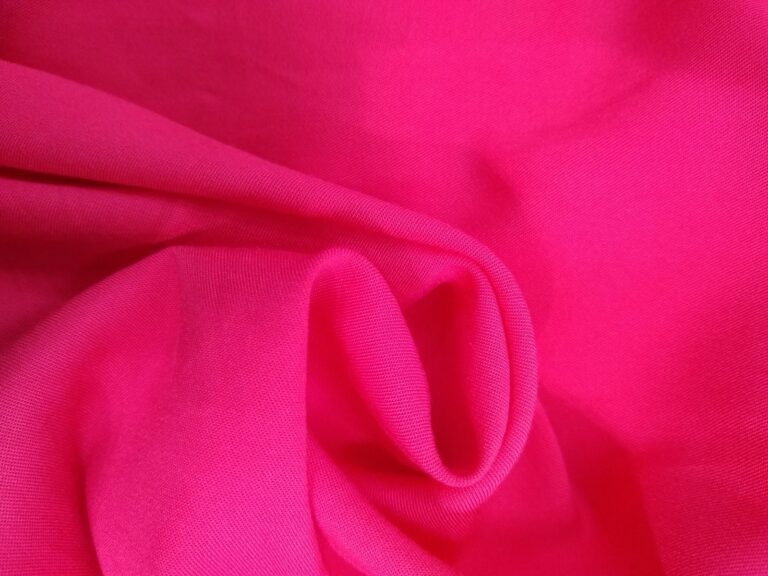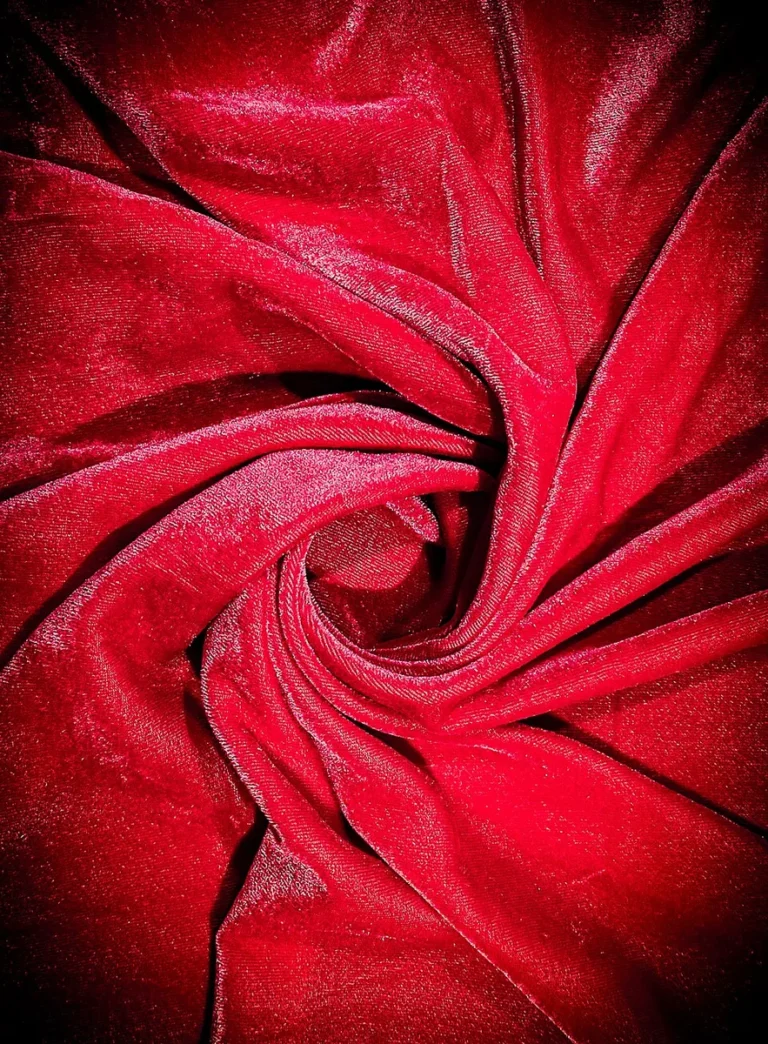
Minky is a market name commonly used for very soft, plush fabric with a raised pile on the face and a backing that holds that pile in place. It is widely associated with blankets, quilt backs, soft accessories, toys and comfort-focused apparel. The surface may be smooth, dimpled, embossed or longer-pile, so two fabrics sold as “minky” can look and behave quite differently.
The useful short answer is this: minky describes a plush fabric category, not a complete specification. The name alone does not confirm the fiber percentage, backing construction, stretch, pile height, weight, width, colorfastness, shedding, care route or suitability for a regulated end use.
Many retail minky products are polyester knits. For example, Shannon Fabrics describes its Cuddle minky range as knit polyester with inherent stretch. That is good evidence for that product family, but it is not a rule for every fabric using the minky name. Check the actual fiber label, data sheet and sample before treating a category description as a product fact.
Quick answer
Minky fabric is a plush pile fabric chosen mainly for a soft, velvety hand. Its performance comes from more than the fuzzy surface:
- the pile affects softness, direction, appearance and how the surface mats;
- the backing affects stretch, stability, seam behavior and drape;
- the fiber and finish affect care, static, color and heat sensitivity;
- the finished product and intended use determine which safety or labeling requirements apply.
Before buying, compare the exact composition, weight, width, stretch by direction, pile height, wash instructions and sample behavior. “Minky,” “plush,” and “cuddle” are not substitutes for those fields.
What gives minky its soft feel?
The face of minky has many short or long fibers standing above the base. Together they form the pile. When those fibers bend under the hand, the surface feels soft and dense rather than flat and crisp.
Pile changes how light reflects, so brushing the fabric in opposite directions may make the color look lighter or darker. This directional effect is called nap. It matters when cutting several garment or panel pieces: if pieces are rotated in different directions, the finished item may appear to contain mismatched shades even when they came from the same roll.
The word “soft” still needs context. A tall loose pile, a short dense pile and an embossed dot surface can all feel different. Softness also does not tell you how quickly the surface will mat, how much it will shed at cut edges, whether it will snag, or how it will feel after repeated washing.
What is the difference between the pile and the backing?
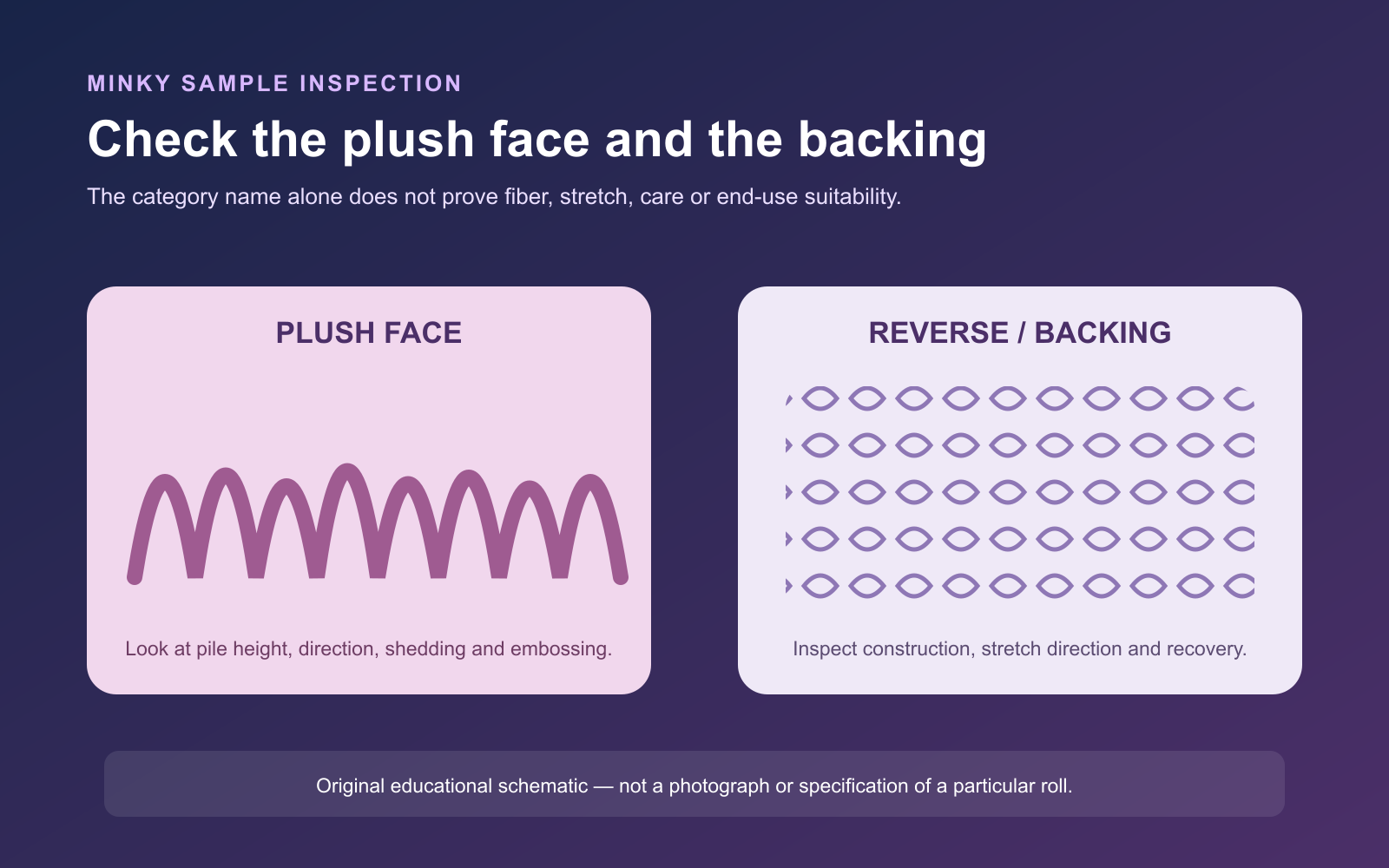
The pile is the touchable surface. The backing is the structural base that holds it.
This distinction explains why two visually similar minky fabrics can have different stretch and sewing behavior. A knit backing can allow movement, but the amount and direction depend on the actual construction and finishing. One fabric may stretch mainly across the width; another may have noticeable movement in both directions; a quilting-oriented version may be engineered for greater stability.
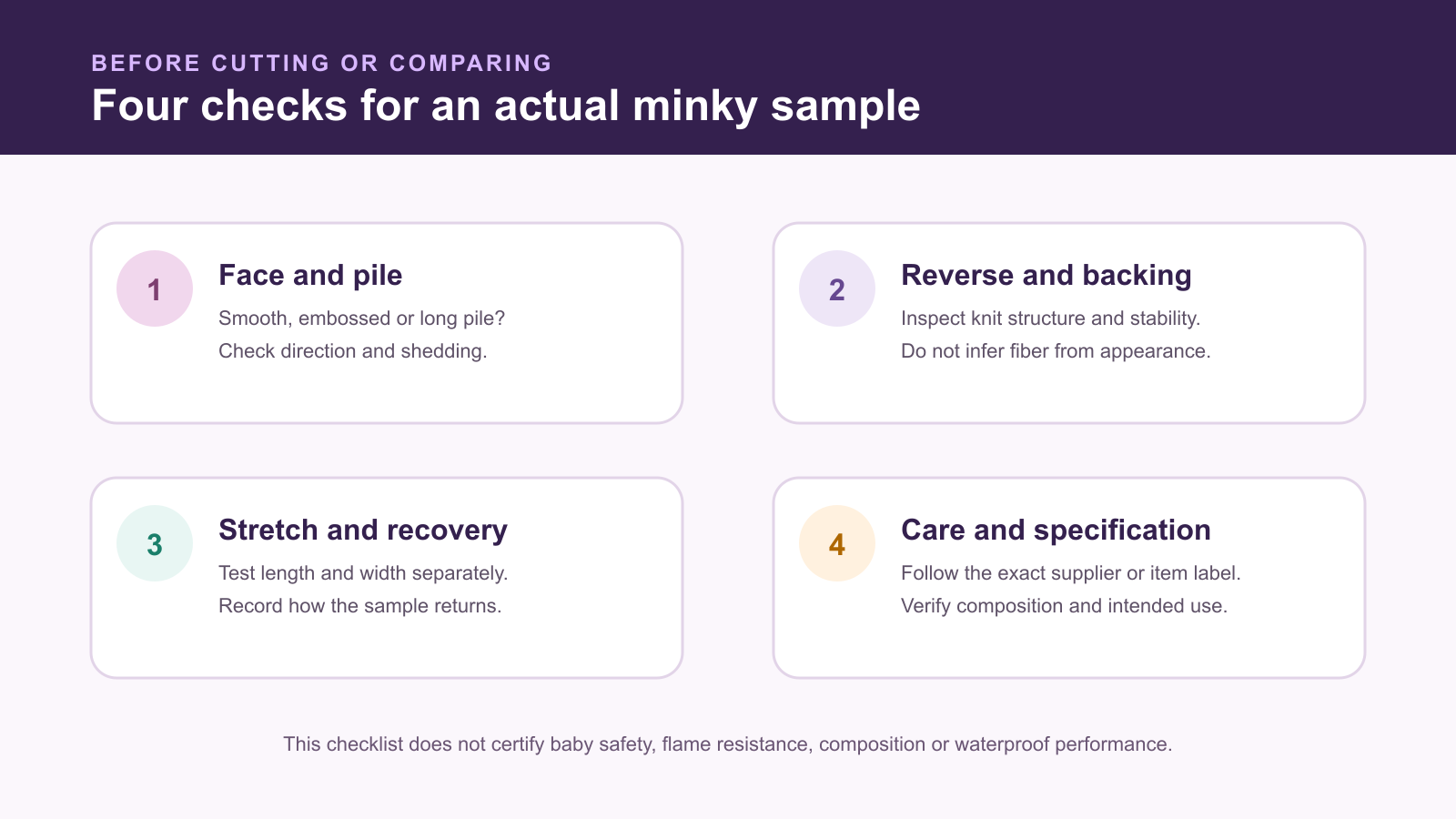
Look at both sides of a swatch. On the face, inspect pile density, direction and recovery after rubbing. On the reverse, inspect whether the backing is visibly knitted, how open or compact it is, whether the edges curl, and how the fabric responds to gentle tension.
Do not infer stretch from the word minky. Record it from the exact sample, ideally in both warp/wale and weft/course directions using a defined method.
What is minky fabric made from?
Many commercially sold minky fabrics are labeled polyester, but the category name itself is not a fiber name. A seller may use related names for products with different fibers, blends, backings, coatings or finishes.
For a real purchase, use the label or supplier specification to answer:
- generic fiber name and percentage;
- whether the face and backing have different compositions;
- whether any film, foam, adhesive or print is present;
- whether the information applies to the exact color and finish;
- which market’s labeling rules apply to the finished product.
In the United States, most covered textile products must identify fiber content, origin and the responsible business. That is why “ultra-soft minky” is an appearance description, not a replacement for “100% polyester” or another verified composition.
Common minky surface styles
Minky is sold in many visual forms. Names differ by seller, so treat them as shopping categories rather than universal technical classes.
| Surface style | What you may see | What to verify |
|---|---|---|
| Smooth short pile | even plush face with a clear nap | density, pile direction, show-through and matting |
| Dimple or dot | raised or recessed repeating dots | whether the pattern is embossed, pile-defined or backed by another process |
| Printed minky | color or motif added to the plush face | print clarity, crocking, wash change and batch consistency |
| Longer-pile plush | deeper, more dimensional surface | shedding at cut edges, seam bulk and recovery after compression |
| Textured or embossed | waves, rosettes, channels or geometric relief | pattern scale, usable width, distortion and appearance after care |
A style name does not guarantee a particular pile height, weight or composition. Ask for numbers or a physical sample when those differences matter.
Does minky stretch?
Many knit-backed minky fabrics stretch, but “minky stretches” is too broad for pattern planning.
Shannon Fabrics’ Cuddle sewing guide identifies its range as knit polyester and notes inherent stretch. The same guide recommends tools and handling suited to knit plush fabric. Use that as a product example, not as proof about an untested roll from another source.
For your own swatch, check:
- stretch in both directions;
- recovery after holding the stretch for several seconds;
- edge curl and distortion after cutting;
- pile separation when the backing is extended;
- dimensional change after the intended wash and dry route.
Stretch can be helpful for soft wraps or comfort products but inconvenient in a quilt backing or precise panel if the layers feed at different rates. Stabilization, seam choice and cutting direction should follow the actual material rather than the category name.
What is minky fabric used for?
Common uses include blanket faces and backs, quilt backings, cushion covers, soft toys, robes, loungewear, scarves, baby accessories and sensory or comfort items. These are examples, not automatic recommendations.
Choose by the finished product’s needs:
- Blankets and quilt backs: compare pile, width, weight, stretch, seam stability, laundering and compatibility with the other layers.
- Soft toys: consider seam security, pile shedding, small components, cleaning and all rules that apply to the age group and market.
- Apparel: check drape, bulk, breathability expectations, heat retention, seam allowance, nap direction and the relevant flammability and labeling rules.
- Children’s sleep-related products: do not rely on softness, fiber name or a seller’s generic “baby safe” phrase. Intended use, design, marketing, testing, tracking and labeling can change the regulatory scope.
The right fabric for a decorative cushion may be wrong for sleepwear, upholstery or a frequently washed institutional product even if the hand feels identical.
Is minky the same as fleece, polar fleece or Sherpa?
The terms overlap in casual shopping, but they should not be treated as exact synonyms.
| Term | Main visual idea | Useful distinction |
|---|---|---|
| Minky | smooth, embossed or long plush pile | often selected for a velvety face; backing and specification vary |
| Polar fleece | brushed insulating knit associated with layering and outdoor clothing | usually discussed through weight, brushing, warmth, breathability and pilling |
| Sherpa fleece | curly or looped face resembling fleece-lined wool | surface is more irregular and wool-like than smooth minky |
| Coral fleece | very soft, fine plush surface used in blankets and home textiles | its market definition and specifications should be checked separately |
For the broader family, see what fleece is and the guide to types of polar fleece. If your question is specifically about the curly pile, the Sherpa fleece guide is the better next page.
How should minky be washed and dried?
Follow the care label for the exact fabric or finished product. Pile height, embossing, backing, print, trim, adhesive, lining and other layers can change the safe route.
For one product-specific example, Shannon Fabrics says its Cuddle and Luxe Cuddle fabrics can be machine washed in cool water and dried on low heat, and advises against overdrying or fabric softener. That does not authorize the same instruction for every minky item.
A sound care plan asks:
- What wash method and water temperature have evidence behind them?
- Is machine drying allowed, and at what setting?
- Can ironing or direct heat flatten or damage the pile?
- Are bleach, softener or dry cleaning restricted?
- Does the finished item contain another layer with stricter care limits?
- What happens to dimensions, color, pile recovery and seams after repeated cycles?
The FTC Care Labeling Rule requires covered care instructions to have a reasonable basis. For buyers and product teams, that is a useful principle everywhere: do not invent a care label from a generic blog tip when a representative sample can be tested.
Is minky safe for babies or sensitive skin?
Softness is a sensory property, not a safety certificate.
A safety decision may require verified fiber and chemical information, physical construction checks, intended-use classification, flammability requirements, age grading, labeling, tracking and market-specific testing. The finished item matters: a loose blanket, plush toy, robe and children’s sleepwear garment do not necessarily follow the same rules.
The CPSC explains that children’s sleepwear scope depends on intended use, garment design, marketing and fabric/garment factors, and that in-scope products have specific testing and labeling requirements. Therefore a statement such as “minky is polyester” or “minky is soft” cannot prove that an unknown product is suitable for children’s sleepwear.
This article does not certify any minky fabric as non-toxic, hypoallergenic, flame resistant or suitable for infants. Those claims belong in a separate evidence review tied to the exact product, lot, market and end use.
How to sew minky with less shifting and mess
Plush pile can hide marks, release cut fibers and make layers creep against each other. The exact setup depends on pile height and backing, but a few sample-first checks help:
- mark and cut from the back where practical;
- keep every directional piece aligned with the same nap;
- test a stretch or ballpoint-style needle when the backing is knit;
- test stitch length, presser-foot pressure and feed before sewing the project;
- secure layers closely enough to prevent shifting without crushing the pile;
- vacuum or collect loose cut fibers rather than mistaking edge-cut lint for in-use shedding;
- make a wash-and-dry sample that includes the actual seam and companion layer.
Shannon Fabrics recommends specific tools for its Cuddle products, including cutting from the wrong side for some higher-pile styles and using knit-oriented needles. Treat those as a starting point for a sample test, not a universal machine setting.
Minky sample checklist
Before approving a roll or finished item, record:
- supplier and exact style code;
- lot, color and finish;
- face and backing composition;
- usable width, mass and thickness;
- pile height, density, direction and pattern repeat;
- stretch and recovery in both directions;
- edge shedding versus continued surface shedding;
- seam slippage, puckering and feed behavior;
- color change, pile matting and dimensional change after care;
- applicable end-use safety, labeling and test evidence;
- approval sample and tolerance for production lots.
The broader fabric specification checklist can help turn these observations into comparable supplier records.
Final takeaway
Minky is best understood as a plush pile category rather than a guaranteed recipe. Its soft face is easy to recognize, but the backing, fiber content, stretch, pile design, care and end-use evidence determine whether it will work in a real product.
Start with the label and both sides of a sample. Then test the exact construction with the intended companion layers and care route. If you already have a defined application and sample checklist, you may optionally send a project brief; an inquiry is not required to use this guide.
FAQ
Is minky always 100% polyester?
Many popular minky products are polyester, including the branded Cuddle example cited here, but the category name does not prove composition. Check the actual label or specification.
Is minky a woven or knit fabric?
Many commercial minky fabrics use a knit backing, but the safe answer for a specific roll comes from inspecting its reverse side and technical data. Do not use the name alone as a construction guarantee.
Does minky have a right and wrong side?
Usually the plush pile is treated as the face and the backing as the reverse. A design may intentionally expose either side, but seams, markings and nap direction should account for the difference.
Does minky shrink?
The result depends on fiber, backing, finish and care conditions. Test dimensional change on the exact sample rather than assuming that a polyester label eliminates all size or shape change.
Why does minky look like two different colors?
Pile direction changes how the surface reflects light. Aligning pattern pieces in the same nap direction helps avoid unintended shade differences.
Can minky be ironed?
Do not assume direct heat is safe. The pile or finish may flatten or change. Follow the exact care label and test a hidden sample if any pressing is required.
Is minky waterproof?
Not because it is minky. A plush face does not prove a waterproof barrier. Look for a verified backing, coating or laminate and a relevant water-resistance method if that function is required.
Is minky safe for children’s sleepwear?
The name and softness do not answer that question. Classification, design, marketing, fabric and garment tests, tracking and labeling may all be relevant in the intended market.
References
- Shannon Fabrics. 10 Tips for Working with Cuddle Minky. Accessed 2026-09-07.
- U.S. Federal Trade Commission. Apparel and Labeling. Accessed 2026-09-07.
- U.S. Federal Trade Commission. Care Labeling of Textile Wearing Apparel and Certain Piece Goods, 16 CFR Part 423. Accessed 2026-09-07.
- U.S. Consumer Product Safety Commission. Flammable Fabrics Act Business Guidance. Accessed 2026-09-07.
- U.S. Consumer Product Safety Commission. Children’s Sleepwear FAQ. Accessed 2026-09-07.