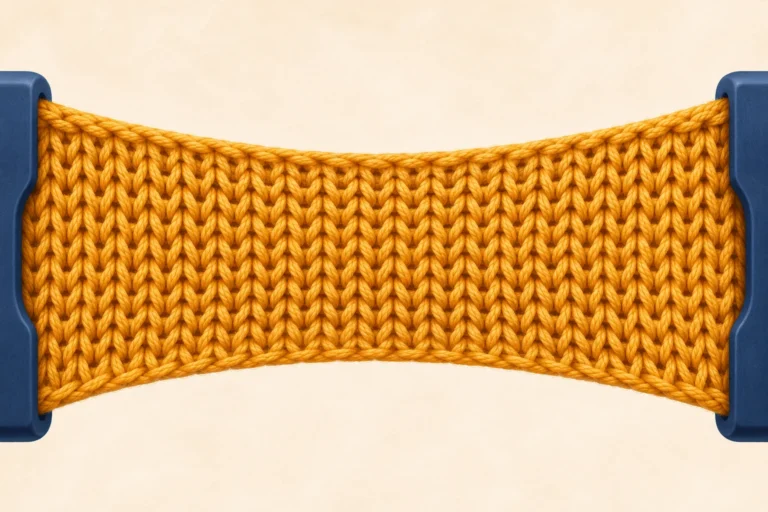
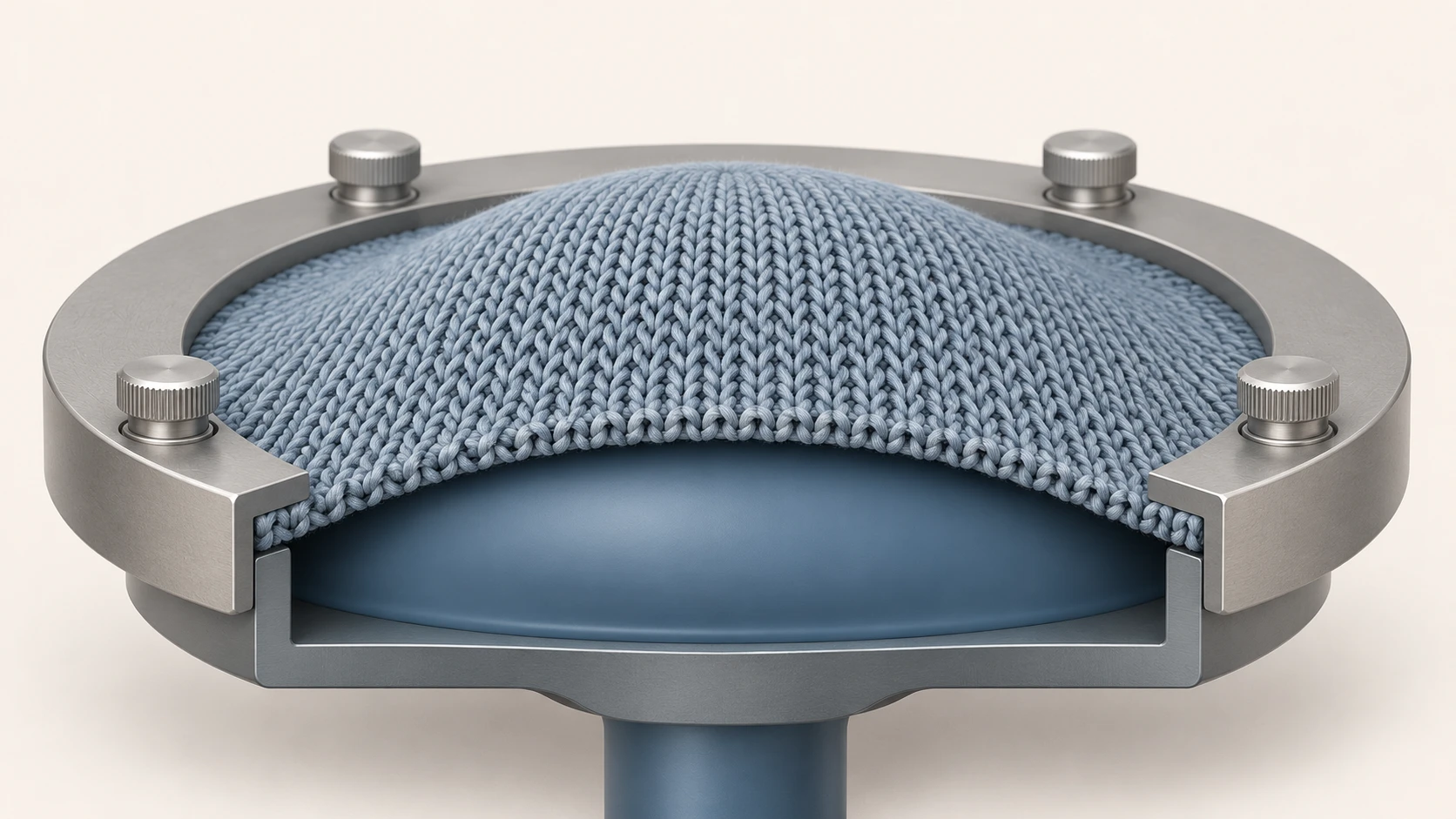
Image note: the featured image is a conceptual illustration of knitted fabric above an expanding diaphragm. It is not a laboratory photograph, a test procedure or a representation of measured results.
When specifying a fleece bursting-strength test, agree the method, fabric condition, reporting units and acceptance requirement before comparing results. A number described only as “burst strength” is incomplete: one laboratory may report diaphragm pressure while another reports the force from a ball-burst test.
This guide helps buyers prepare a testing brief for custom knit fleece. It is a purchasing checklist, not a laboratory procedure or a claim about WellDoneTex test performance.
What a bursting-strength result tells you
A bursting test assesses the fabric under the loading conditions of the selected method. The method matters because the apparatus and way of loading the specimen affect what the result means.
Keep this result separate from a general promise of garment durability. ASTM D3786/D3786M notes that clamping prevents the load transfer and stretch that occur during wear. ASTM D3787 also cautions that its results have not been correlated with actual performance. A passing report therefore does not establish garment lifetime, seam performance or every other quality requirement.
1. Name the exact test method
Ask the buyer’s technical team and laboratory to select the method appropriate to the product requirement. Write the full reference and edition into the testing request:
- ISO 13938-1:2019 covers bursting strength and bursting distension using hydraulic pressure.
- ISO 13938-2:2019 covers bursting strength and bursting distension using pneumatic pressure.
- ASTM D3786/D3786M-18(2023) uses a diaphragm bursting-strength tester with hydraulic or pneumatic pressure.
- ASTM D3787-16(2020) is a constant-rate-of-traverse (CRT) ball-burst method. Its scope distinguishes CRT equipment from constant-rate-of-extension (CRE) equipment and points to ASTM D6797 for CRE testing.
Do not shorten these to “ISO burst” or “ASTM burst” in the purchase specification. If a supplier proposes a different method, settle that change before testing and record which requirement will govern acceptance.
2. Keep pressure, force and distension separate
Diaphragm bursting strength is a pressure measurement, commonly expressed in kPa or psi. Ball-burst strength is a force measurement, commonly expressed in newtons or pounds-force. The method summaries in a NIOSH-commissioned protective-material study distinguish these pressure and force measurements. That study is not evidence of any fleece product’s performance.
Changing pressure units does not turn a diaphragm test into a ball-burst test. Do not rank two fleece fabrics by comparing the largest printed numbers when one is pressure and the other is force.
Where the chosen method reports bursting distension as well as strength, retain both labels and their units. Ask the laboratory to explain an unclear result rather than copying an unlabeled figure into the approval sheet.
3. Define the fabric and its condition
Identify the article code, composition, knit construction, target GSM, color and final finish. State whether the submitted material is a development sample or comes from an identified production lot. For fleece, specify the intended brushed or finished condition instead of leaving “fleece sample” as the entire description.
The ISO methods cover conditioned or wet specimens. Ask the laboratory to identify the specimen state and applicable conditioning procedure. If the requirement concerns material after laundering, agree that pretreatment separately and distinguish it from testing the fabric as supplied.
ISO 6330:2021 provides domestic washing and drying procedures and notes that machine, detergent and drying choices can affect test results. “After wash” alone is therefore an incomplete purchasing instruction. Record the agreed procedure and cycles, detergent and drying route.
Do not assume that evidence for an unfinished development fabric automatically applies after a change in finishing or care preparation. Ask the technical team which evidence remains applicable and whether another test is needed.
4. Agree the limit before testing
Set an acceptance value with the responsible technical team, laboratory and any applicable product specification. Include the method, units, specimen condition and the rule used to assess the reported results. This guide does not prescribe a universal passing value for fleece.
Clarify whether the buying decision depends on a reported average, individual results or another agreed rule. Decide how an incomplete report, an out-of-limit result or a material change will be handled. Keep the requirement in the specification rather than choosing a favorable limit after seeing the report.
A supplier’s “pass” conclusion is useful only when you can identify the requirement behind it. If that requirement is absent or differs from the purchase specification, record the point as unresolved.
5. Make supplier results comparable
For a side-by-side comparison, check the exact method, equipment type, test area or clamping arrangement, relevant test settings, specimen condition and pretreatment. Ask the laboratory to identify departures from the agreed method and explain their effect on comparability.
The ISO 13938 abstracts describe evidence of no significant hydraulic-versus-pneumatic difference up to 800 kPa, while identifying hydraulic equipment as more suitable for specialty textiles requiring high pressure. This is a qualified method observation, not a fleece passing threshold or permission to ignore differences elsewhere in the test setup.
Illustrative purchasing example, not test data: Supplier A submits a pneumatic diaphragm report, while Supplier B submits a CRT ball-burst report. Instead of choosing the larger number, ask the technical team whether both fabrics need assessment under the same agreed method and conditions. The example does not represent WellDoneTex products or results.
6. Link the report to bulk production
Match the report’s material identification to the approved specification and the lot offered for shipment. Keep the laboratory, report number, test date and complete pages in the approval record. Ask which material the submitted specimen represents and how it was selected under the agreed sampling plan.
Request the result, units, specimen count and any variability information needed for your acceptance decision. Ask for clarification of a no-burst result, equipment-limit entry, slippage, rejected test or other qualification rather than treating every nonnumeric entry as a pass.
Carry the accepted lot references into the roll packing list and receiving records. Keep any authorized exception or retest with the original report so the receiving factory can see which material is cleared and which remains unresolved.
Buyer checklist before a testing request
- Identify the intended garment use and the requirement owner.
- Record the exact test standard, edition and equipment method.
- Define the fabric article, finish and development or production status.
- Agree specimen condition, conditioning and any laundering pretreatment.
- Set the acceptance value, units and decision rule before testing.
- Ask for enough method and result detail to compare reports responsibly.
- Link the evidence to the production lot and define how exceptions are handled.
This is a buyer’s documentation checklist, not an exhaustive list of mandatory clauses in every test standard. The laboratory should use the current licensed method for its procedural details.
Add bursting-strength requirements to your fleece inquiry
Send the intended use, composition, construction, GSM, usable width, finish, color references and quantities by color. Add the required bursting-test method and acceptance criteria where these have been set. Flag undecided requirements before approving the testing brief.
WellDoneTex supplies made-to-order knit fabrics, including fleece, and does not hold ready stock. Orders typically start at 1,000 kg total, with a usual minimum of 400 kg per color. Confirm the specific program and color quantities with the team; the MOQ and color-split guide explains the planning basis.
Send your fleece specification and testing requirements for a quotation discussion. Testing scope, sample arrangements, timing and commercial terms need confirmation for the actual program.