Twill fabric is a woven material recognized by diagonal lines across its surface. You probably already own it: denim jeans, chinos, some jackets, uniforms, caps, and bags often use a twill weave. The word describes how the yarns cross, not what the yarns are made from, so twill can be cotton, polyester, wool, a blend, or another fiber.
That is why twill does not have one fixed feel. It can be light and smooth, heavy and firm, soft and brushed, or crisp and structured. The weave creates the familiar diagonal look; the yarn, density, weight, and finish shape the way the fabric feels and behaves in daily use.
Quick answer
Twill is a woven structure in which the crossing points move sideways from one row to the next, creating a diagonal rib. Denim is one familiar example, but not every twill is denim. Twill can be made from many fibers and finished in many ways, so read the fiber label and care instructions for the specific item instead of relying on the weave name alone.
What does twill fabric feel like?
Many twills feel smooth on the face because the weave uses longer yarn floats than a basic plain weave. Some feel sturdy and compact, while lighter versions can be flexible and drapey. A brushed or peached finish can make the surface feel softer, and a coating can make it feel firmer or less porous.
The diagonal line is the one feature you can expect to look for. Softness, thickness, stretch, and breathability are variable. Two pairs of twill trousers may feel completely different even though both fabrics show the same basic diagonal pattern.
What clothes are made from twill?
Common twill items include jeans, chinos, cargo trousers, work jackets, trench-style coats, uniforms, overshirts, caps, and structured skirts. Outside clothing, twill also appears in tote bags, cushion covers, aprons, and other products that benefit from a visible woven surface.
The weave is popular because it can be adapted from light apparel weights to heavier, firmer fabrics. That range also means the word “twill” is not enough to predict whether a fabric suits hot weather, hard wear, or a flowing silhouette.
Is twill fabric stretchy?
Traditional twill does not need to stretch. Some twills have a little give from the angle of the weave, while stretch twill usually gets more noticeable movement from elastane, stretch yarns, or a deliberately engineered construction.
If a garment needs to bend with the body, check the fiber content and try the fabric in both directions. A label such as “stretch twill” is more useful when it is paired with an actual stretch-and-recovery specification. Jeans that stretch comfortably can still use the same broad twill family as rigid denim.
Is twill breathable?
Twill can be breathable, but the weave name does not answer the question by itself. A light cotton twill may allow more air movement than a dense, coated, or heavy twill. Fiber type, yarn size, fabric density, finishing, and garment fit all influence comfort.
For everyday clothing, compare the fabric’s weight and density and consider whether it is lined. For technical claims, air permeability can be measured using a method such as ISO 9237. Avoid assuming that all cotton twills are airy or all polyester twills are hot.
Is twill good for summer or winter?
Twill can work in either season. Lightweight twill appears in summer trousers, skirts, overshirts, and uniforms. Heavier twill appears in jeans, jackets, and colder-weather layers. Color, fit, lining, and garment design matter alongside the fabric.
If you are choosing a garment for warm weather, look for a lighter weight, an unlined design, and enough air movement for the intended activity. For cooler weather, a denser or heavier twill may provide more coverage, but twill is not automatically an insulating fabric.
How is twill fabric woven?
In a basic plain weave, warp and weft yarns alternate over and under each other frequently. A twill weave changes that sequence. One yarn passes over more than one yarn before going under, and the interlacing point shifts in the next row. The repeated offset creates the diagonal line that people associate with twill.
The notation often appears as two numbers. In a 2/1 twill, for example, a warp yarn passes over two weft yarns and under one before the sequence repeats. A 3/1 twill uses a different over-under repeat. The direction of the line may run to the right or left, and broken arrangements can create patterns such as herringbone.
These construction choices influence the surface and handling of the cloth, but they do not work alone. Yarn count, yarn twist, sett, fiber blend, fabric weight, dyeing, mechanical finishing, and chemical finishing can all change the result. That is why two fabrics with the same broad weave name may not be interchangeable.
How to identify twill fabric
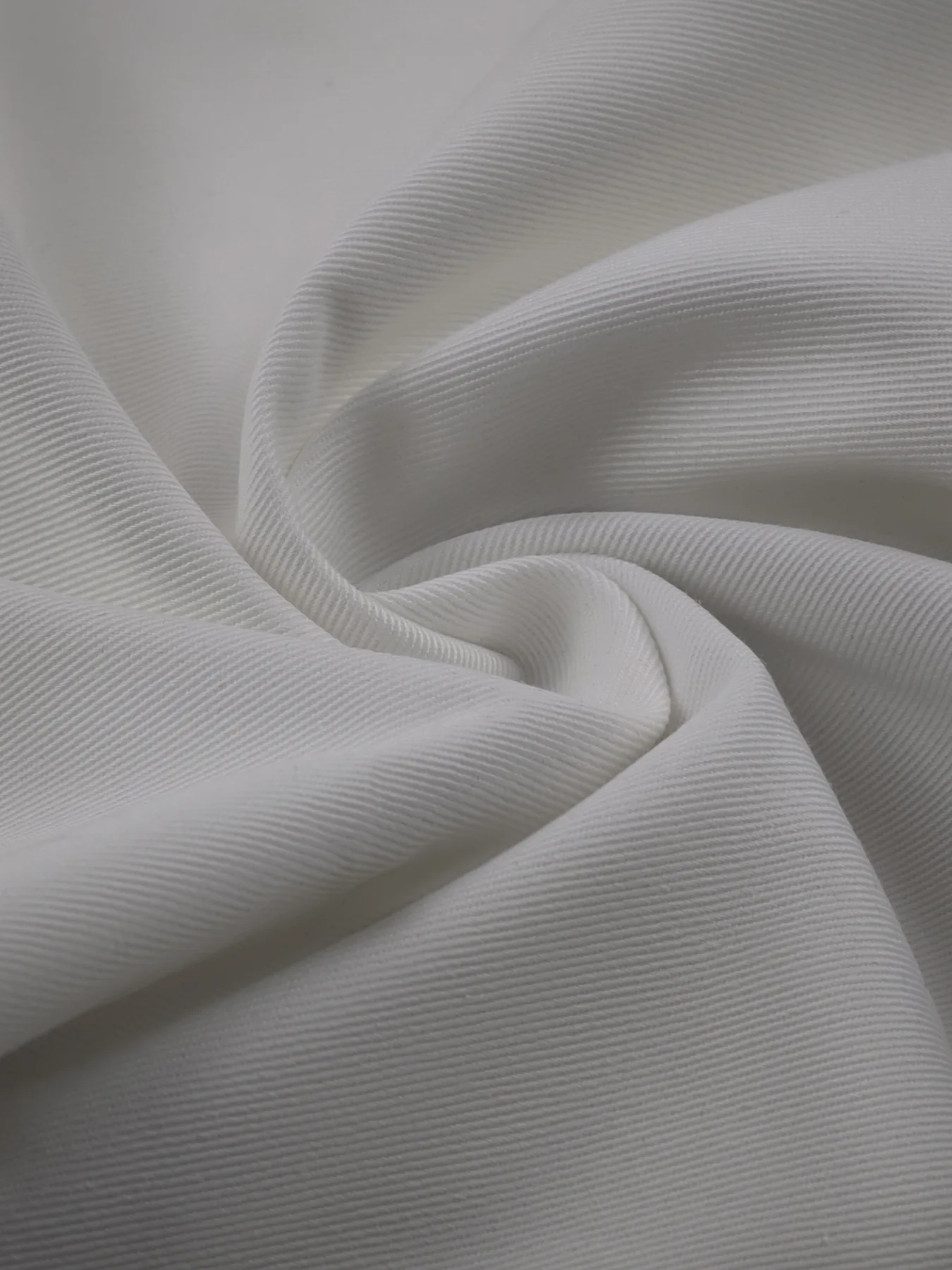
Start by placing the fabric under even light and looking for a repeated diagonal rib. If the face is heavily brushed, coated, printed, or very dark, use a magnifier and inspect both sides. The reverse may reveal the interlacing pattern more clearly.
Then check the fabric in three ways:
- View the face at a shallow angle to see whether the diagonal line is continuous.
- Compare the face and back to understand whether the weave is face-dominant or more balanced.
- Bend and drape the swatch rather than judging it flat; a clear twill line does not by itself tell you how the fabric will hang in a garment.
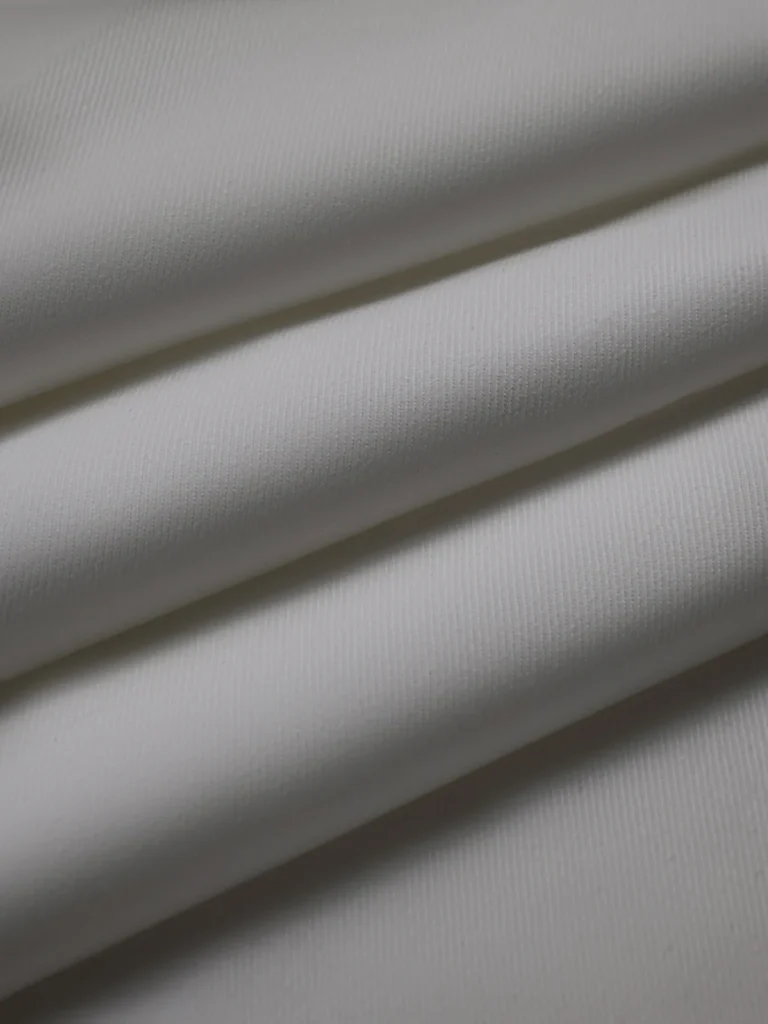
A photograph can help you recognize the diagonal appearance, but it cannot confirm fiber content, exact weight, shrinkage, or colorfastness. Use the image as a visual reference and read the label or technical information for the specific fabric.
Twill vs plain weave
Twill and plain weave are both broad woven structures. Neither term guarantees one fixed performance result.
| Check | Twill direction | Plain-weave direction |
|---|---|---|
| Visual structure | Usually shows a diagonal line | Usually shows a simpler alternating grid |
| Interlacing | Longer floats and fewer interlacings may be used, depending on the twill | Frequent over-one, under-one interlacing |
| Surface | Can appear smoother or more directional | Often appears more even and balanced |
| Drape and flexibility | Can be more pliable at a comparable setup, but the actual fabric must be compared | Can feel crisper or firmer at a comparable setup, but density and finish matter |
| What the name does not tell you | Twill ratio, direction, density, fiber, or finish | Density, yarn, fiber, finish, or opacity |
Compare fabrics of a similar weight and intended use. A lightweight twill and a heavy plain weave do not create a meaningful one-to-one comparison.
What fibers can be used in twill?
Twill describes the weave, so many fibers and blends can use it. Cotton twills are common, but polyester, cotton-polyester blends, wool, nylon, regenerated cellulosic fibers, and stretch blends can also be woven in twill structures.
Do not infer composition from the diagonal line. For US-market products covered by the Textile Fiber Rule, fiber names and percentages are labeling matters, not visual guesses. Read the label on a finished item; for product development, confirm the stated composition through the agreed documentation or testing route.
The same rule applies to terms such as “stretch twill,” “peached twill,” or “workwear twill.” These phrases add a feature or finish direction, but they still do not define every parameter. Stretch can come from fiber content, yarn engineering, or mechanical structure. A peached surface is a finish description, not proof of a particular softness level after repeated care.
Is twill fabric durable?
Twill is often associated with durable garments because many denim, chino, and workwear fabrics use twill structures. However, durability is not created by the weave label alone. A finished fabric’s tear strength, tensile strength, abrasion resistance, seam performance, and surface change depend on the yarns, density, fiber, finish, garment construction, and care conditions.
The useful question is therefore: durable against what, under which conditions, and for which item? Everyday shoppers can check weight, surface wear, seams, and care instructions. Product teams should define the test method and requirement before comparing reports. If pilling or surface fuzzing matters, use an agreed method such as an applicable ISO 12945 procedure rather than accepting an unsupported “anti-pill” description.
Does twill shrink?
Any statement about shrinkage should refer to a specific fabric and a defined wash and drying procedure. Cotton-rich fabrics, synthetic-rich fabrics, stretch blends, garment-washed fabrics, and resin-finished fabrics can behave differently. Construction tension and finishing also affect dimensional change.
ISO 5077 describes determining dimensional change after specified washing and drying procedures. In development, record the specimen, initial marks, wash program, drying method, number of cycles, and result by length and width. Do not compare percentages produced under different conditions as if they were equivalent.
For garment planning, also consider relaxation, skew, bow, torque, and seam behavior where relevant. A single overall shrinkage number may not explain how the finished garment changes.
How should twill fabric be cared for?
Care instructions must come from evidence for the actual fabric and finished garment. Fiber composition provides a starting point, but dyes, trims, coatings, prints, elastane, interlinings, and garment construction can change the safe procedure.
For an item you already own, follow its care label because fiber blends, dyes, coatings, stretch yarns, and trims can change the safe method. Before a brand finalizes a care label, the complete garment or a representative product should be checked under the intended wash, dry, bleach, and ironing route. For the US market, the FTC Care Labeling Rule requires covered manufacturers and importers to have a reasonable basis for the care information they provide.
Optional checklist for designers and product teams
Use this checklist before approving a twill for development or bulk production:
- Intended garment and use case
- Fiber content and blend percentage
- Twill type, ratio, and line direction when relevant
- Yarn details and fabric density
- Finished GSM and usable width
- Face and back appearance
- Drape, hand, opacity, and surface finish
- Stretch and recovery, if required
- Color standard and shade tolerance
- Dimensional-change method and acceptance criteria
- Colorfastness, pilling, abrasion, tear, or tensile requirements relevant to the program
- Care route and number of test cycles
- Sample, lab-dip, and bulk approval references
If these items are not defined, a quote based only on “twill fabric” can compare unlike materials. A short, precise brief produces a more useful sample review.
Want to explore twill further?
For more fabric education, browse the WellDoneTex fabric guides. Designers and product teams comparing an actual quality can use the fabric specification checklist. The existing TC Twill page is an optional commercial handoff for that specific product direction, and a sample review is available when a real development brief is ready.
FAQ
What makes a fabric twill?
A twill is created by shifting the yarn interlacing points from row to row, producing a diagonal line. The weave name does not define the fiber, weight, finish, or final performance.
Is twill always made from cotton?
No. Cotton is common, but twill can be woven from polyester, wool, nylon, regenerated cellulosic fibers, blends, and other yarns. Confirm the actual fiber content rather than identifying it by appearance.
Is denim the same as twill?
Denim uses a twill structure, but twill is the broader weave category. Not every twill is denim, and denim itself can vary by yarn, weight, dyeing, stretch, and finish.
Is twill better than plain weave?
Neither is universally better. Twill may offer a more directional surface and different drape, while plain weave may provide a simpler balanced structure. The correct choice depends on the garment, weight, density, finish, and required tests.
How can I tell if a fabric is twill?
Look for a repeated diagonal rib on the face or back. Use magnification if the surface is brushed or coated, and confirm the construction with the supplier when the visual pattern is unclear.
Does twill fabric shrink?
It can, but the result depends on the complete material and care process. Request dimensional-change results from a defined wash and dry method; do not rely on a generic percentage for all twills.
What should a product-development twill inquiry include?
Include garment use, composition, GSM, width, finish, color, stretch, tests, quantity, and timing. Add a reference swatch or approved quality when possible.