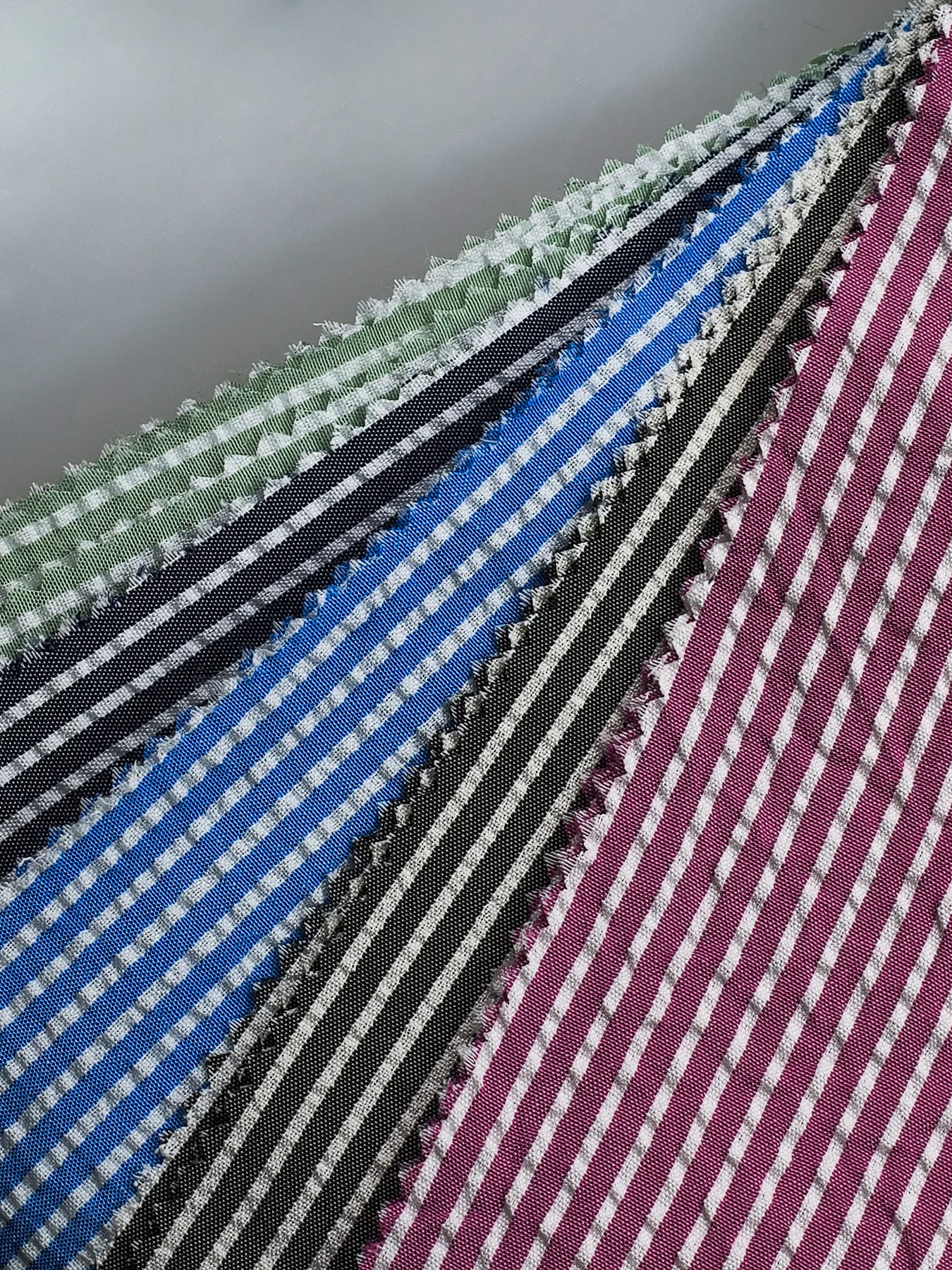
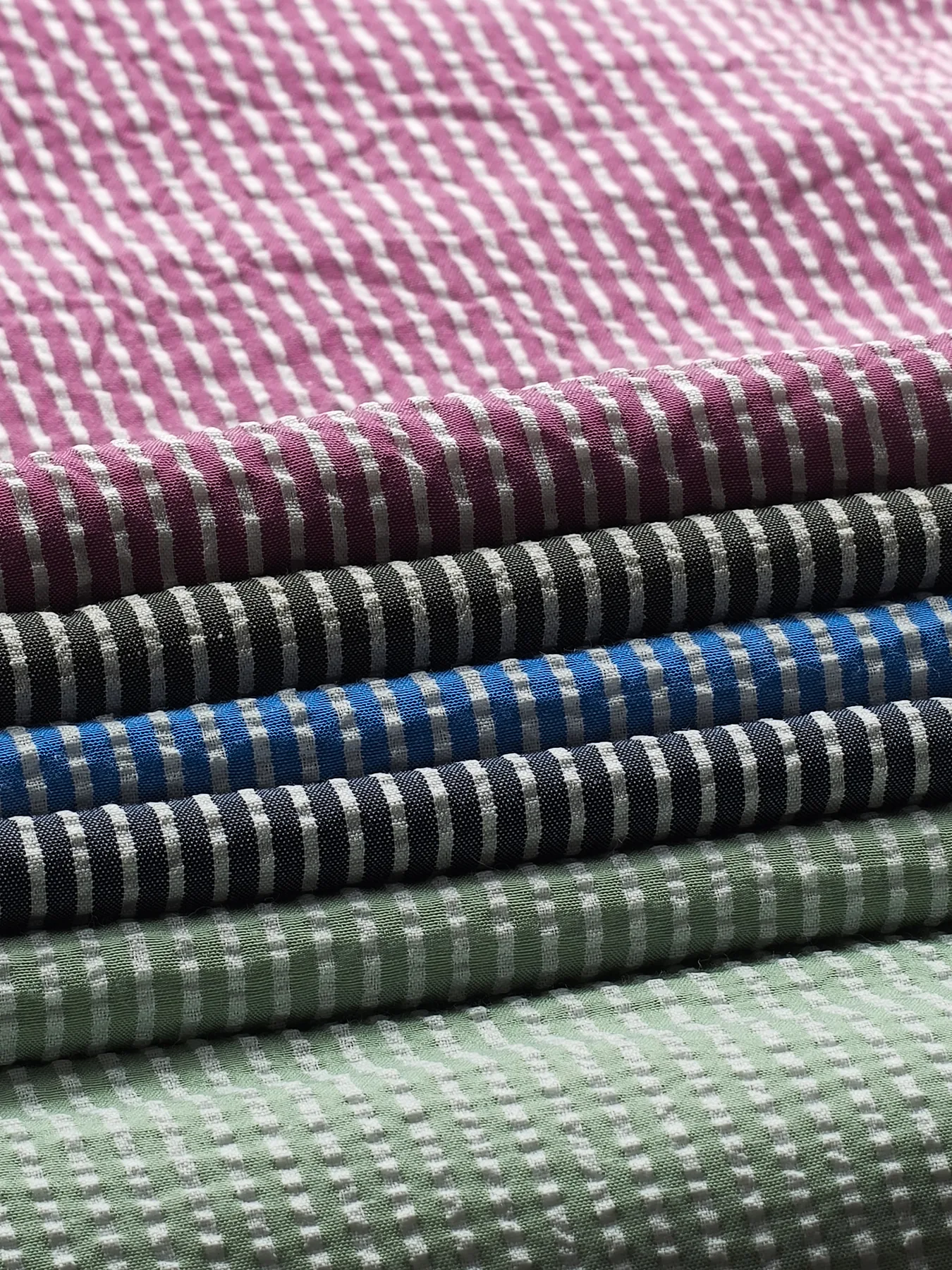
Seersucker is a woven fabric recognized by alternating smooth and puckered areas. The raised texture keeps parts of the cloth from lying flat against the skin, creates a relaxed crinkled appearance, and gives the fabric its familiar warm-weather identity.
Traditional woven seersucker often uses different warp-yarn tensions so some lengthwise areas remain smooth while others draw up into puckers. However, the name does not guarantee one fiber or one manufacturing route. Cotton is common, but seersucker can use other fibers or blends. The Smithsonian, for example, documents a 1942 viscose-rayon seersucker sample made with plain and satin weave stripes.
The practical lesson is simple: seersucker describes a surface and construction effect, not a complete fiber or performance specification.
Quick answer
Seersucker is usually a lightweight to medium-weight woven fabric with built-in puckers. Its texture can:
- reduce the area that rests directly on the skin;
- give garments a casual, three-dimensional appearance;
- make ordinary wrinkles less visually dominant;
- change drape, thickness and seam behavior compared with a flat cloth.
Those effects do not make every seersucker equally breathable, cool, shrink-resistant or easy-care. Fiber content, yarn size, density, pucker depth, finishing, color, garment design and laundering all matter.
How is the puckered surface made?
In classic slack-tension construction, groups of warp yarns are controlled differently during weaving. Tighter groups form flatter stripes. Slacker groups have extra length and rise into a crinkled or puckered stripe when tension is released and the fabric is finished.
Cotton Incorporated’s technical bulletin on woven cotton seersucker describes fabric engineering and tension control across warping, weaving and finishing. That supports the underlying principle for cotton seersucker, but it should not be used to claim that every commercial “seersucker look” uses the same loom setup.
Some fabrics resemble seersucker because of yarn choice, weave combination, chemical treatment, embossing or other finishing. If the permanence and process matter, ask whether the pucker is woven in, created by differential shrinkage, or added mainly by finishing.
Is seersucker always striped?
The classic version has narrow smooth and puckered stripes running with the warp. Blue-and-white stripes are familiar, but color does not define the fabric. Seersucker can be solid, checked, printed or arranged in wider or irregular textured zones.
The functional stripe is the difference between flatter and raised areas, even when both areas share the same color. A printed stripe on a flat fabric is not seersucker simply because it looks similar from a distance.
Is seersucker always cotton?
No. Cotton is traditional and common, but the name does not guarantee cotton.
The Smithsonian’s rayon seersucker record is a useful historical counterexample: the sample is described as viscose filament rayon with plain and satin weave stripes that create a seersucker effect. Modern qualities may also use polyester, cotton/polyester blends, viscose, linen blends, elastane-containing blends or other combinations.
Different fibers change the trade-offs:
| Fiber route | What it may contribute | What still needs checking |
|---|---|---|
| Cotton or cotton-rich | familiar dry hand and absorbency | shrinkage, colorfastness, drying, pucker retention and finish |
| Polyester or polyester-rich | potential dimensional stability and faster drying | hand, static, heat sensitivity, absorbency and finish |
| Viscose/rayon | fluid hand and color potential | wet behavior, dimensional change and care |
| Elastane-containing blend | added stretch | recovery, heat setting, growth and care |
| Other blends | combined properties | exact percentage, yarn placement and test evidence |
These are design considerations, not guaranteed outcomes. Read the label and test the exact quality.
Why can seersucker feel airy?
The pucker creates high and low points, so the cloth may touch the body over a smaller area than a comparable flat fabric. That can reduce cling and help small air spaces form between fabric and skin.
It is safer to say “can feel airier” than “is always more breathable.” Air permeability is measurable under defined conditions; ISO 9237 provides one test method for many fabric types. A deeply puckered but dense, coated or tightly finished fabric may move less air than a lighter, more open flat weave. A garment’s fit, layers, lining and humidity also affect perceived comfort.
When airflow matters, compare actual results using the same method, pressure difference, test area and conditioning. Do not rank two fabrics by texture photographs alone.
Is seersucker wrinkle-free?
No. The permanent-looking crinkle can make ordinary wear wrinkles less noticeable and may reduce the desire for a perfectly pressed surface. That is not the same as wrinkle-free performance.
Seams, collars, plackets and smooth stripes can still crease. Some finishes may change after heat, washing or repeated use. If appearance after care matters, evaluate a sewn sample after the intended laundering route rather than relying on the phrase “no iron.”
Trying to press every pucker flat can also work against the design. Follow the care label and use the lowest effective treatment for the exact fiber and finish.
What is seersucker used for?
Seersucker is widely used where a light, textured appearance is useful:
- warm-weather shirts, dresses, skirts and trousers;
- suits, lightweight jackets and coordinated separates;
- children’s clothing;
- robes and casual homewear;
- bedding, duvet covers, pillowcases and curtains;
- decorative accessories and bags.
The same name can cover very different weights and hands. A fine shirting seersucker is not interchangeable with a heavier bedding or outer-layer quality. Check opacity, drape, pucker scale, seam behavior and care for the intended product.
If you are comparing a commercial fabric rather than learning the definition, use the existing seersucker fabric page as the product-level starting point and confirm the current specification separately.
How does seersucker compare with a flat woven fabric?
| Feature | Seersucker | Flat woven fabric |
|---|---|---|
| Surface | alternating raised and smoother zones | more uniform plane |
| Skin contact | pucker can reduce continuous contact | usually rests more evenly |
| Visual wrinkles | built-in texture can disguise some creases | new creases may be more obvious |
| Drape | affected by pucker depth and stripe layout | driven more directly by weight, yarn and weave |
| Cutting | texture can distort measurements if stretched flat | generally easier to measure on a plane |
| Pressing | pucker should not automatically be flattened | normal pressing may be suitable if fiber allows |
| Performance proof | texture alone proves no airflow or shrink value | appearance alone also proves no performance value |
The closest fair comparison uses the same fiber content, mass, density, finish and garment design. Otherwise several variables change at once.
Does seersucker stretch?
Classic woven seersucker may have limited mechanical give from its puckered geometry, but that is not the same as controlled elastane stretch. The amount and direction vary with construction.
A blend containing elastane may provide greater stretch and recovery. A woven cotton quality without elastane may still move slightly as the puckers open, yet it may not recover like a stretch woven designed for close-fitting garments.
For fit-critical uses, measure extension and recovery in both directions and after care. Do not substitute “crinkled” for an actual stretch percentage.
How should seersucker be washed and dried?
Follow the exact care label. Fiber, dye, finish, pucker route, trims and garment construction can impose different limits.
For sample evaluation:
- mark dimensions without flattening the texture unnaturally;
- wash and dry using the intended consumer route;
- condition the sample before remeasurement;
- compare length, width, pucker depth, skew, color and seam appearance;
- repeat for the number of cycles relevant to the product.
ISO 5077 specifies a method for determining dimensional change after an appropriate combination of washing and drying procedures. A report should state the procedure and result; “pre-shrunk” without a method and tolerance is incomplete.
Avoid a universal instruction such as “always machine wash warm” or “never iron.” Cotton, rayon, polyester and blended seersuckers may require different routes, and the finished product may contain interlining, trim or elastic with stricter limits.
What should you check in a seersucker sample?
1. Pucker formation and permanence
Ask how the texture is produced. Compare pucker depth and stripe spacing across the usable width. Wash a representative sample to see whether the texture relaxes, tightens or becomes uneven.
2. Fiber and yarn information
Record composition percentages, yarn type, color route and whether the smooth and puckered zones use different yarns or weaves.
3. Mass, width and usable width
Measure without crushing the texture. Deep puckers can make flat-width handling and cutting less straightforward.
4. Airflow and opacity
Hold the sample normally rather than stretching the pucker flat. If airflow is a requirement, use a defined test. If modesty or lining is important, inspect under realistic light and movement.
5. Dimensional change and skew
Check after the intended care cycles. Measure both the overall size and whether the stripes or checks remain straight.
6. Seam and pressing behavior
Sew the actual seam, hem, button area or elastic channel. Evaluate whether layers feed evenly and whether pressing damages the relief.
7. Lot and color consistency
Compare production lots for pucker scale, shade, usable width and finishing. Keep an approved reference sample.
The fabric specification checklist provides a broader record for weight, width, construction, testing and tolerances.
Common buying mistakes
- assuming every seersucker is cotton;
- treating a printed stripe as proof of woven pucker;
- calling it wrinkle-free without an appearance-after-care test;
- using the raised surface as proof of a specific air-permeability value;
- measuring width or dimensions after stretching the puckers flat;
- pressing the texture out during sample preparation;
- approving only a close-up photo without checking the reverse side and full-width repeat;
- reusing one care instruction across different fibers and finishes.
Final takeaway
Seersucker is a woven fabric effect defined by its alternating smooth and puckered surface. Traditional slack-tension construction explains the classic form, but fiber content and manufacturing routes vary.
The pucker can reduce cling, create small air spaces and make wrinkles less visually dominant. It does not prove a universal comfort, shrinkage or care result. For a real decision, compare the exact fiber, construction, pucker route, mass, width, airflow, dimensional change, seam behavior and care evidence.
If you already have an end use and measurable requirements, you may optionally send a project brief; an inquiry is not required to use this guide.
FAQ
Is seersucker a weave or a fiber?
It is a fabric construction and surface effect, not a fiber. Cotton is common, but rayon and other fibers or blends can also be used.
Why is seersucker puckered?
In classic construction, groups of warp yarns have different effective tension or length, causing some areas to rise while adjacent areas stay smoother.
Is seersucker good for hot weather?
It can feel less clingy because the puckers reduce continuous skin contact. Actual comfort also depends on fiber, density, finish, garment fit, layers and climate.
Does seersucker need ironing?
The textured appearance often makes pressing less important, but the care label should decide. Avoid flattening the pucker unless the product instructions permit it.
Does seersucker shrink?
It can. The amount depends on fiber, construction, finishing and laundering. Request a dimensional-change result or test the exact sample.
Is all seersucker blue and white?
No. It can be solid, striped, checked, printed or made in many color combinations.
Is seersucker always lightweight?
Many apparel qualities are light to medium weight, but the name does not set a fixed mass. Bedding and decorative versions may be heavier.
Is crinkle fabric the same as seersucker?
Not necessarily. Similar texture can be created by different yarn, weave, shrinkage or finishing routes. Ask how the pucker is produced if permanence and process matter.
References
- Cotton Incorporated. Processing Woven Cotton Seersucker Fabrics. Technical Bulletin TRI 2003. Accessed 2026-09-07.
- Smithsonian National Museum of American History. Rayon Seersucker; American Viscose Corporation; 1942. Accessed 2026-09-07.
- The Weavers’ Company. Glossary of Weaving Terms. Accessed 2026-09-07.
- ISO. ISO 9237:1995 — Textiles — Determination of the permeability of fabrics to air. Status shown as Published and confirmed in 2023; accessed 2026-09-07.
- ISO. ISO 5077:2007 — Textiles — Determination of dimensional change in washing and drying. Status shown as Published; accessed 2026-09-07.
- U.S. Federal Trade Commission. Apparel and Labeling. Accessed 2026-09-07.