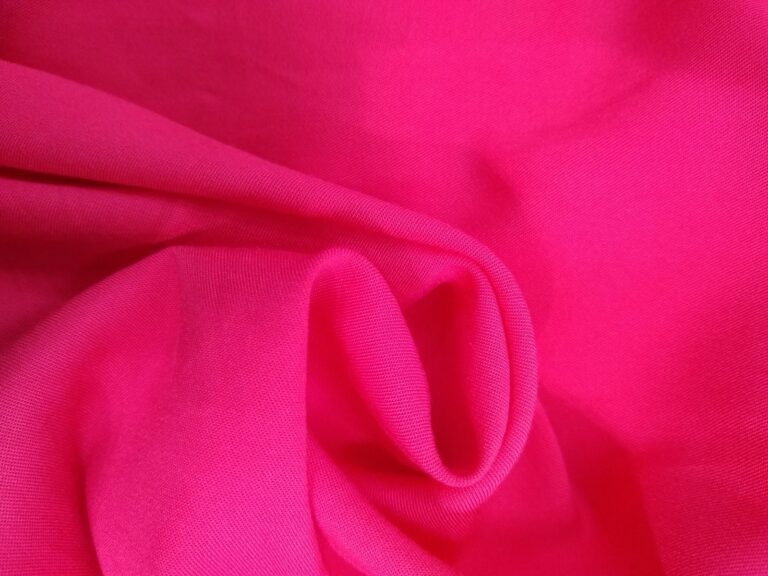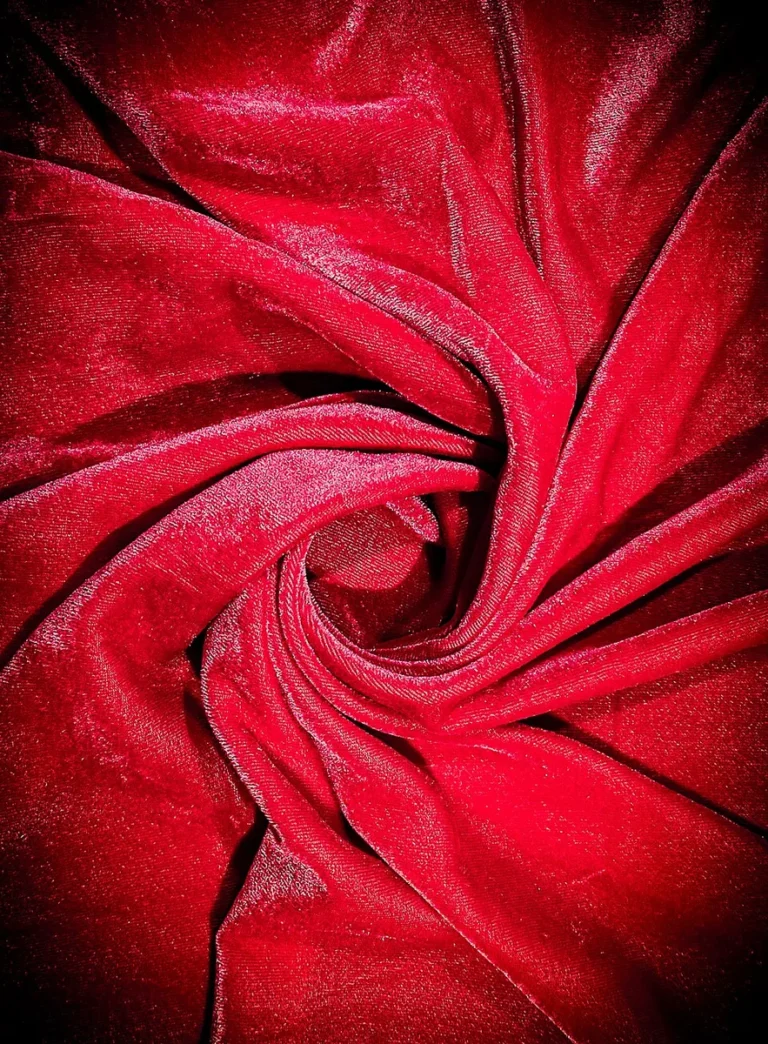
Tricot is a type of warp-knit fabric. Instead of one yarn travelling across a row of loops as it often does in weft knitting, a warp-knitting machine feeds many yarns in the length direction. The yarns form loops and shift between neighbouring columns, creating an interlocked structure.
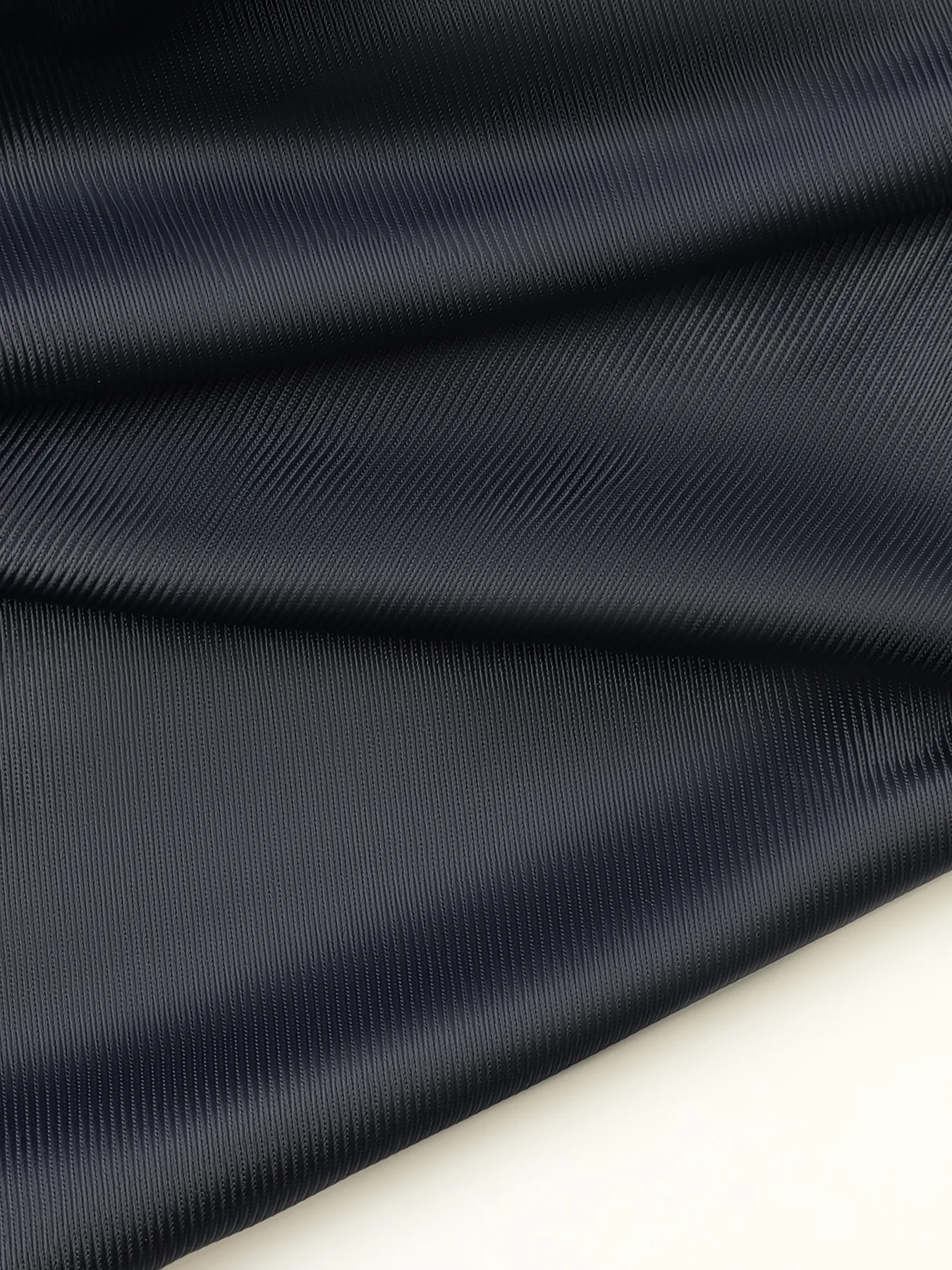
That construction often gives tricot a fine, relatively flat face and a different-looking back. CottonWorks defines tricot as a flat warp knit with fine wales on the face and more or less pronounced crosswise ribs on the back. Those two surfaces are useful identification clues, but they are not a complete specification.
The most important point is simple: tricot names a knit construction, not one fiber, one stretch level or one use. A lightweight lining, an elastic swim fabric and a stable non-apparel backing may all belong to the wider tricot family while behaving very differently.
Quick answer
Tricot is made on a warp-knitting machine using parallel lengthwise yarns. A typical sample may show:
- fine lengthwise wales on the technical face;
- crosswise or zigzag-looking ribs and underlaps on the technical back;
- a flatter, finer surface than many bulky knits;
- stretch and recovery that vary with lapping, yarn, gauge, elastane and finishing;
- polyester, nylon or another verified fiber route rather than one required composition.
To identify a particular fabric, inspect both sides, read the fiber label or data sheet, and compare stretch in both directions. Do not call a fabric tricot only because it is shiny, smooth or stretchy.
How is tricot constructed?
Warp knitting starts with multiple yarns arranged parallel to the direction in which the fabric is made. CottonWorks explains that, in warp knitting, individual needles work simultaneously across the machine and form loops from separate lengthwise yarns. The yarns do not simply remain in straight columns: guide bars move them between needles so that adjacent wales interlock.
You can imagine a row of vertical chains that are tied to their neighbours by small sideways movements. Those sideways connections are part of the lapping pattern. Change the guide-bar movement, threading, gauge, yarn run-in or yarn type and the fabric can change in density, appearance, stability and extension.
KARL MAYER's warp-knitting training treats lappings, guide bars, threading, gauge and yarn run-in as separate design and calculation variables. That is why “warp knit” describes the production family, while “tricot” still covers many possible fabrics.
This also explains why a photograph alone cannot verify a full construction. A close view may show ribs, but a technical record or controlled sample inspection is needed to confirm machine type, lapping and exact specification.
What do the face and back look like?
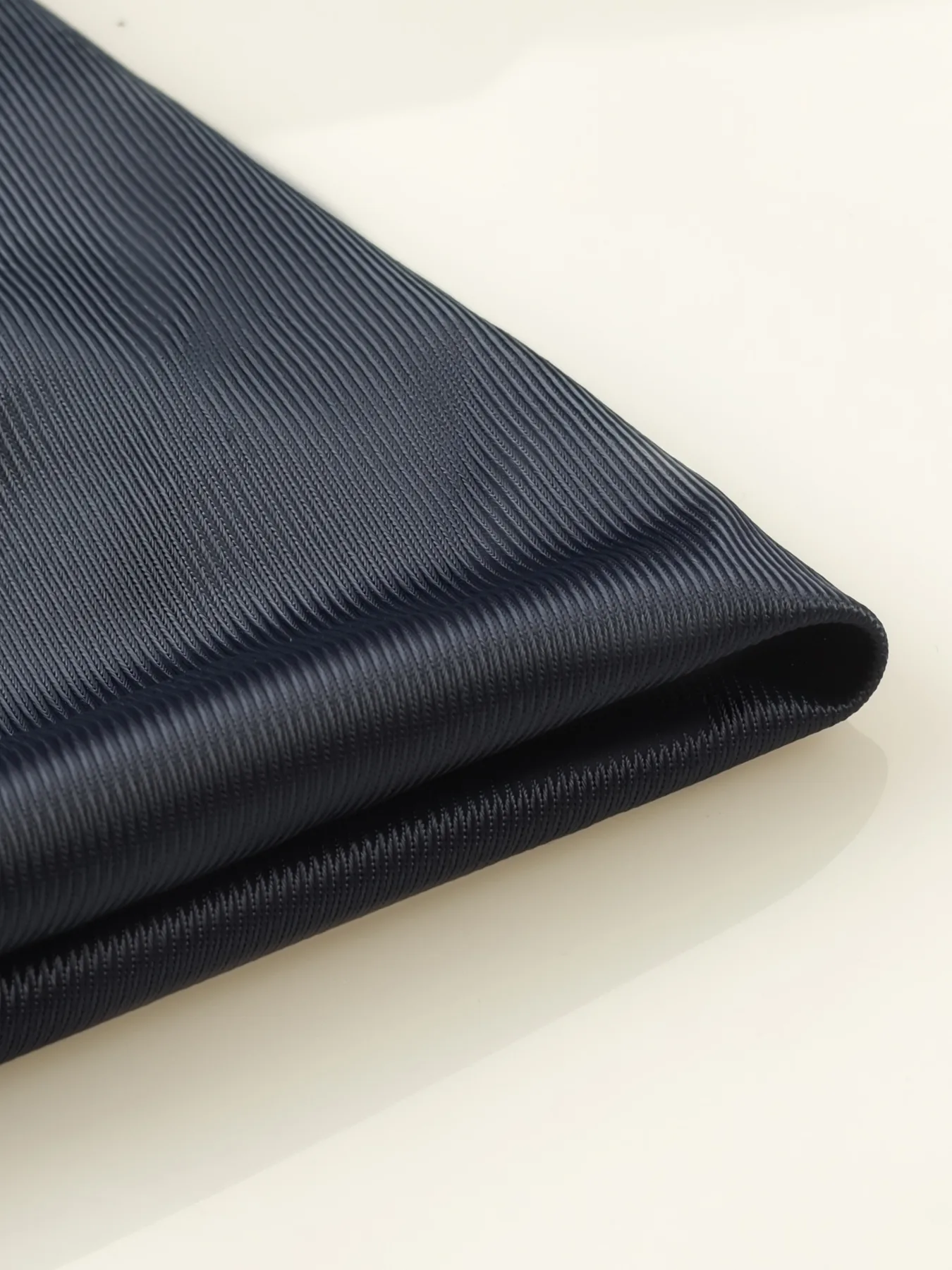
The technical face of a basic tricot commonly shows fine wales running lengthwise. A wale is a vertical column of knit loops. From normal viewing distance, these columns can create a smooth, subtle ribbed or faintly shiny surface.
The technical back commonly shows more obvious crosswise ribs, diagonal connections or a zigzag effect. Those marks come from the yarn travelling between adjacent wales. CottonWorks' tricot definition uses the same practical distinction: fine face-side wales and crosswise back-side ribs.
This is a starting point, not an absolute visual rule. Brushing, sueding, printing, coating, laminating, raising or other finishing can hide the original loop appearance. A patterned or open construction can also look unlike a basic close-knit tricot. Some finished products may deliberately show the technical back on the outside.
When examining a swatch:
- place it flat without stretching it;
- mark the machine or roll direction if known;
- compare the loop columns and ribs under side lighting;
- turn the sample over instead of judging one surface;
- repeat the inspection under gentle lengthwise and crosswise tension;
- record any brushing, coating or laminate that may cover the structure.
Is tricot always polyester?
No. Polyester is common, but the name tricot does not mean polyester.
CottonWorks notes that warp-knitting machinery commonly works with synthetic filament yarns because of the process and yarn-friction demands. Polyester and nylon are therefore familiar choices in commercial tricot. Elastane may be added when a fabric is engineered for more stretch and recovery. Other fiber or yarn routes are possible where the machine, gauge and product design allow them.
For a real item, composition comes from the label, technical data sheet or test—not from the construction name. The FTC Textile Fiber Rule is a useful US example: covered products disclose generic fiber names and percentages by weight. “Tricot,” “warp knit,” “smooth” or “performance” is not a substitute for those fiber disclosures.
The currently published WellDoneTex Tricot product page carries one product-level specification. This educational guide deliberately does not repeat those commercial fields, and no single product may be rewritten as the definition of all tricot.
Does tricot stretch?
Many tricot fabrics extend under tension, but the amount and stronger direction are not fixed by the name.
Stretch depends on several variables working together:
- the lapping path and length of the yarn movement between wales;
- single- or multi-guide-bar construction;
- yarn type and crimp;
- whether elastane or another elastic component is present;
- fabric density and gauge;
- heat setting, coating, brushing or lamination;
- direction of the applied force.
This is why two people can give opposite descriptions of “tricot stretch” and both may be describing their own samples correctly. Runtang describes standard tricot lining in its own range as typically extending more across the width than along the length. That is a useful sample hypothesis, not a universal rule. One fabric may show useful widthwise extension, another more lengthwise give, and an elastic activewear tricot may move in both directions. A stable lining or backing can behave differently again.
For an ordinary comparison, mark a 10 cm reference length in each direction, apply the same gentle load for the same time, release it, and observe extension and recovery. That is a shop-floor comparison, not a formal result. When a specification needs a defensible number, use an agreed method such as ISO 20932-1 and report the direction, specimen form, load or extension cycle, conditioning and result.
Avoid claims such as “four-way stretch,” “excellent recovery” or a percentage value unless they belong to the exact quality and have a stated basis.
How does tricot feel and drape?
A basic fine-gauge tricot can feel smooth, light and fluid. Filament yarns may add sheen, while matte yarns or finishes can reduce it. Denser qualities can feel firm; lighter qualities may feel more flexible or transparent. Brushing can create a softer, less visibly ribbed surface.
None of those traits is automatic. Handfeel and drape depend on yarn size, fiber, texture, gauge, mass, lapping, finishing and any added layer. “Silky,” “breathable,” “non-cling” and “quick-dry” are not safe category-wide promises.
If a particular feel matters, compare physical samples under the same conditions. Check the face, back, edge, folds and recovery rather than approving from one close-up image.
What is tricot fabric used for?
Tricot is used where a fine warp-knit surface and controlled fabric behaviour suit the product. Common application families include:
- lingerie and intimate-apparel components;
- swimwear and activewear fabrics;
- lightweight garment linings;
- dresses, tops and selected fashion layers;
- sportswear details and support panels;
- selected lightweight jackets and loungewear.
These are application examples, not proof that one fabric fits every item. A lining quality may not have the opacity or recovery needed for swimwear. An elastic swim tricot may be unsuitable as a stable backing. A brushed construction may need a different care and abrasion review from a smooth one.
Start with the finished product. Then check composition, mass, width, stretch and recovery, opacity, hand, surface, seam behaviour, colourfastness, dimensional change and required market rules.
Tricot versus jersey and raschel
Tricot is often compared with other knits, but the names refer to different construction families rather than a simple quality ranking.
| Fabric family | Basic construction idea | Practical reading |
|---|---|---|
| Tricot | flat warp knit made from parallel lengthwise yarns | often fine and relatively flat; face and back commonly differ |
| Jersey | commonly a weft-knit structure | usually formed from yarn travelling across courses; edge curl and stretch can differ by quality |
| Raschel | another warp-knit class | often used for more open, patterned, lace, mesh or engineered structures, although dense versions also exist |
Do not assume that tricot is always stronger, smoother or less stretchy than jersey or raschel. The fair comparison is between exact samples at a relevant weight, fiber, finish and test condition.
How should tricot be washed and dried?
Follow the care label for the exact fabric or finished product. There is no universal “tricot wash setting.” Polyester, nylon, elastane, print, coating, adhesive, lining, trim and heat setting can each change the suitable route.
The FTC Care Labeling Rule requires covered US care instructions to have a reasonable basis. That principle is useful even outside a legal-label decision: do not copy a wash temperature from a generic article when the exact product may differ.
For sample development, record the intended washing and drying procedure, measure the specimen before care, repeat the required cycles and then check:
- length and width change;
- distortion or skew;
- loss of stretch or recovery;
- colour change, staining or crocking;
- surface glazing, snagging, fuzzing or brushing change;
- delamination or coating damage;
- seam puckering and edge behaviour.
ISO 6330:2021 provides defined domestic washing and drying procedures for textile testing, while ISO 5077:2007 covers determining dimensional change after an appropriate procedure. A result is meaningful only when the method and conditions are stated.
For consumers, the safe rule is shorter: read the item's label, close hooks or rough fasteners that could snag a fine surface, and do not add heat, bleach or dry cleaning unless the instructions permit it.
What should you check in a tricot sample?
1. Confirm the identity
Record supplier, style code, lot and colour. Confirm that the construction is actually tricot rather than relying on a vague “stretch knit” label.
2. Inspect both sides
Look for the fine face-side wales and the back-side ribs or underlaps. Note any brushing, coating or lamination that hides the base structure.
3. Verify composition
Record generic fiber names and percentages. If the face and backing or laminate differ, identify each component separately.
4. Measure mass and width
Use the agreed conditioned method and distinguish nominal width from usable width. Do not copy the specification from a different Tricot product.
5. Compare extension and recovery by direction
Test lengthwise and crosswise. Record the method, load, cycles and remaining growth rather than saying only “good stretch.”
6. Check opacity and surface under use conditions
View the sample flat and stretched under realistic lighting. Look for shine, show-through, snagging, streaks and needle lines.
Cut a small strip in each direction and observe edge curl, ravel, ladders or runs. Many warp knits resist some forms of unravelling, but the exact cut-edge result must be checked rather than assumed.
7. Sew and finish a small trial
Use the intended seam, needle, thread, edge finish and companion layer. Check puckering, skipped stitches, seam growth and curling.
8. Run the intended care route
Measure dimensional change, surface appearance and recovery after the planned washing and drying cycles.
The fabric specification checklist can be used to keep these observations in one comparable record.
Final takeaway
Tricot is a flat warp-knit fabric made from many parallel lengthwise yarns. Fine wales on the face and crosswise ribs or underlaps on the back are useful clues, but finishing can change what you see.
The word tricot does not guarantee polyester, four-way stretch, breathability, durability or one care method. Verify the exact fiber content, both surfaces, stretch by direction, weight, width, finish and care behaviour on the actual sample.
Related questions
Is tricot woven or knitted?
It is knitted—specifically warp knitted. The word “warp” describes the lengthwise yarn arrangement; it does not make tricot a woven fabric.
Does tricot have a right and wrong side?
A basic tricot usually has a technical face with fine lengthwise wales and a technical back with more crosswise ribbing or underlaps. A designer may expose either side, and finishes can obscure the difference.
Is tricot always nylon or polyester?
No. Those fibers are common, especially as filament yarns, but the construction name does not establish composition. Check the label or technical record.
Is all tricot four-way stretch?
No. Directional extension and recovery depend on structure, yarn and finish. Test the exact sample in both directions and use a stated method when a numeric claim matters.
Is tricot the same as jersey?
No. Tricot is a warp knit; jersey is generally a weft-knit structure. Both families contain many weights, fibers and finishes, so compare actual samples rather than assuming one is always better.
Can you identify tricot from a photograph?
A close photograph may show fine wales or back ribs, but it cannot reliably prove fiber content, lapping, stretch, recovery, finish or care. Use both-side inspection and a specification.
What is the safest care method for tricot?
There is no category-wide setting. Follow the exact care label and verify the intended washing and drying route on a representative sample.
Where can I review a specific Tricot product?
See the WellDoneTex Tricot product page for one current product example and its product-level information. Compare that exact record with your own application because one sample does not define the whole Tricot category.
References
- Cotton Incorporated, CottonWorks. Tricot. Accessed 2026-09-12.
- Cotton Incorporated, CottonWorks. Knit Basics. Accessed 2026-09-12.
- Cotton Incorporated, CottonWorks. Knit Machinery: Flat, Circular, and Seamless. Accessed 2026-09-12.
- KARL MAYER Academy. eLearning Introduction to Warp Knitting. Accessed 2026-09-12.
- International Organization for Standardization. ISO 20932-1:2018 — Determination of the Elasticity of Fabrics — Part 1: Strip Tests. Accessed 2026-09-12.
- International Organization for Standardization. ISO 6330:2021 — Domestic Washing and Drying Procedures for Textile Testing. Accessed 2026-09-12.
- International Organization for Standardization. ISO 5077:2007 — Determination of Dimensional Change in Washing and Drying. Accessed 2026-09-12.
- U.S. Federal Trade Commission. Textile Fiber Rule and Care Labeling Rule. Accessed 2026-09-12.
- WellDoneTex. Tricot commercial product page. Read 2026-09-12.
- Pine Crest Fabrics. What Is Tricot Fabric?. Accessed 2026-09-12.
- Runtang Tex. Tricot Lining Fabric for Sportswear. Accessed 2026-09-12.
- Groz-Beckert. Warp Knitting. Accessed 2026-09-12.
- University of California Cooperative Extension. Fabric Reference Guide. Accessed 2026-09-12.