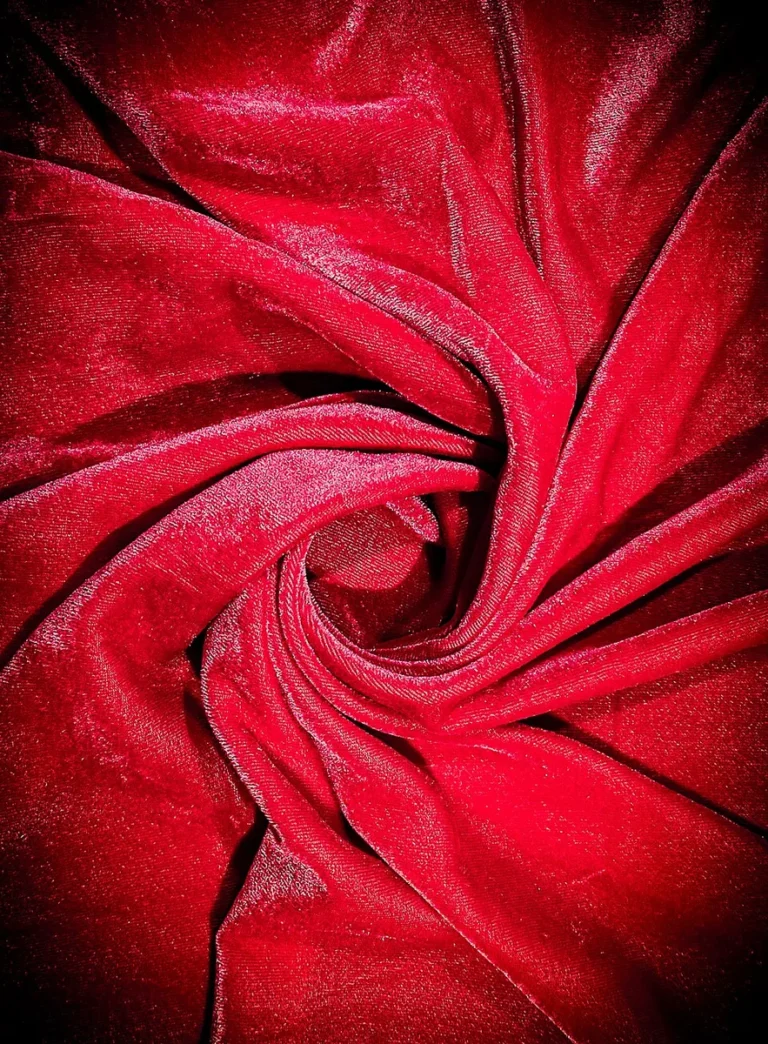
Floral burnout fabric is a patterned textile in which selected parts of a compatible fiber component are removed to form a flower design. Material that remains creates the visible motif, while the treated areas may look lighter, sheerer or more open. Floral names the motif; burnout, also called devoré, names the selective-removal technique.
The name describes a design method, not one universal material. Floral burnout can appear in velvet and in other compatible constructed textiles, and its exact fiber content, weight, stretch, opacity and care needs vary. It is therefore more useful to read “floral burnout” as how the pattern was made than as a complete product specification.
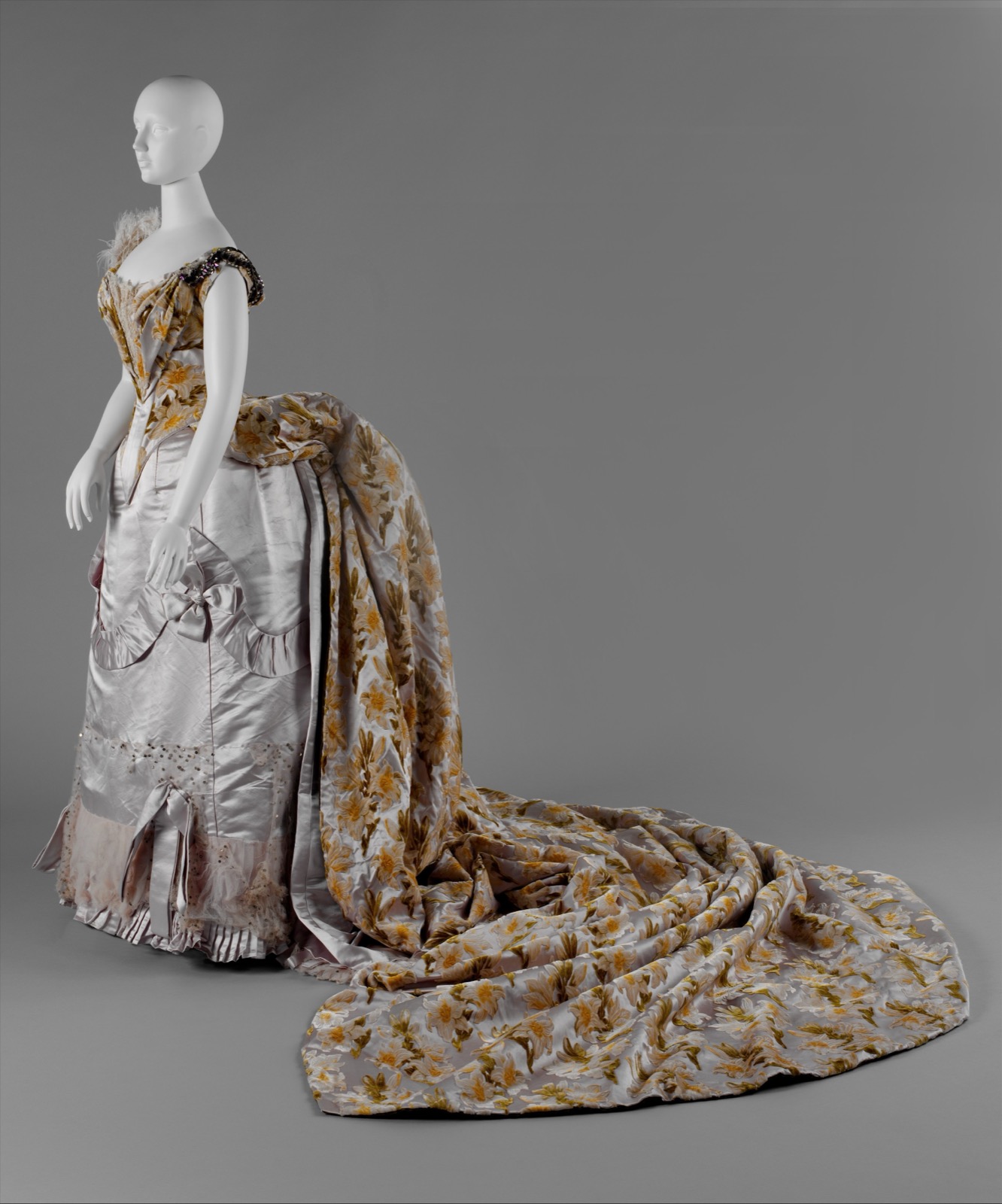
Historical example: House of Worth court presentation ensemble, ca. 1888. The Met documents its floral train as printed ivory, pink and olive-green devoré silk velvet. The photograph identifies one museum object, not a current WellDoneTex product or a universal burnout construction. The Metropolitan Museum of Art, object 137479, CC0 Open Access image.
Quick Answer: What Does Floral Burnout Mean?
Burnout begins with a fabric built from components that do not respond in the same way to the selected removal process. A floral pattern is placed in chosen areas, and a compatible component is removed there while another component remains. The result is a pattern created by a physical change in the constructed textile rather than by color alone.
The Textile Society of America paper Tracing the Temporary Thread: Decorative and Functional Devoré Textiles of the Early Twentieth Century describes devoré as the removal of one or more fibers from a constructed fabric. The paper also records lace-like effects in historical examples. This supports the basic mechanism, but it does not mean every modern burnout fabric uses the same fibers, process settings or finished construction.
Three points prevent the most common misunderstandings:
- A flower can be printed on many fabrics, but a floral print is not automatically burnout.
- Burnout does not mean that the entire fabric is dissolved. Selected compatible material is removed in the patterned areas while another part remains.
- Burnout is not another word for velvet, flannel or fleece. Those are separate fabric descriptions that may or may not appear in a particular product.
How Is the Floral Pattern Created?
At a reader level, the sequence is straightforward:
- Start with a suitable constructed textile. The fabric needs components that allow one part to be removed without eliminating the whole structure.
- Define the flower artwork. Motif scale, repeat, spacing and edge detail determine how the pattern will read across a garment or panel.
- Apply the selective-removal treatment to the pattern areas. The treatment acts on a compatible component in those chosen zones.
- Clear and finish the fabric. Removed material and process residues have to be cleared appropriately, and the surface is finished for the intended appearance and hand.
- Inspect the result. Pattern edges, retained material, ground uniformity, holes or weak areas, shade, width and garment-scale placement all matter.
This is deliberately a high-level industrial explanation. A recipe copied from one fiber combination may damage another material or create unsafe handling conditions. The defining idea is selective component removal—not a particular chemical name, concentration, temperature or dwell time.
What Does Floral Burnout Fabric Look Like?
The eye usually reads two levels at once: the retained floral area and the changed ground around or within it. In burnout velvet, the remaining pile can make flowers or leaves appear richer and more raised, while the treated ground may appear flatter, paler or sheerer. In a non-pile construction, the contrast may be subtler and rely more on openness, texture or light transmission.
Pattern design changes the effect. Large flowers can create dramatic panels; small repeats can read as an all-over texture; widely spaced motifs leave more visible ground. Color also matters because a low-contrast combination may make the structure noticeable only at close range, while a strongly contrasting combination makes the motif visible from farther away.
Light conditions can change what the viewer sees. A fabric that looks mostly solid on a table may reveal more contrast when held against a window or placed over a lining. That visual observation does not establish a numerical opacity or air-permeability result, and a photograph cannot prove breathability.
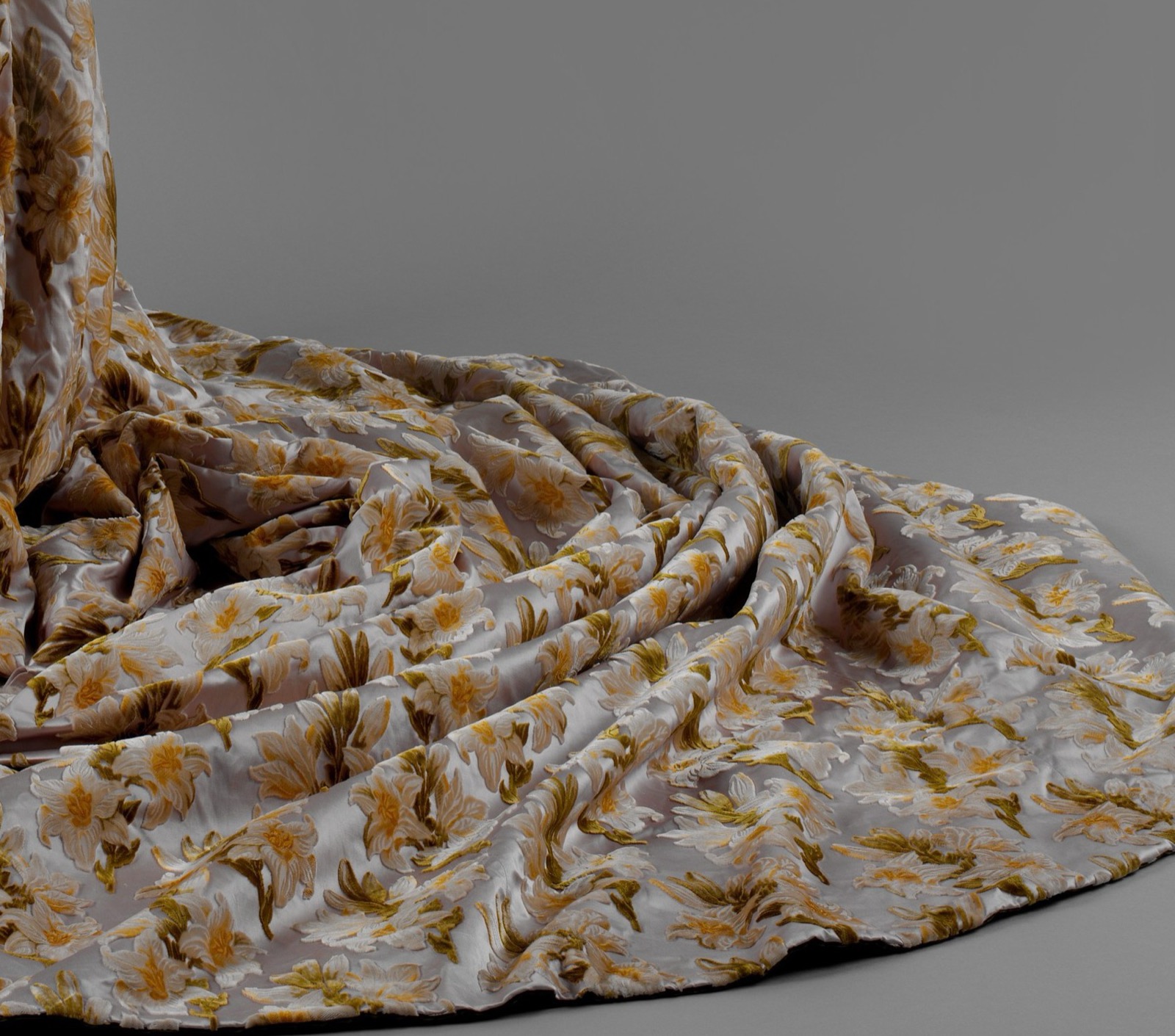
Detail from the floral devoré silk-velvet train of the House of Worth court presentation ensemble, ca. 1888. The retained floral surface is visible against a paler ground. This crop shows appearance only; it does not prove transparency, breathability, production chemistry or the construction of other burnout fabrics. Cropped from The Metropolitan Museum of Art object 137479, CC0.
Burnout vs. Print, Emboss and Woven Jacquard
Several methods can produce a floral surface, but they do not create it in the same way.
| Pattern method | How the pattern is formed | What a reader may see | What the name does not prove |
|---|---|---|---|
| Floral burnout / devoré | A compatible fiber component is selectively removed from chosen areas after the textile is constructed | Retained motifs against a flatter, paler, more open or sometimes sheer ground | Exact fiber blend, opacity, stretch, durability, care or end use |
| Floral print | Color or another print medium is placed or transferred in a design | Color changes that may leave the base surface substantially similar | That any fiber was removed |
| Floral emboss | Relief is pressed or set into the surface | Raised or recessed texture, sometimes with sheen differences | That the design extends through the construction or uses burnout |
| Woven floral jacquard | The pattern is formed by controlled yarn interlacing during weaving | Motifs woven into the fabric structure, often with different face and back appearances | One universal weight, fiber, performance or face/back appearance |
For the mechanism boundary, the University of Arizona-hosted reference Embossed Designs describes embossed designs as pressed into fabric, while Cooper Hewitt’s Jacquard explanation documents a loom weaving intricate images into silk. These sources support the two mechanisms described in the table; they do not prove how an unknown modern fabric was made.
These methods can also be combined. The Met describes the historical train above as printed devoré silk velvet, so “printed” and “devoré” are not always competing labels. One term can describe how color was added while the other describes selective removal. The correct description follows the actual construction and processes used.
Is Floral Burnout Always Velvet?
No. Velvet is a familiar setting because removing selected pile or component areas can create a strong contrast between rich floral motifs and a changed ground. But devoré is a technique with a longer and broader textile history. The Textile Society of America paper traces it through constructed fabrics and different temporary-thread or component-removal applications.
The reverse is also important: not every floral velvet is burnout. A velvet flower may be woven as a figured or voided structure, printed in color, embossed, embroidered or created by another surface treatment. If the seller provides only a photograph and the phrase “floral velvet,” the image cannot establish which mechanism was used. For the broader distinction between two pile-fabric names, the existing Velour vs. Velvet Fabric guide explains why visible pile alone does not make velour and velvet interchangeable; that comparison does not imply that WellDoneTex supplies burnout fabric.
Likewise, a listing called “flower burnout flannel fleece” describes one marketed product direction. It does not redefine the entire category. A buyer or reader should separate four questions:
- What is the base construction: woven, knitted, pile or another form?
- What are the complete fiber percentages?
- Which component remains in the patterned area and ground?
- Which process created the visible flower: removal, printing, embossing, jacquard or a combination?
Where Is Floral Burnout Used?
Floral burnout is often chosen when the pattern itself should add visual depth rather than act as color alone. It may appear in dresses, skirts, blouses, sleeves, overlays, scarves, occasion panels and decorative textile applications. The Met court train and the Te Papa day dress are documented garment examples from different periods; Te Papa states that devoré created a transparent effect around the dress’s heart motifs.
Those examples show the range of visual possibilities, not a recommendation for every use. A sheer or open area may need a lining in one dress but be intentionally exposed in a sleeve. A raised velvet motif may suit an occasional garment but create unwanted bulk at a tight seam. A widely spaced pattern may look elegant on a large panel yet lose its intended repeat on a small collar or cuff.
Before choosing the fabric for a garment, look at the full pattern repeat on a body-size panel. Check which part of the motif falls at seams, darts, hems and closures. Also inspect both sides, fold the material as it will sit in the garment, and view it over the intended lining or skin-tone reference. These steps answer practical design questions that a close-up swatch photograph cannot.
How Do You Read a Floral Burnout Label?
Start by separating the style description from the required product information. “Floral burnout” tells you about motif and technique; it is not a generic fiber name and does not give percentages.
For textile products covered by U.S. rules, the FTC Textile Fiber Rule requires disclosure of generic fiber names and percentages by weight, along with the manufacturer or marketer identity and country of processing or manufacture. A fiber line such as “65% rayon, 35% polyester” is therefore different in purpose from a front-of-page phrase such as “floral burnout velvet.”
Read the available information in this order:
- Fiber content: record every named fiber and percentage instead of assuming that “velvet” or “burnout” identifies the composition.
- Construction description: look for terms such as woven, knit, velvet, mesh or lining. If construction matters and is not stated, the fiber label alone will not answer it.
- Care instruction: follow the finished product’s actual care label, not a generic web instruction for another burnout fabric.
- Responsible company and origin: these fields identify the marketer or manufacturer route and where the product was processed or made; they are not performance certificates.
- Technical specification when needed: for production decisions, request pattern repeat, usable width, finished weight, face/back photos and the tests relevant to the garment.
A label can accurately list total fiber percentages without telling you which fiber remains in every part of the motif. If that distinction matters for development, it needs supporting construction information from the actual fabric—not visual guesswork.
Can You Wash Floral Burnout Fabric?
There is no safe universal wash instruction for everything called floral burnout. The final care route depends on the exact fibers, dyes, retained structure, trims, lining, garment construction and finishing. A historical devoré silk-velvet train, a rayon-blend fashion dress and a modern knit burnout top should not be assigned the same care cycle just because their patterns share a technique name.
For a finished garment, use the attached care label. The FTC Care Labeling guidance explains that care instructions and warnings need a reasonable basis and must account for the garment as a whole. Evidence for one fabric component is not enough if a lining, trim, color combination or assembled seam can be harmed during the stated procedure.
For an unlabeled vintage, handmade or sample item, do not infer a wash cycle from the visible floral effect. The prudent next step is identification by a qualified cleaner or textile specialist, especially where age, pile, silk, rayon, metallic decoration or unknown dyes are involved. The museum image in this guide is not care evidence for another object.
A Practical Review Checklist
For ordinary shopping or wardrobe use, ask four direct questions:
- Does the label give the complete fiber content?
- Is the garment lined where the ground is visibly lighter or sheer?
- Does the pattern sit well at seams, closures and high-friction areas?
- What does the attached care label actually allow or prohibit?
For product development, record a little more:
- base construction and complete fiber composition;
- confirmed meaning of “burnout” in the seller’s description;
- which component is removed and which remains;
- motif artwork, repeat size, direction and placement tolerance;
- finished GSM, usable width and ground uniformity;
- appearance over the intended lining and under backlight;
- hand, drape, stretch and recovery where relevant;
- weak areas, unintended holes, motif-edge definition and seam behavior;
- colorfastness, dimensional change, strength or other agreed tests for the end use;
- finished-garment care instructions supported by the whole item.
The list is not a claim that every program needs every test. Its purpose is to turn an attractive but broad name into a specification that can be compared consistently.
FAQ
What is floral burnout fabric?
It is a patterned textile in which selected parts of a compatible fiber component are removed to form a floral design. Retained material contrasts with a changed ground that may look flatter, paler, more open or sheer.
Is burnout the same as devoré?
Yes. In textile use, devoré is also known as burnout. The terms refer to selective fiber-component removal from an already constructed fabric.
Is floral burnout just a print?
No. A print places or transfers a design, while burnout changes the material in selected areas. A fabric can use both processes, so the correct description may include both “printed” and “devoré.”
Is all floral burnout velvet?
No. Velvet is one familiar form, but burnout describes the selective-removal method rather than one universal fabric type. Not every floral velvet is burnout either.
Is floral burnout transparent?
Some versions create sheer or transparent areas, but not all do. The effect depends on what is removed, what remains, the base construction, color, lighting and any lining. A photograph is not a numerical opacity result.
Is floral burnout breathable?
The name alone cannot answer that. Openness in selected areas may change air movement, but breathability depends on the complete construction, fibers, finish, lining and garment design. It should not be claimed from appearance alone.
Can you wash floral burnout fabric?
Follow the finished item’s care label. Burnout is a technique, not a care instruction, and different fiber combinations, dyes, linings and trims can require different methods.
References
- Andie Robertson, Textile Society of America Symposium Proceedings, Tracing the Temporary Thread: Decorative and Functional Devoré Textiles of the Early Twentieth Century
- Museum of New Zealand Te Papa Tongarewa, Day dress, registration GH013642 — text evidence only; its images are All Rights Reserved and are not reproduced here
- The Metropolitan Museum of Art, Court presentation ensemble, object 137479
- The Metropolitan Museum of Art, “Trailing Lilies” curatorial record
- The Metropolitan Museum of Art, Open Access policy
- The Metropolitan Museum of Art, Textile Production in Europe: Printed, 1600–1800
- Cooper Hewitt, Smithsonian Design Museum, Meet Monsieur Jacquard
- University of Arizona-hosted textile reference, Embossed Designs
- Federal Trade Commission, Textile Fiber Rule
- Federal Trade Commission, Clothes Captioning: Complying with the Care Labeling Rule
Source identity note: The Met’s 2007 “Trailing Lilies” record gives accession 2007.385a–m, while the current Collection API snapshot gives 2007.385a–l. Both routes identify The Met object 137479, the House of Worth court presentation ensemble, ca. 1888. This article uses the stable object ID and both official links rather than silently choosing one accession range.