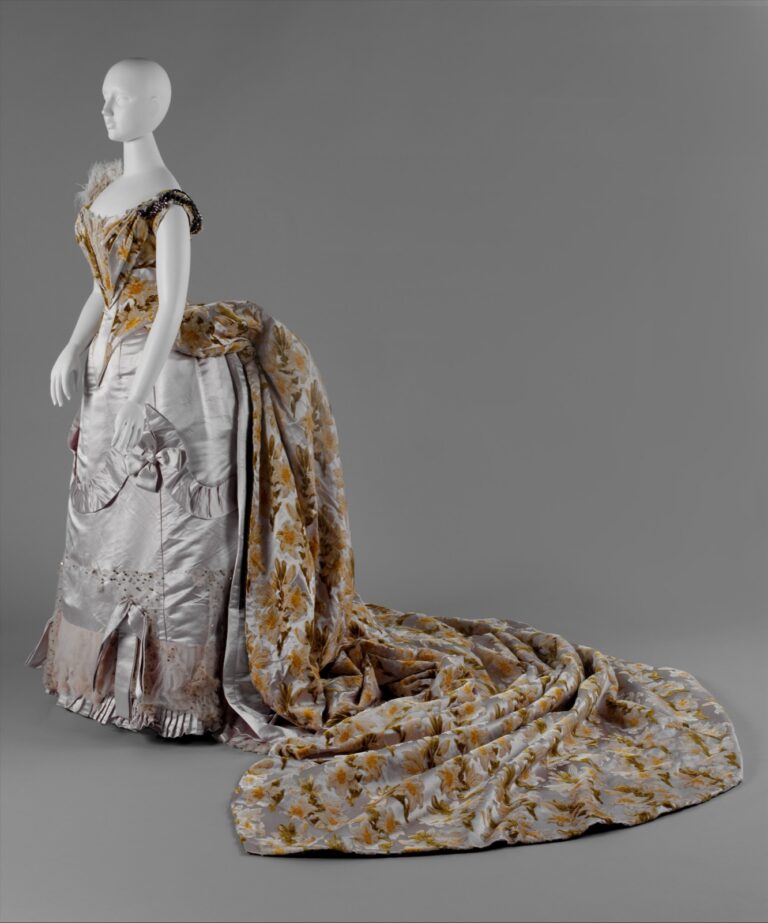
Viscose garments can shrink or change shape during laundering, but the fiber name alone cannot tell you whether the item in your hand may be washed. Start with the finished garment's care label. If it permits washing, follow the printed wash method, water setting, drying route and warnings. If it does not permit washing—or the label is missing or unclear—do not replace that instruction with a generic hand-wash recipe.
Cold water may be part of a permitted care route, but it is not a universal guarantee. Machine action, detergent, drying, fabric construction, finishing, seams and trims can also affect the result. The practical question is not simply “Does viscose shrink?” It is “What care procedure was this exact garment designed and tested to tolerate?”
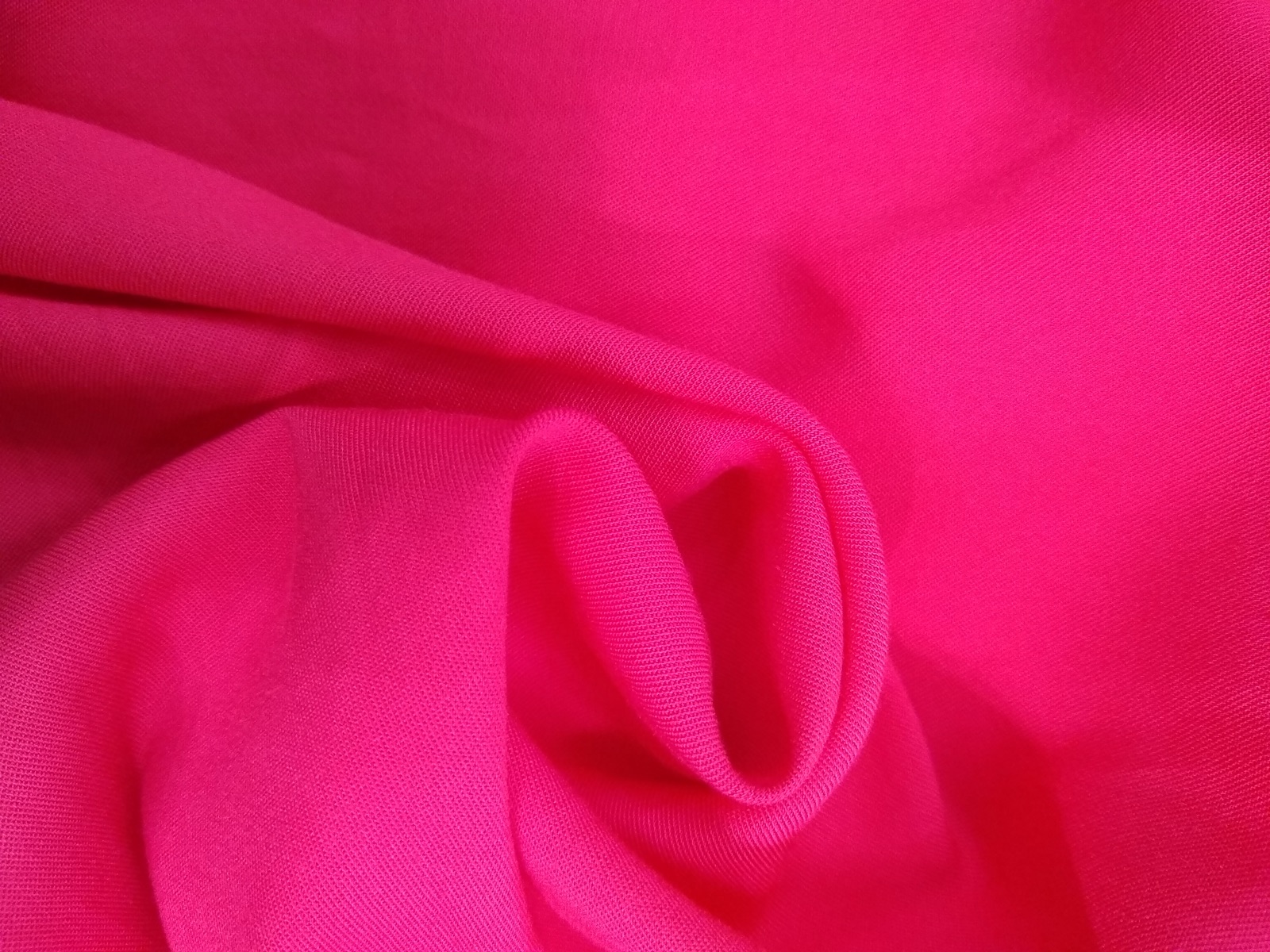
A rayon challis sample photographed to show drape. It is an appearance example, not a wash test, shrinkage result or universal viscose construction. Photo: Arkirkland, source, CC0 1.0; resized from the original. The source record says rayon challis but does not establish that this exact sample is conventional viscose.
Quick answer: can viscose shrink?
Yes, a viscose textile can undergo dimensional change after washing and drying. That does not mean every viscose item shrinks, that every item changes by the same percentage, or that one home-care recipe is safe for all of them.
ISO 5077:2007 determines dimensional change by measuring an actual fabric, garment or textile article before and after an appropriate combination of specified washing and drying procedures. The standard does not assign a universal result to a fiber name. The specimen, procedure, cycle count and measured lengthwise and widthwise changes still matter.
Historical fiber-level context also requires care. A 1970 National Bureau of Standards reference described regular rayon as having fair-to-poor dimensional stability, wet strength, resiliency and wrinkle resistance, while noting that newer rayons were developed to improve limitations. That is useful background, not a test report for a modern garment and not permission to reuse the booklet's old generic care advice.
The safest short answer is therefore:
- Identify every listed fiber and percentage.
- Read the finished garment's care instruction before adding water.
- Follow the exact permitted wash and drying route.
- Do not infer a shrink percentage or recovery method from the word “viscose” alone.
Are viscose and rayon the same thing?
The terms overlap, but the careful answer depends on labeling context. In U.S. textile-label guidance, the Federal Trade Commission says the ISO name viscose is used for the predominant form of rayon, and either name may be used. The industry association CIRFS, citing the BISFA definition, describes viscose as cellulose fiber obtained by the viscose process and notes that it is known as rayon fiber in the United States.
That does not make “rayon” a safe shortcut for every regenerated-cellulose subtype or finished product. The FTC's broader rayon definition covers manufactured regenerated-cellulose fibers, and the Commission separately recognized lyocell as a named subclass. A label can therefore provide more specific information than the broad family word.
For a garment reader, use this hierarchy:
- Fiber-content label: tells you the declared generic fiber names and percentages.
- Care label: tells you the supported cleaning route for the finished item.
- Brand or product instructions: may clarify an exact style, but should not be generalized to unrelated garments.
Why viscose, modal and lyocell should not share one care rule
Viscose, modal and lyocell are regenerated-cellulose directions, but that common starting point does not turn them into interchangeable labels or care instructions. Lenzing's current technical overview distinguishes direct-dissolution lyocell production from the viscose process. It describes modal as following a similar path to viscose with modified spinning-solution and process settings associated with high wet strength.
That manufacturer description supports a category boundary, not a universal performance ranking. It does not prove that every modal or lyocell garment is washable, that conventional viscose always performs worse, or that garments from different producers share the same finish and construction.
If a label says Modal, see What Is Modal Fabric? for the terminology boundary. That article is not a substitute for the garment's care instruction, and it does not authorize treating Modal as a synonym for every viscose or rayon article.
Can viscose go in a washing machine or dryer?
Some finished viscose garments permit machine washing. Some specify hand washing. Others specify professional care or warn against washing. The fiber name alone cannot choose among those routes.
The FTC Care Labeling Rule requires covered U.S. manufacturers and importers to provide regular care instructions and possess a reasonable basis for them. FTC guidance also says washing instructions need to address the wash method and drying method, along with relevant ironing, bleaching and warning information. Components such as non-detachable linings, trims and zippers must be considered.
Drying is not an afterthought. ISO 6330:2021 defines multiple washing procedures and six drying procedures, including line, flat and tumble routes. It explicitly notes that machine type, detergent type and tumble-dryer type can affect results. A cool wash followed by an unapproved drying method is not the same complete procedure as the one on the label.
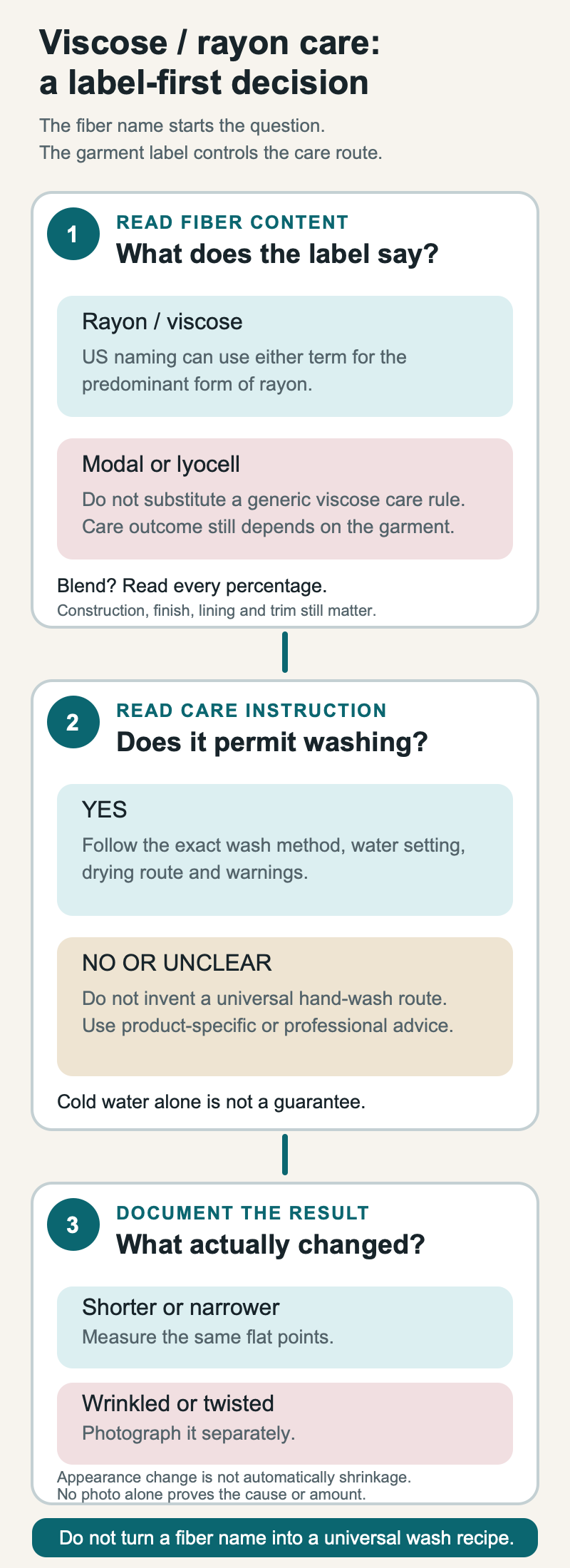
Original educational decision guide based on the FTC Textile Fiber Rule and Care Labeling Rule plus ISO 5077, ISO 6330 and ISO 15487. It contains no copied or AI-generated artwork and is not a product-specific care instruction or test result.
What should you do when washing is permitted?
Read the instruction as one connected procedure rather than selecting the most convenient words. Check:
- whether washing is by machine or hand;
- the printed water setting or temperature;
- the permitted detergent or bleach warning, if stated;
- whether fasteners should be closed or accessories removed;
- whether the item should be turned inside out or washed separately;
- whether drying is by tumble, line, drip, flat or another stated route;
- the permitted ironing or steaming instruction;
- any warning that limits an otherwise common procedure.
Then follow that route without adding a hotter wash, longer soak, stronger agitation, faster spin or hotter dryer in the hope of improving fit. This article does not supply a default temperature because the label may permit or prohibit different settings for different products.
If the item is valuable and the label is missing, damaged or contradictory, look for instructions tied to the exact style number or ask a qualified textile-care professional. “All viscose should be hand washed cold” is not a responsible replacement for missing product evidence.
Is cold water enough to prevent viscose shrinkage?
No universal guarantee can be made. Water temperature is one variable, but ISO 6330's procedure set also varies machine type, detergent, washing action and drying route. The fabric structure, finishing history and garment components add further product-level variables.
This does not mean temperature is irrelevant. It means “cold” cannot erase the rest of the care instruction. If the label permits a particular cold-water method, use that complete method. If the label says not to wash, cold water does not silently cancel the warning.
The same evidence boundary applies to tumble drying. Do not infer a safe dryer threshold from the word viscose, and do not use a dryer as a predictable way to size a garment down. A defined industrial study of single-jersey viscose and other knitted specimens found dimensional behavior changed with specific heat-setting conditions. That study supports process dependence; it is not a consumer dryer recipe or a universal percentage.
What changes when viscose is blended with another fiber?
A blend label gives useful composition information, not a complete behavior forecast. For U.S.-covered products, the FTC generally requires constituent generic fiber names and percentages by weight in descending order. A viscose-polyester dress, a viscose-elastane jersey and a viscose-linen shirt can therefore be identified more precisely than “viscose blend,” but their labels still do not replace testing of the actual article.
Ask:
- What are all declared fibers and percentages?
- Is the fabric knit, woven or another construction?
- Is there stretch yarn, lining, coating, print, embroidery or trim?
- Is the garment loose, structured, pleated or bias cut?
- What wash-and-dry procedure supports the finished item?
Two fabrics with the same percentages can differ in yarn, density, finish and assembly. Do not rank blends or promise that adding one fiber prevents shrinkage without matched specimens and comparable test results.
Shrinkage, wrinkling or distortion?
“It looks smaller” and “it looks different” are not the same observation. Document the symptom before naming the cause.
| What you notice | What it may indicate | What to document |
|---|---|---|
| Shorter body, sleeve or inseam | Lengthwise dimensional change, seam draw-up or measuring variation | Measure the same flat points and record the procedure |
| Narrower chest, waist or panel | Widthwise dimensional change or changed relaxation | Measure without pulling or stretching |
| Longer, wider or baggy area | Growth, wet distortion or loss of recovery rather than shrinkage | Compare stressed and unstressed areas |
| Twisted side seam or skewed panel | Torque, skew or uneven construction response | Photograph the item laid flat |
| Rippling near zipper, elastic or trim | Components responding differently | Inspect each material; do not blame the named fiber alone |
| Creases or crushed-looking surface | Wrinkling or appearance change | Record separately from dimensional measurements |
ISO 15487:2018 assesses appearance after domestic washing and drying, including smoothness of fabric and seams, creases and component damage. ISO 5077 addresses dimensional measurement. The distinction matters: a photograph can show twisting or wrinkling, but it cannot reconstruct missing pre-wash dimensions or prove how much shrinkage occurred.
Can a shrunken viscose garment be restored?
There is no universal recovery guarantee. Soaking, steaming, pulling or reshaping may alter the garment again without restoring its original pattern dimensions, seam alignment, finish or component balance. A temporary visual change is not proof of full recovery.
If an item changed unexpectedly:
- Stop repeating washing, heat or stretching experiments.
- Photograph the fiber-content and care labels.
- Record the wash and drying procedure actually used.
- Lay the item flat without tension and measure consistent points.
- Photograph twisting, puckering, wrinkling or stretched areas separately.
- Compare with a duplicate item or pre-care measurement if available.
- Contact the brand or a textile-care professional for product-specific advice.
Do not promise that damp reshaping will reverse every change. It is appropriate only when the exact product instruction supports it.
How buyers and developers should specify dimensional-change testing
For a fabric or garment program, replace “viscose should not shrink” with a requirement that can be tested and reviewed. Define:
- the exact fabric or finished-garment specimen;
- the declared composition and construction;
- color, finish and production state;
- specimen conditioning and marked measurement points;
- the specified wash procedure, machine type and detergent;
- the specified drying method;
- the number of cycles;
- lengthwise and widthwise results separately;
- appearance, seam, skew, trim and component observations;
- the acceptance tolerance for the intended market and product.
ISO 5077 supplies a dimensional-change method, while ISO 6330 supplies standardized domestic washing and drying procedures. Use the standard and method required by the actual program. A reference to a standard is not itself a pass result, and one sample does not prove every future lot.
Before sourcing or approving a viscose article, ask the supplier to identify the exact fiber percentage, fabric construction, finish and care-test basis for the offered sample. This article does not claim a WellDoneTex stock item, certification, safety property or laboratory result.
FAQ
Does rayon shrink?
A rayon article can undergo dimensional change, but “rayon” is a broad U.S. labeling term and does not supply one result for every subtype or product. Read the more specific fiber information and the finished item's care label, then judge the exact wash-and-dry procedure.
Does 100% viscose shrink?
It can, but 100% viscose does not predict a fixed percentage. Fabric construction, finishing, seams and the washing and drying procedure still affect the finished item. An actual specimen must be measured to report dimensional change.
Can viscose be machine washed?
Only when the garment's care instruction permits it. If machine washing is allowed, use the stated method and settings. Do not turn a generic online recipe into permission to wash an item labeled for professional care.
Can viscose go in the dryer?
Use only the drying route printed for the item. Some products may allow a machine-drying procedure; others may require line, flat or professional care. The word viscose does not provide a universal dryer setting.
Does viscose shrink in cold water?
Cold water is not a guarantee against dimensional or shape change. It is one part of a complete procedure that also includes washing action, detergent, machine type and drying method.
Does viscose wrinkle?
Viscose articles can wrinkle, but fiber-level historical descriptions should not be converted into “viscose always wrinkles.” Finish, construction, garment design and care procedure matter. Record wrinkling separately from measured shrinkage.
Should I size up in viscose?
Do not use an assumed shrink percentage as a sizing rule. Choose the fit from the brand's current measurements and product guidance. A care label is meant to preserve the supported product condition, not to plan a size change.
Can you reverse viscose shrinkage?
There is no universal reversal method. Stop repeated treatments, document the label, procedure and measurements, and use advice tied to the exact product before attempting further reshaping.
References
- U.S. Federal Trade Commission, Threading Your Way Through the Labeling Requirements Under the Textile and Wool Acts.
- U.S. Federal Trade Commission, 1996 amendment adding lyocell as a rayon subclass.
- CIRFS/BISFA, Viscose fiber definition and process overview.
- Lenzing, Fiber technologies: lyocell, viscose and modal production routes.
- National Bureau of Standards/NIST, Consumer Information Series 1: Fibers and Fabrics, issued 1970.
- International Organization for Standardization, ISO 5077:2007 — Determination of dimensional change in washing and drying.
- International Organization for Standardization, ISO 6330:2021 — Domestic washing and drying procedures for textile testing.
- International Organization for Standardization, ISO 15487:2018 — Assessment of appearance after domestic washing and drying.
- U.S. Federal Trade Commission, Care Labeling of Textile Wearing Apparel and Certain Piece Goods.
- U.S. Federal Trade Commission, Clothes Captioning: Complying with the Care Labeling Rule.
- Chowdhury et al., A feasibility study to analyze the behavior of heat settings on the cleaner production of knitted fabrics, Cleaner Engineering and Technology 7, 2022.
For a fabric or garment program, confirm the exact composition, construction, finish, production state and intended care procedure before approving dimensional-change requirements.