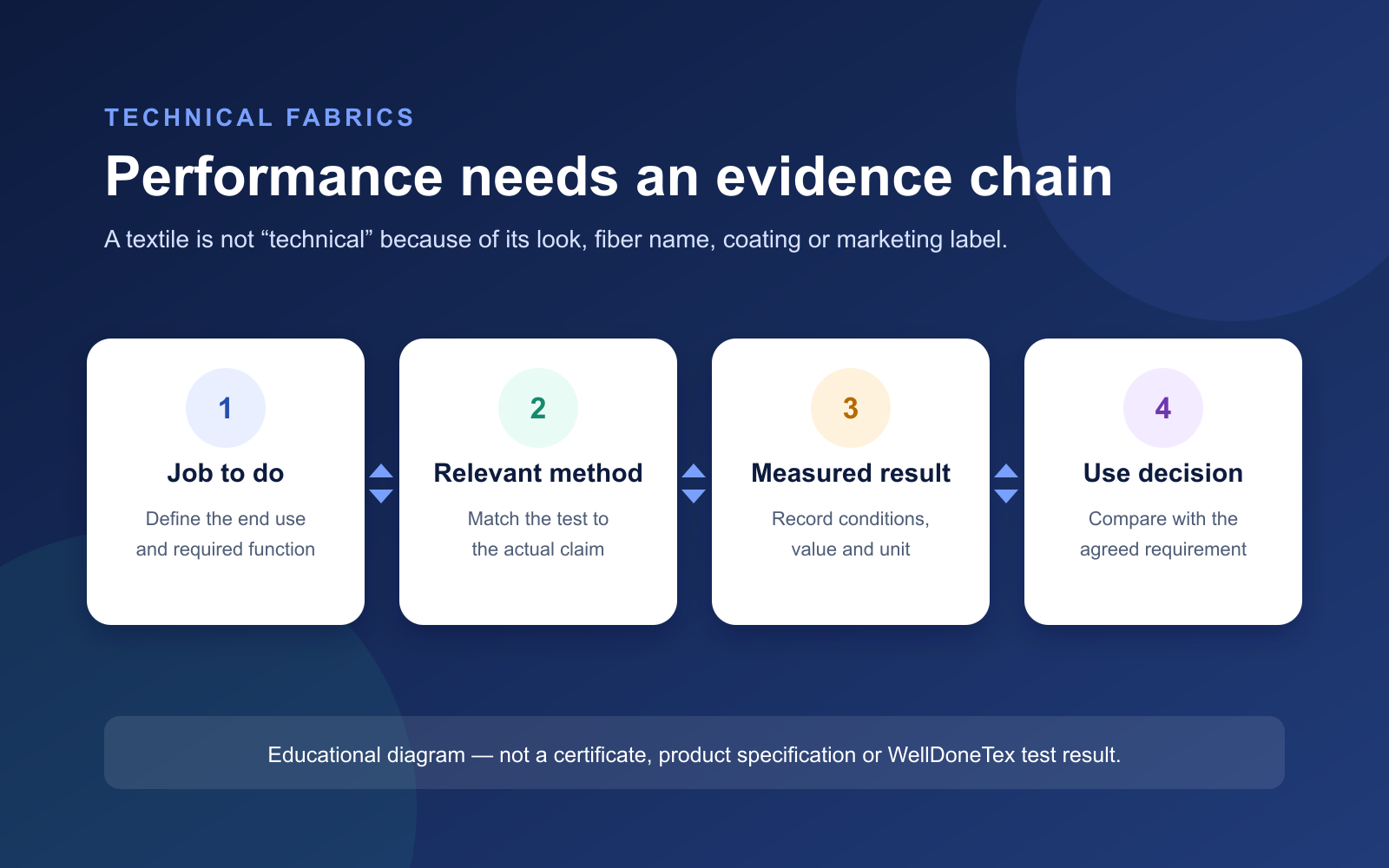
Technical fabrics are textiles chosen or engineered mainly to perform a job. Appearance can still matter, especially in sportswear, workwear, interiors, or transport, but the fabric is selected around a functional requirement such as reinforcement, filtration, protection, insulation, controlled air flow, liquid resistance, absorption, conductivity, or durability.
That does not mean every technical fabric is futuristic, synthetic, coated, or “smart.” A technical textile may be woven, knitted, braided, or nonwoven. It may use natural fibers, man-made fibers, glass, carbon, metal-containing components, or blends. What makes it technical is the intended use and the evidence required for that use—not a single fiber name or fabric construction.
Quick answer
A fabric becomes “technical” when its functional performance is central to the application. Examples include filter media, geotextiles, protective clothing materials, medical textiles, transport reinforcements, agricultural covers, and performance apparel fabrics.
The word alone is not a quality grade. A useful technical-fabric description should identify:
- the end use and operating conditions;
- the exact material and construction;
- the performance property being claimed;
- the test method, specimen and conditions;
- the result, units, acceptance limit and date;
- any certification or regulatory scope that actually applies.
Without those details, “technical,” “high performance,” and “functional” are broad positioning terms rather than complete evidence.
What is the difference between a technical fabric and an ordinary fabric?
The difference is usually priority, not a hard visual boundary.
An ordinary apparel fabric may be selected mainly for color, hand feel, drape, fashion, price, and everyday care. A technical fabric is selected because a measurable function is necessary for the product to work as intended. The same fabric can sit closer to either side depending on the application.
For example, a mesh used as a decorative panel and a mesh used as a filter may look similar. The filter application needs a defined particle-retention or air-flow requirement. A woven fabric used for a casual bag may be selected for appearance and hand. A similar-looking fabric used as an industrial restraint or reinforcement needs evidence for load, elongation, durability, seams, and environmental exposure.
This is why appearance is a poor shortcut. Two black coated fabrics can differ in base cloth, coating chemistry, coating mass, adhesion, water resistance, flex life, temperature range, and ageing behavior. Two white nonwovens can differ in fiber, web formation, bonding, pore structure, strength, absorbency, and cleanliness.
Is “technical” the same as “functional” fabric?
The terms overlap, and people do not always use them consistently.
“Functional fabric” is often used in apparel and consumer products for a fabric that adds a practical behavior, such as stretch, moisture transport, UV protection, water repellency, thermal management, or odor control. “Technical textile” is a broader end-use category that also includes construction, agriculture, transport, filtration, medical, protective, industrial, and geotechnical applications.
A functional sportswear knit can therefore be a technical apparel textile when performance criteria are central to the product. But a finish marketed as “functional” does not prove that the finished fabric meets a specific level. The claim still needs a method, result, and relevant acceptance rule.
Common technical-fabric categories
Technical textiles are easier to understand by the work they do than by the fiber they contain.
| Performance need | What the fabric may be asked to do | Evidence to look for |
|---|---|---|
| Mechanical | resist abrasion, tearing, tensile load, puncture, repeated flexing, or dimensional change | method, direction, conditioning, endpoint, units and result |
| Barrier | slow water, wind, particles, liquids, chemicals, flame, heat, or light | exact hazard, exposure side, pressure/concentration, duration and pass criterion |
| Transport | allow or control air, water vapour, liquid, heat, sound, light, or electrical charge | test area, pressure or temperature difference, units and construction tested |
| Absorption and filtration | take up liquid, move it, retain particles, or separate materials | fluid/particle type, efficiency, pressure drop, capacity and test setup |
| Reinforcement | stabilize soil, composites, products, seams, structures, or layered assemblies | load direction, elongation, interface, ageing and installation conditions |
| Comfort-related | manage stretch, recovery, thermal resistance, moisture or skin contact | garment/layer context, method limits and human-use conditions |
| Visibility or sensing | reflect, conduct, detect or respond | component layout, power/signal conditions, wash durability and failure mode |
The categories can overlap. A protective jacket material may need liquid resistance, water-vapour transport, seam compatibility, abrasion resistance, color visibility, and care durability at the same time. Passing one test does not prove the whole system works.
Where are technical textiles used?
Agriculture and landscape
Technical textiles can be used for crop covers, nets, shade structures, ground stabilization, drainage, erosion control, and containment. The fabric may need a balance of light transmission, air flow, water movement, strength, weathering, and installation behavior.
Construction and geotechnical work
Applications include reinforcement, separation, filtration, drainage, membranes, roofing components, insulation, and temporary protection. Soil, water, UV exposure, installation damage, chemicals, and service life can all influence the specification.
Transport and mobility
Vehicles use textiles in seating, interiors, acoustic layers, belts, airbags, composites, filters, insulation, coverings, and reinforcement. The finished assembly can matter more than the visible fabric alone. Foam, adhesive, backing, stitching, coating, and neighboring materials may change the result.
Medical, hygiene, and filtration
Examples include dressings, wipes, barriers, supports, nonwoven components, and filter media. These are high-consequence uses. A generic statement such as “antibacterial,” “medical grade,” or “safe” is not enough; the applicable product classification, test scope, regulatory route, and evidence must be checked for the intended market.
Protective and occupational products
Protective clothing and equipment may address flame, heat, chemicals, weather, cuts, impact, visibility, static electricity, or biological hazards. The fabric is only one part of the protective system. Garment design, seams, closures, accessories, ageing, cleaning, fit, and user instructions can affect protection.
Sportswear and outdoor use
Some apparel fabrics qualify as technical because stretch, recovery, air permeability, thermal resistance, water-vapour resistance, abrasion, or weather protection is central to the use. That does not make every activewear fabric equivalent. Our Scuba, Ponte Roma and Interlock comparison shows why construction and end use should be compared before broad performance labels are applied.
What are technical fabrics made from?
Almost any fiber family can appear in a technical textile when it suits the end use.
- Cotton and other cellulosic fibers may be used where absorbency, comfort, process compatibility, or renewable feedstock matters.
- Polyester, polyamide, polypropylene, elastane, and other man-made fibers can be selected for strength, low mass, elasticity, processability, chemical behavior, or moisture direction.
- Glass, carbon, aramid, mineral, and metal-containing materials can be used in reinforcement, heat-related, conductive, or specialized applications.
- Blends, coatings, membranes, adhesives, foams, and finishes can add or modify performance.
Fiber content is only one layer of the specification. Yarn type, filament or staple form, twist, fabric formation, density, weight, thickness, pore structure, brushing, heat setting, coating, lamination, bonding, and finishing can all change how the material behaves.
In the United States, covered textile products may need generic fiber names and percentages by weight under the FTC Textile Fiber Rule. A performance name such as “cooling fabric” or “waterproof shell” does not replace the required fiber information where that rule applies.
How are technical-fabric claims tested?
There is no single “technical fabric test.” The method must match the claim and the actual construction.
Air permeability
Air permeability describes air passing through a fabric under defined conditions. ISO 9237 provides a method for many fabric types, including technical industrial fabrics and nonwovens. A result is meaningful only with its units, pressure difference, test area, specimen conditioning, and any relevant face or direction.
“Breathable” is broader than air permeability. People may use the word for air flow, water-vapour transfer, moisture transport, or perceived comfort. A report should state which property was measured.
Water resistance
ISO 811 uses hydrostatic pressure to assess resistance to water penetration for fabrics intended to resist water. That is different from a surface spray appearance, liquid absorbency, or water-vapour resistance. A claim should say what was tested rather than treating water-resistant, water-repellent, and waterproof as interchangeable.
Abrasion resistance
ISO 12947-2 describes a Martindale method for assessing specimen breakdown within its stated scope. It excludes coated and laminated fabrics. When assessing abrasion of a coating itself, consult the relevant ISO 5470 method. Check the exclusions before choosing a test for the actual construction and claim.
Thermal and water-vapour resistance
ISO 11092:2026 measures thermal and water-vapour resistance under defined steady-state conditions for fabrics and multilayer assemblies. The standard does not prescribe specific physiological comfort performance. A laboratory value can inform comparison, but it does not by itself prove how every person will feel in a finished garment, climate, activity level, or layering system.
How to read a test report without being misled
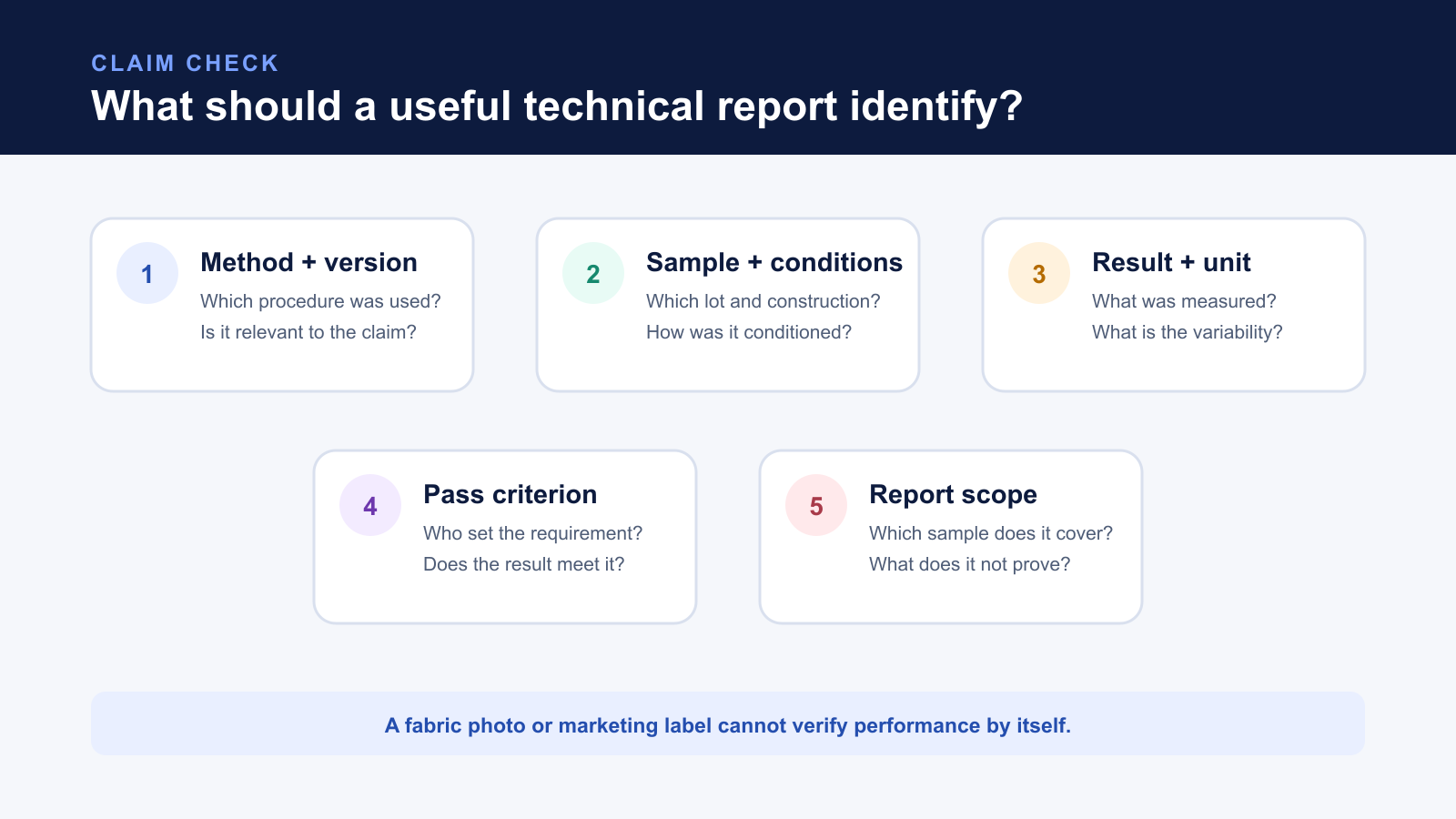
Start by matching seven items:
- Identity: Does the report identify the same material, lot, color, finish, coating, weight, and version you are evaluating?
- Method: Is the named standard or internal method appropriate for the property and fabric type?
- Conditions: Are conditioning, washing, ageing, direction, pressure, temperature, humidity, duration, and specimen preparation recorded where relevant?
- Result: Is there a numerical or categorical result with units, not just the word “pass”?
- Limit: Who set the acceptance threshold, and does it match the intended market and end use?
- Date and issuer: Is the test current enough for the supplied construction, and is the laboratory or issuing body identifiable?
- Scope: Does the evidence apply to a fabric, finished garment, seam, multilayer assembly, or only one treated surface?
A real report can still be misapplied. A result from one color or finish may not cover another. A pre-wash result may not describe performance after care. A fabric result may not cover seams or garment construction. A certificate for a company is not automatically a certificate for every product it sells.
A practical technical-fabric specification checklist
Before requesting samples or quotations, define the operating problem rather than starting with a marketing adjective.
- End product and user
- Use environment: indoor/outdoor, temperature, humidity, sunlight, chemicals, soil, water, movement, or repeated care
- Fabric form: woven, knit, braided, nonwoven, coated, laminated, bonded, or composite
- Fiber content and percentage
- Weight, thickness, width and usable width
- Stretch and recovery direction where relevant
- Required performance property and exact test method
- Minimum or maximum acceptance level with units
- Pre-treatment: washing, drying, ageing, abrasion, UV, heat, or chemical exposure
- Color, finish, hand, appearance and tolerance
- Sampling plan, lot identity and change-control rule
- Applicable labeling, safety, certification and regulatory requirements for the selling market
The fabric specification checklist gives a broader format for organizing these fields. For a narrower example, the thermal fleece checklist separates weight and appearance from evidence about thermal behavior.
Red flags in technical-fabric marketing
Treat these statements as prompts for evidence:
- “100% waterproof” with no method, pressure, duration, seams, or ageing route
- “Breathable” with no definition of air or water-vapour behavior
- “Anti-pill forever” with no pilling or abrasion method and no care cycles
- “Medical grade,” “food grade,” or “certified” without the issuing body, product scope, standard, report, and validity
- “Eco-friendly” based only on color, touch, one fiber name, or an unlinked logo
- “UV proof,” “flameproof,” “antibacterial,” or “chemical resistant” without the exposure, endpoint, result, and market context
- A report whose sample description does not match the offered material
- A pass result with no acceptance limit or whose method excludes the material being tested
The safe response is not to reject every claim. It is to ask what the claim means, how it was measured, and whether the evidence follows the exact material into the intended product.
Final takeaway
Technical fabrics are defined by purpose and performance requirements, not by one fiber, construction, or futuristic appearance. The most useful question is not “Is this a technical fabric?” but “What job must this textile do, under which conditions, and what evidence shows that it can?”
For general learning, start with the application, construction, and method. For a real product, match the supplied lot to the specification, test result, care or ageing route, and market requirements. If you already have a defined application and evidence checklist, you may optionally send a sample brief; an inquiry is not required to use this guide.
FAQ
Are all synthetic fabrics technical fabrics?
No. Polyester, polyamide, polypropylene, and other man-made fibers can be used in technical textiles, but fiber content alone does not define the end use or prove performance.
Can cotton be a technical textile?
Yes. A technical textile can use cotton, another natural fiber, a man-made fiber, an inorganic fiber, or a blend when the material and construction meet the functional needs of the application.
Is waterproof fabric always a technical fabric?
Water resistance can be a technical function, but “waterproof” needs a defined method, result, construction scope, and intended use. The fabric, seams, garment design, ageing, and care may all affect the finished product.
What is the difference between technical textiles and smart textiles?
Smart textiles are a subset or adjacent area in which the material can sense, respond, conduct, communicate, or integrate electronics. Many technical textiles have no electronics or responsive behavior.
Does a laboratory pass mean the finished product is approved?
Not automatically. Check whether the result applies to the exact fabric, finished product, seam, assembly, treatment, lot, and market requirement. A fabric test and a product approval are different scopes.
Which test proves that a fabric is breathable?
There is no single universal answer because “breathable” may refer to air permeability, water-vapour resistance, moisture transport, or user comfort. The claim should name the measured property and method.
Are technical fabrics always expensive?
No. Cost depends on material, construction, finish, testing, compliance, scale, quality controls, and service conditions. A simpler fabric with the right evidence can be more suitable than a complex material with irrelevant features.
References
- European Commission Joint Research Centre: Preparatory Study for the Ecodesign for Sustainable Products Regulation and Energy Labelling Working Plan 2025–2030: Textiles, First Milestone Report. Accessed 2026-09-07.
- European Commission: Technical TCLF Products. Accessed 2026-09-07.
- ISO: ISO 9237:1995 — Textiles — Determination of the permeability of fabrics to air. Status shown as Published and confirmed in 2023; accessed 2026-09-07.
- ISO: ISO 811:2018 — Textiles — Determination of resistance to water penetration — Hydrostatic pressure test. Status shown as Published and confirmed in 2025; accessed 2026-09-07.
- ISO: ISO 12947-2:2016 — Textiles — Determination of the abrasion resistance of fabrics by the Martindale method — Part 2. Status shown as Published and confirmed in 2023; accessed 2026-09-07.
- ISO: ISO 11092:2026 — Textiles — Physiological effects — Measurement of thermal and water-vapour resistance under steady-state conditions. Published 2026-05; accessed 2026-09-07.
- U.S. Federal Trade Commission: Textile Fiber Rule, 16 CFR Part 303. Accessed 2026-09-07.